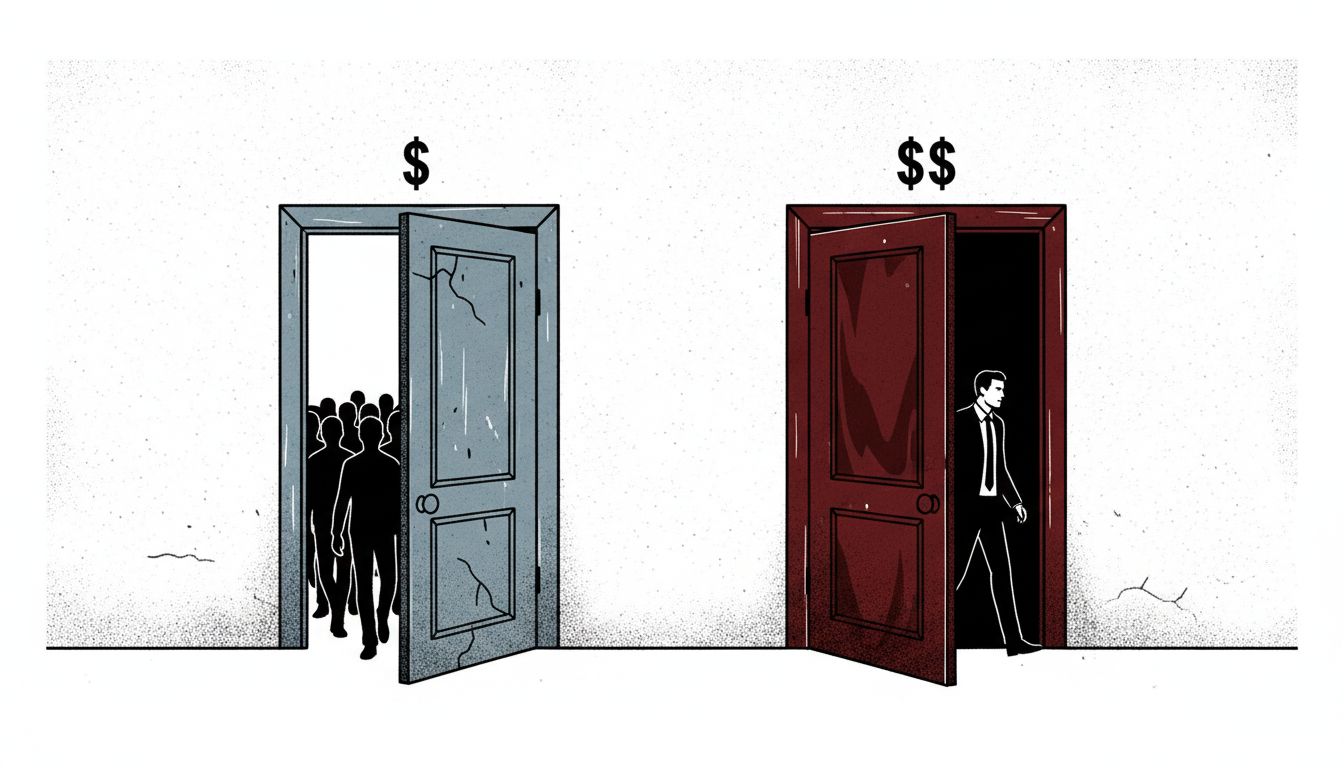
The simple version: Successful startups don’t find unmet needs, they create the conditions under which a need becomes visible for the first time. By the time a market is legible, someone else already owns it.
The Pitch That Sounds Crazy Until It Isn’t
Sometime around 2008, if you’d walked into a room and told investors that people would pay strangers to sleep in their homes, you’d have been shown the door. Airbnb’s early pitch meetings were, by most accounts, brutal. The problem wasn’t that investors couldn’t see demand. It’s that the demand didn’t exist in a form anyone could measure. Nobody was filling out surveys saying “I wish I could monetize my spare room to fund my vacation.” The behavior had never been normalized. The trust infrastructure wasn’t there. The problem, in any conventional sense, hadn’t arrived yet.
Airbnb didn’t discover a latent need. They manufactured the social conditions under which that need could exist, then filled it before anyone understood what was happening.
This is the pattern that keeps repeating, and most startup mythology gets it exactly backwards.
Why “Find a Problem People Have” Is Incomplete Advice
The standard advice you’ll hear in every accelerator and business school goes something like: talk to customers, find their pain points, build a solution. It’s not wrong, exactly. It’s just a description of how to build a company in a market that already exists.
Markets that already exist have incumbents. They have entrenched pricing, existing customer relationships, and years of accumulated switching costs. Walking into a legible, well-defined market as a startup is walking into a knife fight with a plastic fork.
The founders who build genuinely new categories operate on a different premise. They aren’t reading existing demand signals. They’re watching for conditions that will produce demand: a new behavior becoming normalized, a regulatory change creating a vacuum, a piece of infrastructure (usually technical) becoming cheap enough to change what’s economically possible.
Slack is a useful example here. The “problem” of workplace communication was not unsolved in 2013. Email existed. IRC existed. HipChat existed. What Stewart Butterfield’s team noticed was that the combination of mobile ubiquity, cloud file storage, and the normalization of informal digital communication at consumer scale was about to make people expect something different from work tools. The problem Slack solved wasn’t articulated by its eventual users before Slack existed. It was created by the same technological shift that made Slack possible.
The Mechanics of Building a Pre-Existing Problem
There’s a specific structure to how this works, and it’s worth being precise about it.
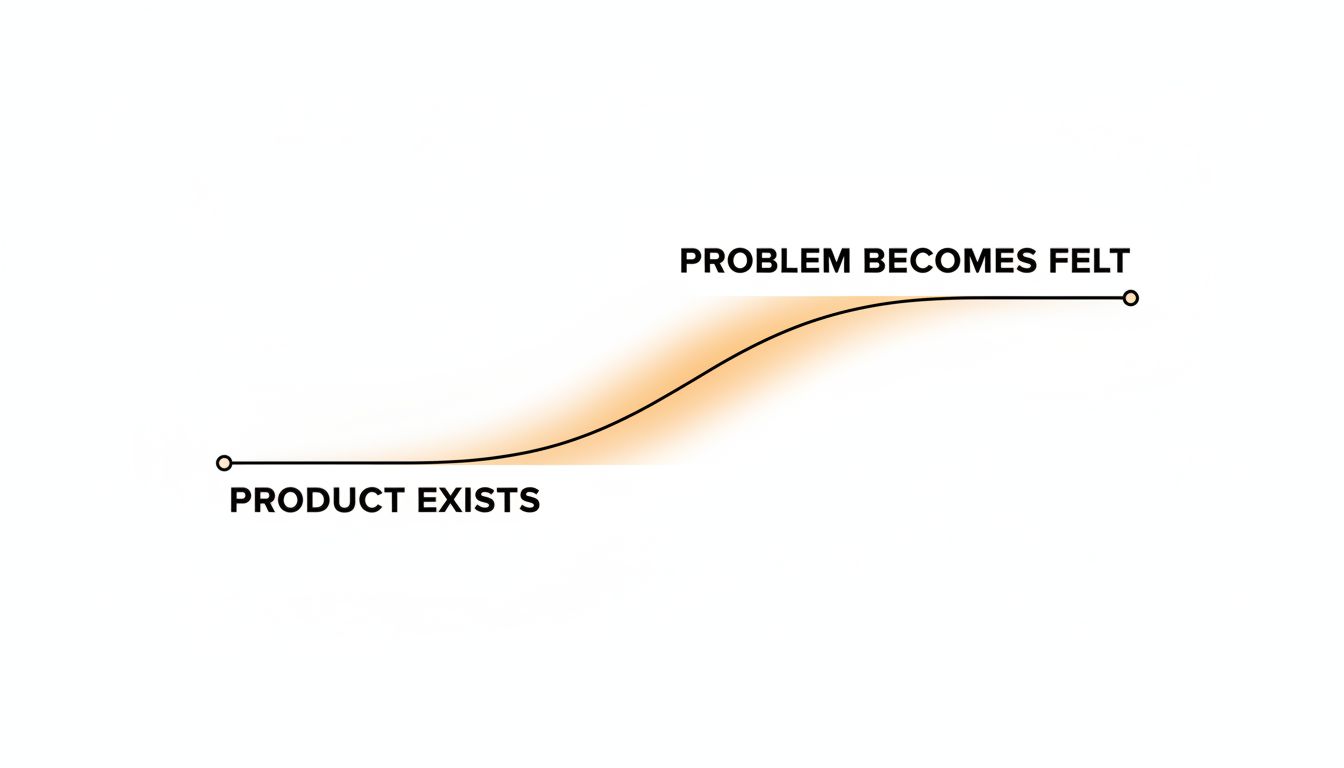
First, something changes in the environment: technology gets cheaper, a behavior reaches critical mass, a regulatory shift opens a gap, or some prior product creates users who now have new expectations. This is the precondition.
Second, a founder notices that this environmental change will make a certain kind of friction unbearable in the near future, even though it isn’t unbearable yet. This is the insight, and it requires a particular kind of imagination that’s distinct from market research.
Third, the startup builds something that only makes sense once the environmental change completes. The product often looks premature or even unnecessary at launch. This is by design, not by mistake. Deliberately choosing unfundable business models in the early phase is sometimes how you maintain that position without getting crushed by well-funded competitors who would enter if the market looked obviously attractive.
Fourth, the environmental change finishes landing, users suddenly feel the friction the founder anticipated, and the product is already there. The company looks prescient. It wasn’t. It was early.
Stripe is a clean illustration. The difficulty of accepting payments online in 2010 was a known annoyance, but most developers considered it a bureaucratic hassle to navigate, not an unsolvable problem. What Patrick and John Collison saw was that the explosion of new web businesses being built by non-enterprise developers would turn “annoying payment integration” into a genuine structural barrier at scale. The problem didn’t fully exist yet. The infrastructure and user behavior that would make it critical was still arriving. Stripe built the solution into an environment where the problem was a few years away from being universally felt.
Why This Pattern Produces Category Leaders Specifically
Here’s what the mythology misses when it talks about “first mover advantage”: being first into an existing market is usually worthless. Being first into a market that doesn’t exist yet, when you’ve correctly anticipated its arrival, is one of the few durable competitive positions available to a startup.
By the time the market becomes legible to everyone, the early company has something no competitor can easily replicate: they’ve been learning in production for years. They have customer relationships, pricing intuition, and product iteration cycles that are grounded in real usage. They’ve already made most of the early mistakes.
This is also why the apps that conquered their markets were often not built for those markets initially. Instagram launched as a check-in app with photo filters. The photo-sharing behavior it eventually owned wasn’t what the original product was trying to capture. The team was close enough to the environmental conditions that produced that behavior that they could pivot quickly when it emerged.
Contrast this with a startup that enters a well-defined market. They’re immediately legible to investors, which helps fundraising. They can point to TAM calculations and competitor analyses. But they’re also immediately legible to the competition, and to the market’s existing buyers who already have relationships and contracts with incumbents. The clarity that makes them fundable is the same clarity that makes them a target.
What This Actually Requires From a Founder
I want to be honest about what the pattern demands, because it’s not something you can reduce to a framework.
It requires being genuinely immersed in the environmental conditions that precede a market. Not reading trend reports about them, but living in them closely enough that you feel the friction before it’s been named. Stripe’s founders were building web software and personally hitting the payment problem. Airbnb’s founders needed cash and couldn’t afford a hotel during a conference. The insight wasn’t intellectual. It was physical.
It also requires the confidence to build toward a problem that your potential investors and early customers can’t fully articulate. This is uncomfortable. It means your early metrics will look thin, your TAM will look speculative, and your pitch will sound slightly crazy. That discomfort is, perversely, evidence that you’re in the right territory.
The founders who succeed at this aren’t people with a special ability to predict the future. They’re people who pay close attention to the present, specifically the parts of the present that are unstable and changing fast, and who have the patience to build something that only becomes obviously valuable once the instability resolves.
The market catches up. It always does. The only question is whether you’re already there when it arrives.