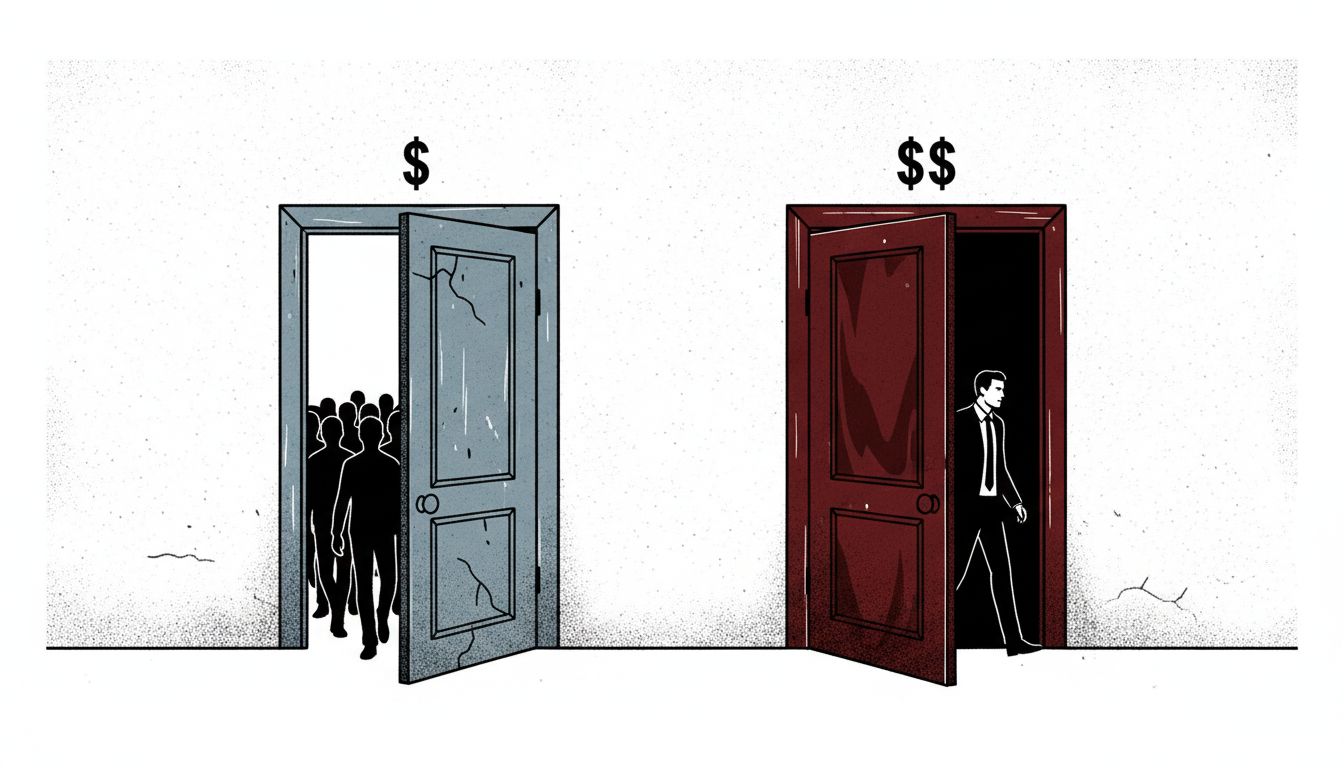

Picture this: a founder spends eight months building a project management tool for freelance designers. She talks to her designer friends, gets encouraging nods, launches to crickets. Not angry crickets. Indifferent ones. Nobody signs up, nobody complains, nobody cares. She calls this failure. It isn’t. It’s a gold mine she hasn’t learned to dig yet.
Most early-stage founders treat customer rejection the way they treat a bad performance review: something to survive, rationalize, and move past as quickly as possible. The founders who actually build durable companies do the opposite. They treat rejection as the most precise signal their business will ever receive, and they build systematic ways to extract intelligence from it. Billion-dollar startups win by deliberately ignoring what experts tell them to pay attention to, and one of the things they ignore is the conventional wisdom that rejection means stop.
Rejection Is a Diagnostic, Not a Verdict
The first thing to understand is that a customer saying no is not one data point. It’s a cluster of them, most of which the founder never thinks to unpack. When someone declines to buy, they’re telling you something about price, something about timing, something about how well you communicated value, and sometimes something about whether the problem you’re solving is actually the problem they have.
These are completely different signals, and conflating them is how founders give up on ideas that were actually right while pivoting toward ideas that are fundamentally broken.
Here’s a concrete example. In the early days of what would become a widely-used expense reporting platform, the founding team pitched CFOs at mid-sized companies and heard variations of “we’re not interested” dozens of times. Lesser teams would have iterated the product. This team kept asking a single follow-up question: “What would have to be true for you to be interested?” The answers were not about features. They were almost entirely about implementation complexity and switching costs. The product was fine. The sales process was broken. That single question, asked consistently after every rejection, pointed directly to the fix.
The Patterns Most Founders Miss
Rejection data is only useful if you’re collecting it systematically. This sounds obvious and almost nobody does it.
Most early-stage teams track rejections loosely, in memory, in scattered notes, in post-mortems that happen once a quarter if they happen at all. The startups that use rejection as a competitive advantage build lightweight tracking from day one. Not a complex CRM. A simple log: who said no, what reason they gave (explicit), what you infer the real reason was (implicit), and what question you asked to probe deeper.
Over time, patterns emerge that are invisible when you’re living through individual rejections. You start to see that a specific type of customer almost always objects on price, while another type almost always objects on timing. You start to see that certain framings of your product generate a particular category of objection that disappears entirely when you reframe. Most revolutionary software features were discovered by accident, and the pattern is hiding in plain sight, and the same is true of product-market fit. The signal is usually right in front of founders, buried in their rejection data, waiting to be noticed.
The mechanics of this are almost aggressively simple. You don’t need fancy tooling. You need discipline and honesty with yourself about what you’re actually hearing versus what you want to hear.
The Asymmetry Large Competitors Can’t Exploit
Here’s the part that most startup strategy writing misses entirely: rejection-based learning is a structural advantage that scales inversely with company size.
A large company with an established product line and significant revenue cannot afford to let every piece of customer rejection reshape its roadmap. There’s too much momentum, too many stakeholders, too many downstream consequences to every change. They run structured research programs, focus groups, NPS surveys, all of which are systematically filtered through layers of interpretation before reaching decision-makers.
An early-stage startup with ten customers has no such constraint. When three of those ten customers say no for the same reason, you can change course by next Tuesday. You can rewrite your pitch deck this afternoon. You can call the customer back and test a new framing before end of week. This kind of response speed is genuinely unavailable to a company managing thousands of accounts and multiple product lines.
This asymmetry compounds. Venture capitalists don’t predict the future, they recognize the past, which means they’re often looking for traction patterns that match historical winners. But the actual mechanism behind those patterns is frequently this: early teams that stayed in tight feedback loops with real customers, including customers who said no, developed product instincts that couldn’t be faked or purchased. By the time larger competitors understood what they’d built, the advantage was structural.
How to Make Rejection Productive Without Becoming Paralyzed
There’s a real danger here worth naming. Some founders swing too far in the other direction. They treat every rejection as an instruction, constantly pivoting based on the last conversation, never building enough of anything to test it properly. This is equally destructive.
The discipline is in distinguishing between signal and noise. A single customer rejection is noise. A pattern across fifteen customer conversations is signal. An objection that appears in two different customer segments using almost identical language is extremely high-signal and deserves immediate investigation.
The practical heuristic most experienced operators use is the three-conversation rule: if you hear the same core objection in three separate conversations without prompting it, you have a real problem worth solving. If it’s one conversation, write it down and keep moving.
It also matters enormously how you close rejection conversations. The worst thing you can do is end on a graceful exit. The best thing you can do is end on a specific question. “What would have to change for you to reconsider?” or “Who do you know who might have this problem more acutely?” Both questions extract value from a conversation that otherwise produces nothing. Successful startups intentionally build products their founders hate using, and the same counterintuitive logic applies here: the conversations you most want to end quickly are usually the ones with the most in them.
The Competitive Moat Nobody Talks About
Here’s the endgame. Founders who systematically learn from rejection develop something that has no formal name but is immediately recognizable: they develop a calibrated intuition for what their market actually wants, as opposed to what their market says it wants or what they want their market to want.
This calibration is an actual competitive moat. It’s not patentable. It’s not visible in a pitch deck. It doesn’t show up in a competitive analysis. But it means that when these founders make product decisions, pricing decisions, go-to-market decisions, they’re drawing on a data set that their competitors don’t have and can’t easily acquire.
The irony is that this moat is built entirely from failure. Every no, carefully examined, is a brick in a wall that eventually becomes very difficult for anyone else to climb over.
So when the next prospect passes, the question isn’t what went wrong. The question is what just got added to the data set.