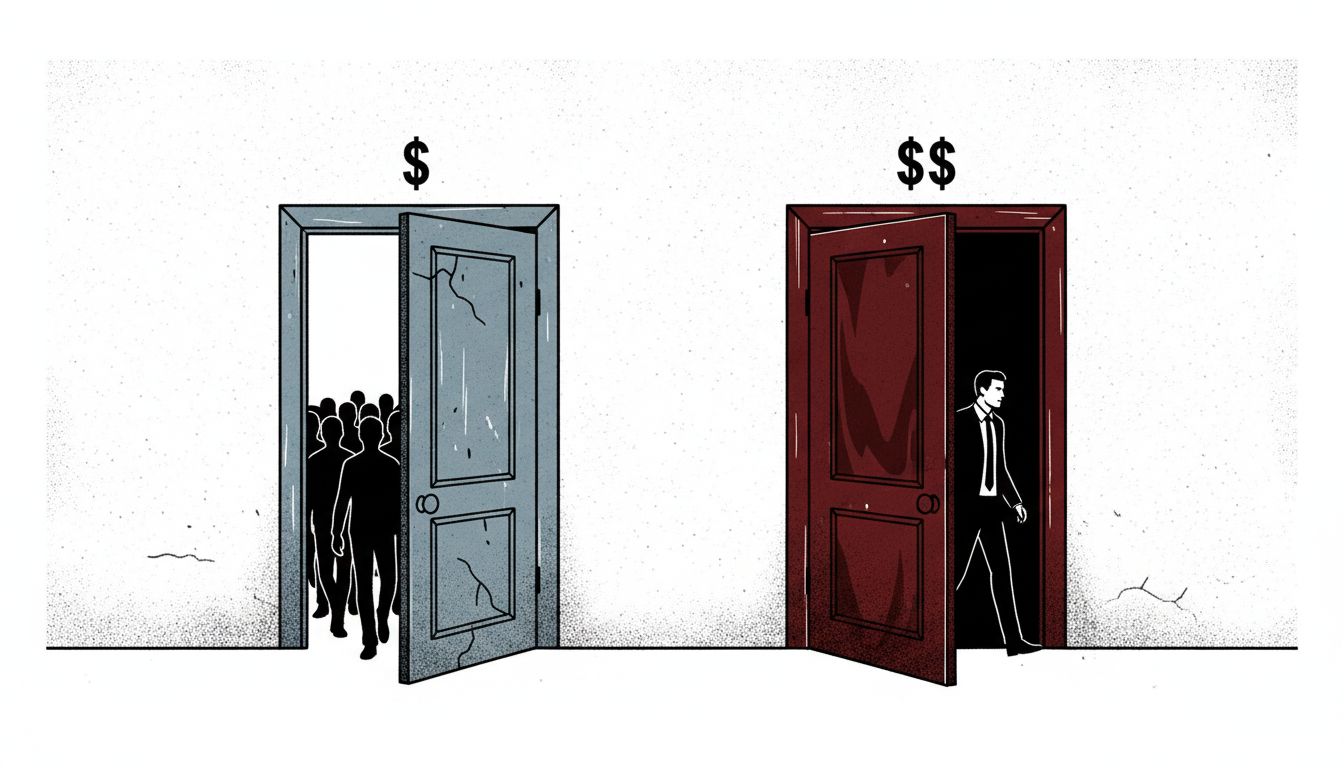

Imagine you’re a smart, well-funded founder in 2008. You have a marketplace idea. You know marketplaces need two sides to work, that the cold-start problem is brutal, and that you will almost certainly lose money on every transaction for years before the economics make sense. You know all of this. So you launch anyway, and you spend your first eighteen months doing something completely different: renting air mattresses in your own apartment.
Airbnb’s founders didn’t start with a scalable marketplace. They started with a hospitality hack that couldn’t possibly grow. Brian Chesky and Joe Gebbia personally photographed listings, stayed in hosts’ homes, and manually managed bookings. That model was wrong. It was labor-intensive, geographically limited, and impossible to replicate at scale. They chose it deliberately, and it saved the company.
This pattern is not the exception. It’s closer to the rule, and we keep misreading it as improvisation when it’s actually strategy.
The “wrong” model is the only way to learn what the right one needs to be
Business models are theories about how value flows between people. Early-stage startups don’t have enough information to build a correct theory. The market hasn’t told them who their best customers are, what those customers actually value, or what it costs to serve them reliably. Any model chosen before that information exists is a guess.
The productive move is to choose a model that generates real transactions with real customers quickly, even if that model is unsustainable. You’re not trying to run a business yet. You’re trying to generate data dense enough to build one.
Stripe spent its early days doing what they called “collisions,” where the founders would sit with developers and watch them integrate the product in real time. That’s not a business model at all. It’s research dressed up as support. But it told them exactly which parts of payment infrastructure were genuinely painful versus merely unfamiliar, and that distinction shaped the product and pricing model that made them worth hundreds of billions of dollars.

The unsustainable model builds the asset the scalable model needs
The Airbnb founders weren’t just learning. They were building supply. Every host they personally recruited and photographed was inventory that a marketplace required to function. The manual work wasn’t the business; it was the foundation underneath the business.
This is the part the startup mythology consistently gets wrong. We frame these early manual phases as “doing things that don’t scale” as if that’s a temporary embarrassment on the way to real operations. Paul Graham’s famous essay on the topic is right about the tactic but undersells the reason. It’s not just that you should do unscalable things when you’re small. It’s that the unscalable activity is often the only credible path to the asset or data or trust that the scalable model requires.
LinkedIn launched as a professional networking site. The model that made them valuable, the one that generated real revenue, was recruiting and talent solutions. But they needed a dense professional graph before that model could work at all. The early model, getting professionals to build profiles and connect, was the wrong business. It was also the necessary precondition for the right one.
Choosing the wrong model buys time against competitors who chose the right one
This is the counterintuitive part. If you enter a market with a model that looks sustainable and defensible, you attract serious competition immediately. If you enter with something that looks like a side project or a consulting arrangement or a niche tool, incumbents ignore you long enough for you to get traction.
This is related to what some people call the trojan horse product pattern, where startups enter markets through a low-threat beachhead before expanding. The business model version works the same way. Slack started as the internal tool of a video game company. The game failed. The tool survived. No serious enterprise software vendor looked at a gaming startup’s internal chat tool and felt threatened. By the time they should have been threatened, it was too late.
You do not want your actual business model visible to competitors before you have the leverage to defend it.
The counterargument
The obvious objection here is survivorship bias, and it deserves a real answer rather than a dismissal.
For every Airbnb that bootstrapped its way from air mattresses to a real marketplace, there are dozens of startups that told themselves they were doing unscalable things deliberately while actually just failing to find product-market fit at any scale. The “we’re doing this on purpose” framing can become a story founders tell themselves to avoid confronting the harder question of whether anyone wants what they’re building.
The difference is whether the unscalable activity is generating signal. If you’re manually doing the thing your product is supposed to automate, and real customers are paying for the output (or at minimum, deeply engaged with it), you’re building a foundation. If you’re manually doing the thing because you can’t figure out how to build the product, and customers are tolerating it out of politeness, you’re not in a strategic phase. You’re just struggling.
The test is not “are we doing things that don’t scale?” The test is “are we learning something from this that we could not learn any other way?”
Start wrong on purpose, but know what you’re looking for
The companies that survive their deliberately wrong business model are not the ones who pivot away from it fastest. They’re the ones who understood what the wrong model was supposed to teach them before they started.
Chesky knew he needed to understand hosts. Stripe’s founders knew they needed to understand developer pain. The manual phase was the curriculum, not the confusion. When they built the scalable model, they built it around what they’d actually learned rather than what they’d assumed.
Most founders treat the early business model as a placeholder until the real one arrives. The better move is to design the placeholder to answer specific questions. What do your best customers actually need? What does it cost to deliver real value, not theoretical value? What would have to be true for a scalable version of this to work?
Choose the wrong model. Choose it deliberately. Know what it’s supposed to teach you before you choose it. That’s not improvisation. That’s the only kind of planning that works this early.