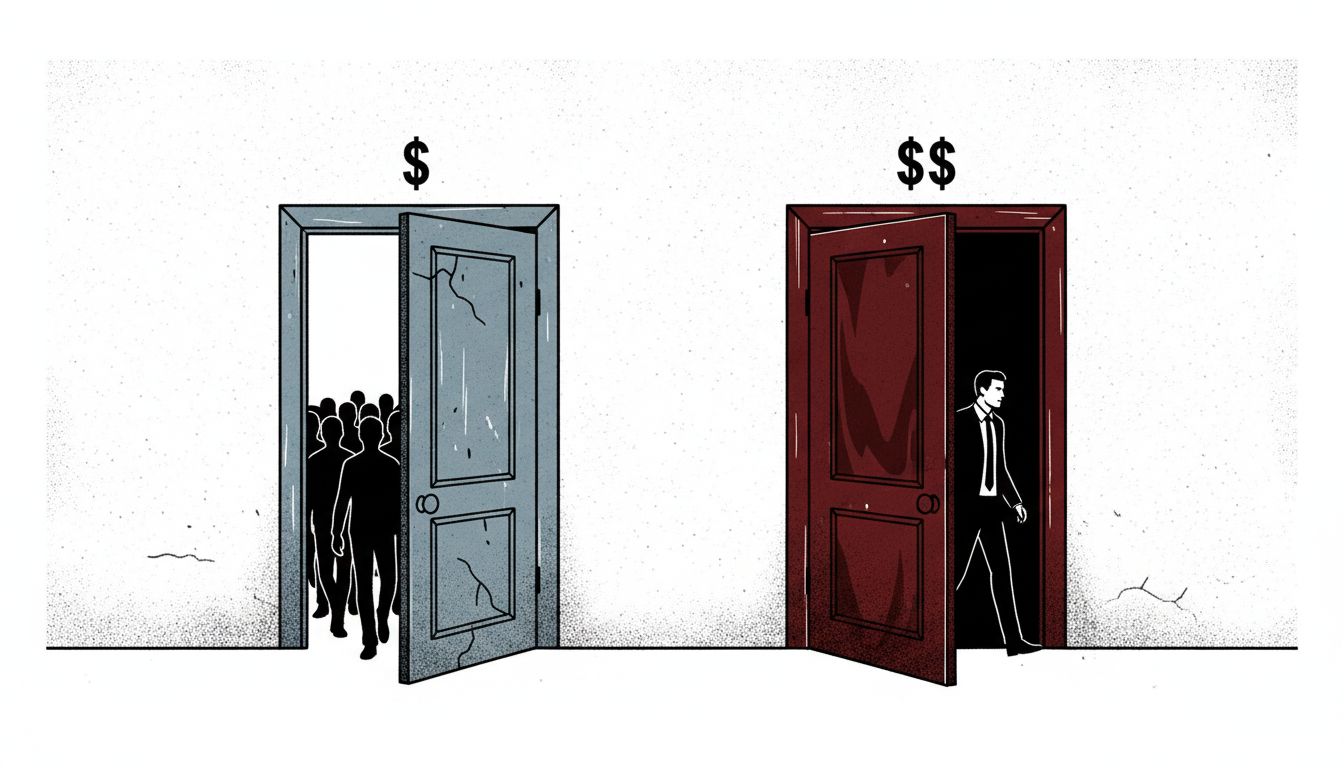
A founder I know spent three weeks migrating off a free database solution onto something that cost her startup $1,800 a month. Her co-founder thought she was losing her mind. Her investors asked pointed questions on the next call. But she had watched a competitor spend four months paralyzed by scaling issues during the exact moment they needed to be shipping features, and she refused to let that happen to her. She paid the $1,800. They shipped. They closed their Series A eight months later. The cheap option had already cost the competitor something no invoice could capture: momentum.
This story plays out constantly in the startup world, and yet the mythology persists that frugality is always a virtue. It is not. The reality is that enterprise software costs 10x more than consumer versions, and the real reason has nothing to do with features — it has to do with accountability, reliability guarantees, and the cost of the alternative. Startups that understand this stop treating price tags as the primary filter.
The Real Cost of Cheap
Here is what cheap actually costs: engineering time.
When you pick the bargain-tier infrastructure, you are not saving money. You are trading a known monthly expense for an unknown time expense, and time is the one thing startups cannot manufacture more of. Every hour an engineer spends duct-taping a free tool into production-readiness is an hour they are not building the thing you actually sell.
There is a reason fixing software bugs costs 100x more than preventing them, and it has nothing to do with code. The same logic applies to infrastructure choices. The savings you capture at the front end compound into debt that gets collected later, usually at the worst possible time, usually right when you are trying to close a deal or handle a traffic spike or onboard a major client.
I have watched startups lose enterprise contracts because their free-tier monitoring solution did not catch an outage fast enough. The contract was worth $400,000 annually. The upgrade to proper monitoring would have cost $600 a month. The math there is not subtle.
Speed Is the Product
At the earliest stages of a startup, you are not really selling software. You are selling proof that you can execute. Investors, early customers, potential hires — they are all watching the same thing: can this team move?
Expensive solutions are frequently purchased because they eliminate the category of problem entirely. You pay Stripe instead of building payment processing. You pay Datadog instead of rolling your own observability stack. You pay Salesforce instead of arguing about how to organize a spreadsheet. These are not luxury decisions. They are decisions to stay focused on the thing that actually differentiates you.
The best tech leaders I have observed operate on a version of this principle instinctively. As explored in why the best tech leaders succeed by knowing less than you think, the most effective founders are not trying to optimize every line item. They are aggressively buying back their team’s attention. The expensive solution is often just the fastest way to make an entire class of problems disappear.
This is not about being reckless with capital. It is about having a clear-eyed view of what your capital is actually for. Capital is not for saving. Capital is for buying time to find product-market fit before the runway ends.
The Signal Value of Expensive
Here is a dimension most founders miss entirely: what your tooling communicates to the people you are trying to recruit and close.
Top engineers notice when a company is running serious infrastructure. Not because they are snobs, but because it tells them something real about the organization. A startup that has thought carefully about its data pipeline, its observability stack, its deployment tooling, is a startup that has thought carefully about engineering. The expensive solution signals that the founders understand what it takes to build something that scales.
The same principle applies to sales. When you are sitting across from an enterprise buyer, the fact that you run on the same cloud infrastructure they trust, that you use the same security vendors they recognize, that your compliance posture reflects real investment — these things close deals. The cheap alternative puts you in a position of having to explain and defend your choices under scrutiny. That is a tax on every sales conversation you will ever have.
Startups that ignore trending markets on purpose often make the same kind of counterintuitive choice: they are not being contrarian for its own sake. They are making calculated bets that position them to win in ways that are not immediately obvious to observers.
When Cheap Is Actually Right
I want to be honest here because this argument has limits.
Cheap is right when you are running genuine experiments. When you have not validated that a feature should exist at all, spending money to build it properly is not prudence, it is waste. The goal of the experiment phase is to get signal as fast as possible. Duct tape is fine when you are testing whether anyone wants the thing.
Cheap is also right when the category of tool genuinely does not matter to your customers, your engineers, or your ability to move. There are plenty of internal tools and workflows where the free version is completely sufficient and upgrading would be a vanity exercise.
The mistake is treating cheap as the default virtue and expensive as the thing requiring justification. In most cases, for most critical systems, the burden of proof should run the other way.
The Compounding Problem
There is one more thing worth naming: cheap solutions do not stay cheap.
You start on the free tier. Then you need one feature that is on the paid tier. Then you hit a limit. Then you need an engineer to work around the limit. Then the workaround breaks. Then you spend a week migrating. The total cost of that free solution, properly accounted for across eighteen months, is almost never what it looked like on the day you signed up.
Cloud giants cut their own costs by 70% and then raise your prices anyway, which is its own tax on startups that got comfortable on a pricing structure that turned out to be temporary. Add the migration costs of moving off cheap tools that stopped being cheap, and the picture gets darker.
The founders who get this right are not the ones who spend the most. They are the ones who think clearly about the full cost of a decision, not just the number on the invoice. Sometimes that analysis leads you to the cheap option. But if you are being honest with yourself, a lot of the time it does not.
The expensive solution is often just the one where someone else has already figured out the hard parts. And in a startup, that might be the most valuable thing money can buy.