
The simple version
When a startup has limited money, it is forced to find out whether its product actually works before it runs out. Well-funded competitors can avoid that question for years, and usually do.
What money actually buys
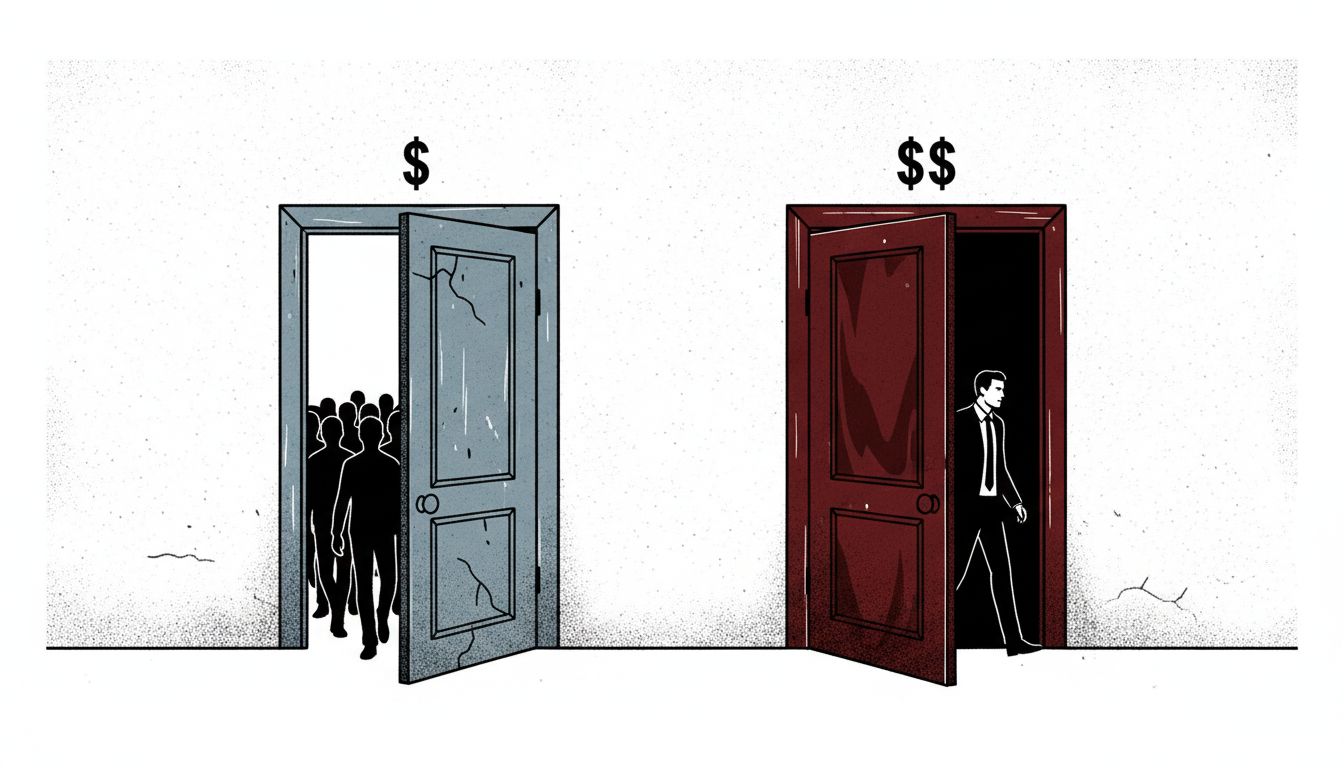
Imagine two teams building competing project management tools. Team A raises $400,000 from angels and works out of one founder’s apartment. Team B raises $12 million in a Series A, takes a lease on a real office, hires a head of marketing, a head of sales, a VP of partnerships, and builds a brand guidelines document before a single user has signed up.
Eighteen months later, Team A has 4,000 paying customers and a clear picture of who they are. Team B has impressive slide decks and a burn rate that terrifies the board.
This is not a hypothetical. Variations of this story play out constantly in tech. The pattern is consistent enough that it has a name in venture capital circles: the capitalization trap. More money buys the ability to delay the hard question, which is whether anyone actually wants the thing you built.
Team A never had the option to delay. Payroll was due in three months.
The mechanism is decision quality under pressure
Here is what tight budgets actually do: they force prioritization that well-funded teams never have to perform. When you have $400,000, you cannot hire a director of enterprise sales before you know if enterprises want your product. You cannot run a brand awareness campaign before you know what your brand stands for. You cannot build version two before anyone has paid for version one.
Every one of those constraints sounds like a disadvantage. Collectively, they function as a forcing mechanism toward the only work that matters in the early stage: finding out if the product solves a real problem for real people at a price they will actually pay.
Well-funded teams spend months, sometimes years, substituting organizational motion for that question. They hold all-hands meetings about culture. They debate go-to-market strategy in the abstract. They build features their hypothetical customers might want, based on personas assembled from secondary research. The product gets more polished. The customer remains theoretical.
This is not a failure of intelligence. These are often very smart people. It is a structural problem. When you have money, spending it feels like progress. It genuinely looks like progress from the inside.

Why founders mistake activity for traction
There is a cognitive trap embedded in well-funded teams that is worth understanding. When you raise a significant round, you are surrounded by signals that you are succeeding. Press coverage. Recruiter inbound. Congratulations from people you respect. Your investors scheduled check-in calls. You are building.
What you are not doing, in most cases, is talking to customers at the rate that a bootstrapped founder talks to customers, because a bootstrapped founder talks to customers the way a person with a week of food left hunts. Urgency is not a mindset. It is arithmetic.
The research on this is consistent even if the specific numbers vary by study: the majority of startups that fail cite running out of money as the cause, but when you examine the sequence of events, they ran out of money because they spent it on scaling a product that did not have validated demand. The money did not save them. It funded the delay.
Strategically, saying no to most early distractions is how the best early-stage founders preserve this forcing function even when they do have some runway.
The second-order effect: organizational debt
Here is a piece that most analyses miss. When you hire fast on the back of a large raise, you create organizational debt that compounds in exactly the wrong direction.
Every person you hire before product-market fit is someone whose job description is built around a set of assumptions that have not been tested. When the product pivots (and it will pivot), those people are now misaligned. Their skills, their pipelines, their processes all point at the old problem. Reorienting them is expensive and slow. Some will leave. The ones who stay are often the ones who are most invested in the old direction.
Small teams do not accumulate this debt because they cannot afford the headcount in the first place. A four-person company can pivot in a month. A forty-person company needs a board meeting, a reorg, and a company-wide email about the exciting new direction.
This is the organizational version of backward compatibility being a fence rather than a feature. The more infrastructure you build on a set of assumptions, the harder it becomes to question those assumptions.
What well-funded teams get right (and wrong)
None of this means capital is useless. After product-market fit, capital is enormously valuable. The companies that scale fastest after finding fit are often the ones with the most fuel in the tank.
The problem is sequencing. Most large rounds happen before fit, not after, because the incentives of venture capital reward betting early on potential rather than waiting for proof. Founders take the money because it is available and because their competitors might take it if they do not. The logic is defensible. The outcome is often a well-resourced team building confidently in the wrong direction.
The startups that beat well-funded competitors are not doing something mysterious. They found out what their product actually needed to be before their competitors did. They found out faster because they had no choice but to find out fast. And by the time the well-funded competitor figured out the same thing, the scrappy team had 18 months of customer relationships, hard-won product intuition, and no organizational debt to unwind.
The money was never the advantage. The urgency was.