The simple version
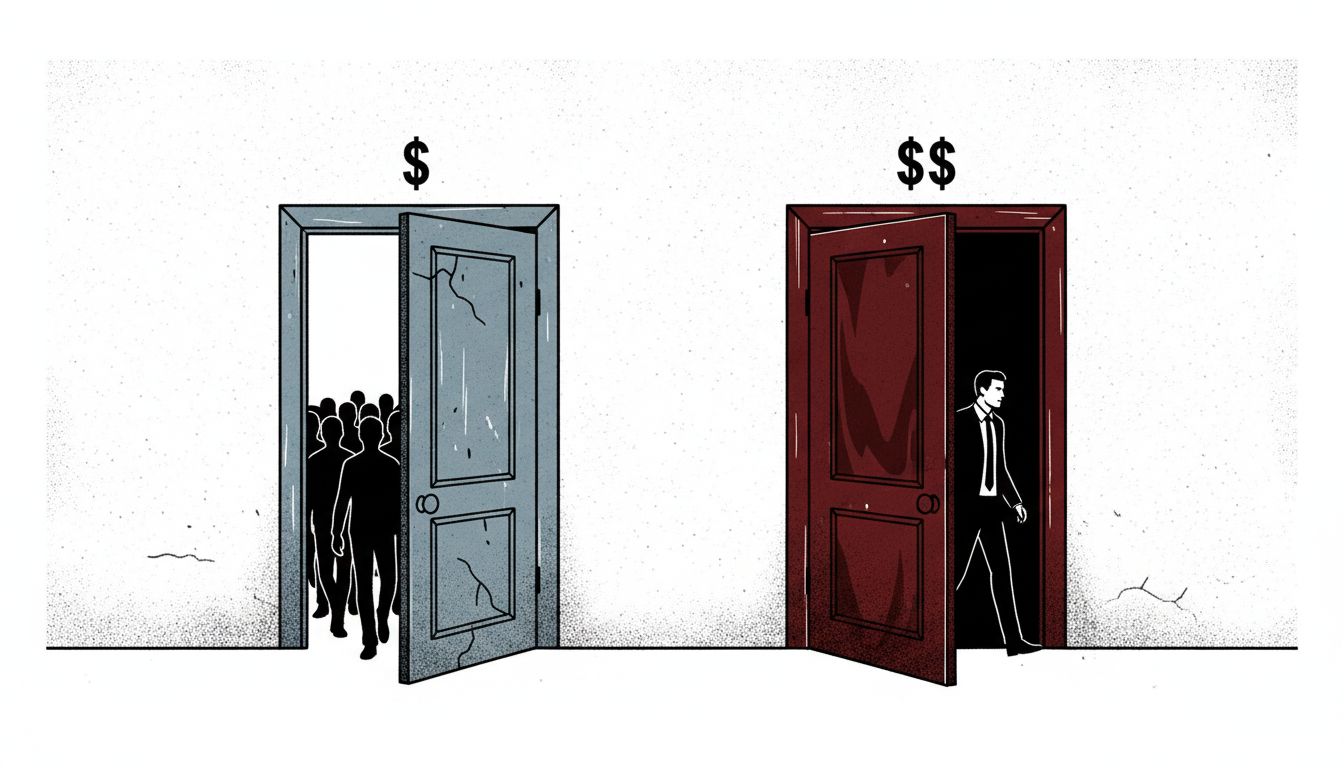
When a startup has limited money, it cannot afford to be wrong about what matters most. When a startup has plenty of money, it rarely has to find out.
A story about two companies building the same thing
Somewhere around 2011, a small team in New York was building a project management tool with almost no runway. They couldn’t hire fast, couldn’t run big ad campaigns, couldn’t build every feature on the wishlist. What they could do was talk to the thirty companies using their early version and find out exactly which parts of the product those customers would pay to keep. Everything else got cut.
Across the country, a better-funded competitor was doing the opposite. They had engineers to spare, so they built. They had a marketing budget, so they acquired. They had time, because the money bought them time. When the market eventually sorted itself out, the scrappy team had a product that a specific kind of customer loved deeply. The well-funded competitor had a product that many kinds of customers thought was fine.
“Fine” does not retain. “Love” does.
What money actually buys, and what it costs
Funding buys optionality. You can hire before you know exactly what you need someone for. You can run experiments without forcing yourself to read the results carefully. You can delay the hard question, which is: what is this company actually for?
That delay is the hidden cost of capital. Not the equity dilution (though that matters too, as VCs are explicitly structured around the math of failure). The real cost is that money lets you avoid clarity. And clarity, it turns out, is the main ingredient in building something people will pay for and keep paying for.
Constraint forces clarity in a way that abundance simply cannot replicate through discipline or good intentions. When you have six months of runway and you’re watching it drain, you stop asking “what should we build next” and start asking “why are people paying us at all.” Those are completely different questions, and the second one is the one that matters.
The prioritization problem that money makes worse
Here is something most well-funded teams won’t admit: when you have budget to build almost anything, deciding what not to build becomes politically complicated. Every team has a roadmap. Every roadmap has champions. Every champion has a good-sounding reason why their feature should ship next quarter.
In a resource-constrained company, the answer to “should we build this” has a built-in forcing function. Can we afford to? Will it move the number that keeps us alive? If not, it doesn’t get built, and there’s no politics to navigate because there’s nothing to negotiate with.
The result is that lean startups almost accidentally end up doing what the best product thinkers recommend on purpose: focus ruthlessly on one thing and treat everything else as a distraction. The constraint enforces the strategy that well-funded teams have to consciously choose and then fight internally to maintain.

Speed is a byproduct, not a cause
People often say underfunded startups win because they move faster. That’s true, but it’s not the root explanation. They move faster because they have fewer people in the decision loop, fewer features to maintain, fewer stakeholders to align. Fewer of all of those things because money wasn’t available to accumulate them.
A team of six ships faster than a team of sixty not because small teams are inherently more talented, but because coordination overhead scales worse than linearly with headcount. Adding people to a software project, as Fred Brooks observed in “The Mythical Man-Month” in 1975, often makes it take longer. The well-funded startup hires to accelerate and ends up decelerating. The underfunded one stays small by necessity and ships.
This is also why the advantage often evaporates if the scrappy startup raises a big round and then behaves like a well-funded one. The money wasn’t the problem when they were winning. The constraint was the asset. Remove the constraint, replace it with headcount and process and competing priorities, and the magic tends to go with it.
What actually survives contact with the market
There’s a selection effect here worth naming directly. Underfunded startups that fail, fail fast and quietly. Overfunded startups that fail do it slowly, publicly, and expensively, burning through capital while building things nobody needed.
So the survivors we observe in the underfunded category have been through a real filter. They found something real people would pay real money for before the money ran out. That’s not luck, exactly. It’s what the constraint demanded of them.
The well-funded failures, by contrast, can sustain the illusion of progress for years. Revenue that costs more to acquire than it’s worth. User numbers that grow because growth was purchased. A product that is always about to be good once the next feature ships.
At some point, the market asks the same question that a thin runway forces immediately: are you building something people need, or are you building something that makes sense in a pitch deck? Startups without money get asked that question early. Startups with money get asked it late, when the answer is much harder to act on.
The lesson is not that you should try to raise as little as possible. It’s that the discipline that constraints enforce is worth engineering deliberately, especially once the money arrives. The startups that stay dangerous after a big raise are the ones that treat the constraint as a practice, not just a circumstance they were glad to escape.