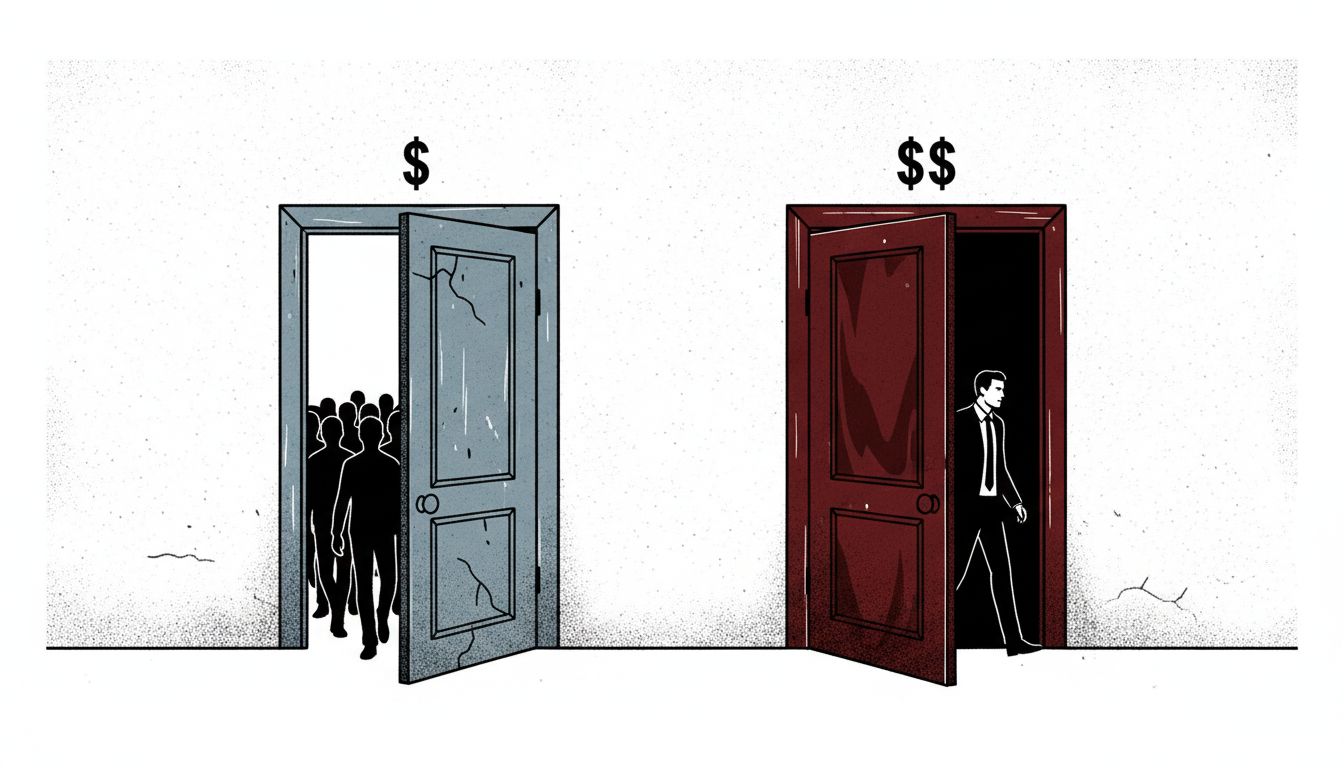

A founder I know raised a $12 million Series A in 2019. Before the wire hit, she was doing customer support herself, sleeping four hours a night, and shipping fixes the same day users reported bugs. Six months after the raise, she had a head of customer success, a VP of product, two layers of engineering management, and a backlog so long that a bug reported in October might get addressed in Q2. Her users noticed before she did.
This isn’t a story about bad management. She was good. The raise just changed the physics of the company in ways nobody warned her about.
Capital is supposed to be an accelerant. Sometimes it is. More often, it accelerates the wrong things first.
The Constraint Myth
The prevailing story about underfunded startups is that they succeed despite their constraints. Scrappy founders making do with less, grinding until the lucky break, outworking the funded competition. This framing is wrong, and it matters that it’s wrong.
Underfunded startups don’t win despite constraints. They win because of them. Constraint isn’t a handicap to overcome. It’s a forcing function that produces better decisions.
When you can’t hire a marketing team, you talk to customers yourself. When you can’t afford to build five features, you figure out which one actually matters. When you can’t run paid acquisition, you learn whether your product spreads on its own. These aren’t consolation prizes for being poor. They’re the inputs that produce product-market fit.
The well-capitalized competitor is solving a different problem. They’re deploying capital. And deploying capital, it turns out, is a full-time job that competes directly with building something people want.
What Hiring Does to a Feedback Loop
The most dangerous thing a startup can do with a large raise is hire quickly. Not because people are bad, but because headcount destroys information flow in ways that are almost invisible while they’re happening.
Before you hire, the founder who built the product is also the person hearing from users, fixing bugs, and making prioritization calls. The feedback loop is a single person or a tiny team. It’s tight and fast.
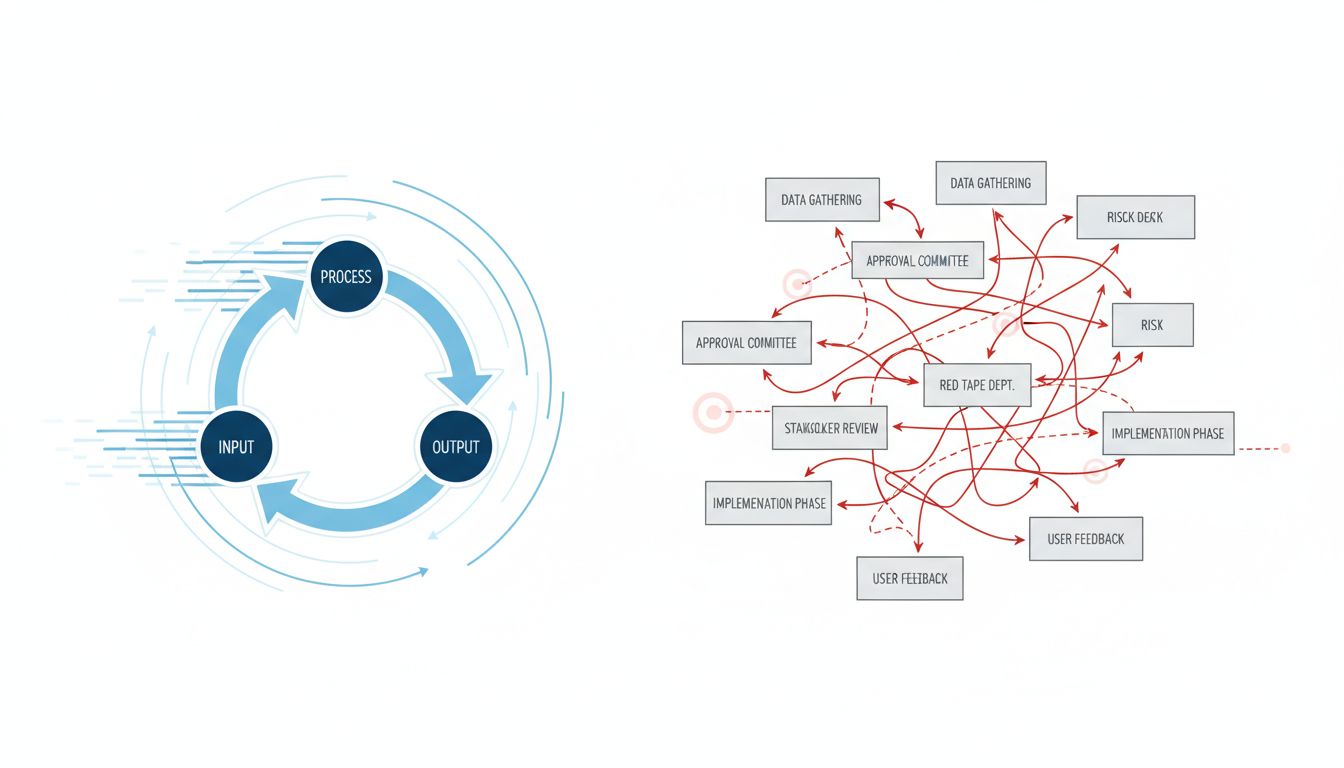
After you hire, information passes through people. A user complaint goes to support, gets triaged, enters a ticketing system, gets reviewed in a weekly meeting, gets estimated by engineering, gets prioritized against a roadmap, and eventually surfaces to someone who can actually decide what to do about it. Each handoff is a place where signal degrades.
Underfunded teams can’t afford those layers. The person making the product decision is often the same person who read the angry email at 11pm. That’s not romantic. That’s a structural advantage.
Speed as a Compounding Asset
Sam Altman has said the single most important thing for an early startup is speed. This gets quoted a lot. What gets quoted less is why speed matters so much: it’s not about working harder than competitors. It’s about running more experiments per unit of time.
Every product decision is a hypothesis. You think users want this feature. You think this pricing model will work. You think this acquisition channel will scale. Every one of those is a guess, and the only way to turn guesses into knowledge is to test them against reality.
Underfunded startups run more tests per month, not fewer. They have to. They can’t spend six months building something that might not work. They build, ship, learn, and adjust in cycles that well-funded competitors can’t match because well-funded competitors have stakeholders who expect the plan to hold.
The math here compounds fast. A team running two-week learning cycles versus eight-week planning cycles accumulates roughly four times as many real data points per year. Over two years, that’s not a gap you close with better talent or a bigger budget. It’s a knowledge deficit.
The Overhead Trap
Here is something nobody tells founders before their Series A: a meaningful portion of your raise will go to supporting the raise itself.
You hire a CFO or a controller to satisfy board reporting requirements. You engage lawyers for compliance work. You hire a head of people ops because you now have enough employees that HR is a legal necessity, not a luxury. You set up more formal security practices because your enterprise customers require SOC 2. None of this is optional. None of it builds product.
Then there’s the coordination cost. Every additional person you add increases the number of communication pathways in the organization non-linearly. A team of five has ten possible pairwise communication paths. A team of twenty has one hundred and ninety. This isn’t a management failure. It’s arithmetic.
The lean competitor doesn’t have a coordination problem because they don’t have enough people to generate one. Their decision-making surface is small. They can change direction on a Tuesday because the whole team fits in one room and nobody has a quarterly objective tied to the old direction.
Skin in the Game and What It Selects For
When a startup is operating close to its funding limits, every decision is load-bearing. There’s no cushion to absorb a bad call. This is genuinely stressful, and I’m not going to pretend otherwise. But that stress selects for something valuable: clear thinking about what matters.
Funded startups can afford to pursue multiple bets simultaneously. This sounds like an advantage and sometimes is. More often it means the team never develops the discipline of committing fully to one thing and seeing it through. When everything is a priority, nothing is.
Underfunded teams are forced to make the call. Which customer segment? Which channel? Which feature? The constraint answers the question that abundant resources leave perpetually open.
Mailchimp grew for over a decade without external funding, reached hundreds of millions in annual revenue, and was acquired by Intuit for $12 billion in 2021. Basecamp, 37signals’ flagship product, has been profitable for over two decades without a single outside investment. These aren’t outliers. They’re examples of what happens when a company is forced to make money from customers rather than from investors. The discipline is structural, not cultural.
The Spending Signal Problem
There’s a subtler issue with heavy funding that rarely gets discussed: capital can mask the absence of product-market fit for years.
If you’re spending heavily on paid acquisition, you can report growth metrics that look like traction. If you’re subsidizing customer pricing, you can report retention that looks like love. If you’re hiring fast, you can fill roles that make the org chart look like a real company. All of these things can be true while the core product remains something people tolerate rather than need.
The underfunded competitor doesn’t have this option. Growth either comes organically or it doesn’t come. Retention either holds without discounts or it reveals the churn. The signal is clean because there’s no money to muddy it.
This is why lean startups often stumble into adjacent markets that turn out to be more valuable than their original target. They can’t afford to ignore the market telling them something unexpected. Funded companies can spend another quarter trying to make the original thesis work.
What This Actually Means for Founders
None of this is an argument against raising money. Timing matters, sector matters, and some businesses genuinely require capital to reach the infrastructure that makes them competitive. But the reflexive goal of raising as much as possible as early as possible is a strategy built on startup mythology, not evidence.
The real question is whether you’ve found something that works before you pour fuel on it. Funding amplifies what’s already happening. If what’s already happening is tight feedback loops, fast learning, and genuine user pull, amplifying that is powerful. If what’s already happening is fuzzy product decisions and acquisition-driven growth, amplifying that just speeds up the eventual reckoning.
The founders who navigate this well are the ones who raise when they have clear evidence of what the capital will accomplish, not when the market will let them. They keep teams smaller than the headcount plan says they should. They stay in the feedback loop personally, longer than is comfortable. And they treat constraint not as something to escape but as a quality control mechanism they’ll need to deliberately recreate once the pressure is off.
The scrappy competitor beating your well-funded team isn’t working harder. They just haven’t had the option to stop learning yet.