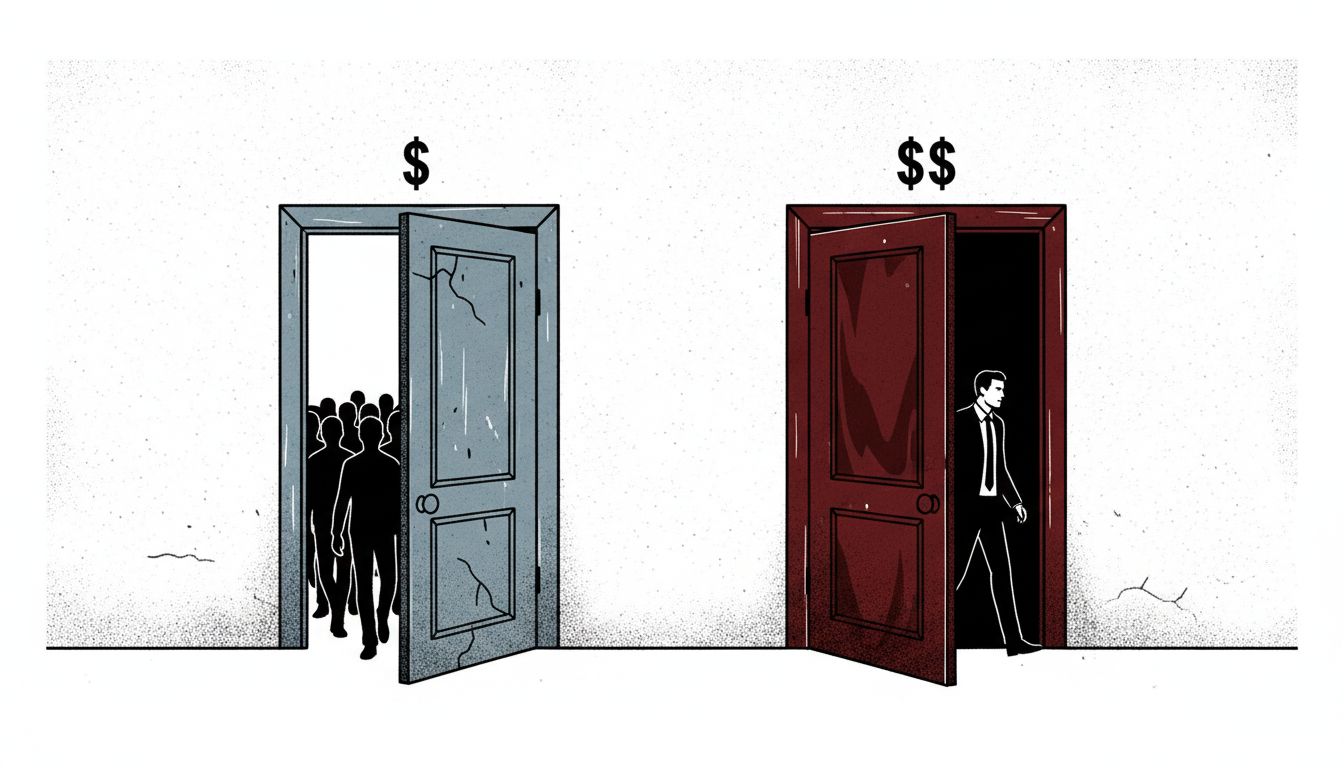

The Email That Sounds Like a Win
Somewhere right now, a founder is staring at an email from a larger company proposing a partnership. The email uses words like “mutual benefit” and “aligned audiences” and promises distribution to hundreds of thousands of potential customers. The founder has eleven users. The math feels obvious.
Six months later, the partnership has produced almost nothing measurable. The founder spent weeks on legal review, integration work, and joint planning calls. Their actual product, the thing that might have made those eleven users into a hundred, barely moved. And now there is a follow-up email asking about “co-marketing opportunities.”
This is not a cautionary tale about one unlucky founder. It is the default trajectory of most early-stage partnerships, and the founders who figured this out, often after getting burned once, built a discipline around saying no that looks almost pathological from the outside.
What a Partnership Actually Costs
The problem is that partnerships are priced wrong in the founder’s mind. The email arrives, there is a Zoom call, someone says the word “synergy” (always a warning sign), and the perceived cost is a few hours. The perceived upside is enormous distribution or credibility.
The real cost never appears on a spreadsheet. Early-stage startups run on attention. The founding team’s attention is the only asset that cannot be replaced or hired around. Every week spent navigating a partnership negotiation is a week not spent talking to customers, shipping features, or figuring out why retention is dropping. These are opportunity costs, and they compound in a direction most founders only notice in retrospect.
The legal component alone is underestimated. A meaningful partnership with a large company involves contracts that require counsel, negotiation rounds, and sometimes procurement processes that large companies treat as routine because they have dedicated teams for it. For a startup, “routine” procurement can take three months and cost tens of thousands in legal fees.
Then there is the technical integration work, the joint go-to-market planning, the internal champion at the partner company who gets promoted or leaves, and the quiet death of a partnership that neither side officially ends. Founders who have been through this once describe the experience the same way: it felt productive while it was happening, and they cannot point to a single customer who came from it.
Why the Offer Keeps Coming Anyway
Larger companies have every incentive to pursue these partnerships, and almost none of the downside. A business development team at a mid-sized or large company has a metric: partnerships initiated or signed. The startup gets a logo in a partner directory and access to a newsletter mention. The BD person gets credit for building the relationship.
The incentive asymmetry is severe. The larger company is making a small bet across many startups, knowing most will not pan out, hoping a few produce something useful. The startup is making what amounts to a large bet on a single relationship that the partner views as low-priority. This is not malice; it is just how large organizations work. The startup simply does not understand what league it is playing in when it signs up for this game.
This is also why the partnership offer almost always comes inbound. Large companies send these emails constantly. Startups feel special receiving them. The feeling is the trap.

The Founders Who Said No and What They Did Instead
Stewart Butterfield built Slack inside a failing gaming company. During Slack’s early growth period, the team was almost maniacally focused on a specific question: why do teams that try Slack keep using it, and how do we find more teams like that? Partnership opportunities were not absent; any fast-growing enterprise tool in 2014 and 2015 attracted attention. What kept Slack sharp was the refusal to let anything dilute that core focus on understanding retention before scaling acquisition.
Basecamp, which has been public about its operating philosophy for years, built an explicit culture around saying no to almost everything that was not core product development. Jason Fried has written and spoken about this extensively. The position is not contrarian for its own sake; it is a recognition that a small team’s output is a direct function of where its attention goes.
The pattern holds more broadly. Early Airbnb famously did things that did not scale, including visiting hosts personally in New York to take better photos of their listings, rather than chasing distribution partnerships. Stripe spent its early years focused obsessively on making payments work better for developers, not on signing referral agreements with banks.
These are not companies that succeeded despite saying no to partnerships. The focus enabled by that discipline is part of why they succeeded.
The Framework That Actually Works
Saying no to everything is not the strategy. The strategy is having a clear test before saying yes.
Founders who do this well tend to ask three questions before any partnership conversation gets past an initial call. First, does this bring us closer to paying customers in the next ninety days, or does it bring us closer to potential customers someday? Second, can we fully resource this without pulling anyone off core product or sales work? Third, if this partnership produces nothing in six months, do we still think we made the right call by pursuing it?
The third question is the most useful because it forces an honest assessment of whether the partnership has standalone value, like access to a specific channel or technology, or whether it is mostly about the hope of what it might become. Partnerships built on hope have a specific failure mode: both sides remain nominally committed while neither side actually invests, and the whole thing dissolves without anyone explicitly calling it off.
The ninety-day test on customer proximity is equally useful. A partnership with a company that has direct access to your exact buyer, where the mechanics of referral are clear and the partner has a real reason to send you business, is a different animal from a content partnership or a mutual marketing agreement. The former passes; the latter almost never does.
The Counterintuitive Truth About Momentum
There is a story founders tell themselves about partnerships, which is that they need scale before they have leverage, and partnerships are how you get scale before you deserve it. This is mostly backwards.
Partners worth having, the ones with real distribution to your real customers, are attracted by traction, not by willingness to partner. A company that has found a customer segment it serves extremely well and can demonstrate that clearly has no trouble getting serious partnership conversations later. A company that spent its first year in lightweight partnership discussions with everyone who emailed them usually has neither traction nor partners.
As described in The Most Valuable Tech Companies Spent Their First Year Doing Everything by Hand, the companies that win almost always do the hard, unscalable, manual work of actually learning their customers before they try to automate or scale acquisition. Partnerships are often a sophisticated way of avoiding that work. They feel like growth strategy but function as growth theater.
The founders who figure this out early do not just say no to bad partnerships. They develop a genuine allergy to anything that substitutes activity for progress. Meetings, announcements, and agreements feel like movement. Customer retention, pricing power, and word-of-mouth referrals are movement. The difference is measurable, and the discipline required to stay focused on measurable progress over visible activity is what most startup advice underweights.
What This Means in Practice
If you are an early-stage founder receiving partnership inquiries, the default answer is no, and the bar for overriding that default should be high. Specifically:
Any partnership that requires more than a week of your team’s attention in the setup phase needs to clear a very high bar on expected customer value. Any partnership with a large company where your counterpart is a business development professional rather than someone who owns a P&L is probably being tracked as a relationship, not a revenue driver. Any partnership framed around “brand awareness” or “mutual visibility” is almost certainly going to produce neither.
The founders who build well tend to revisit the partnership question around the time they have a repeatable sales process and enough revenue that they can hire someone to manage the partnership rather than running it themselves. At that stage, the economics change. The attention cost is delegable. The partnership can be scoped around a clear commercial outcome. The startup has enough proof of traction that larger partners take the relationship seriously.
Before that stage, the email that looks like a win is almost always a cost in disguise. The founders who spot it fastest tend to build the best companies.