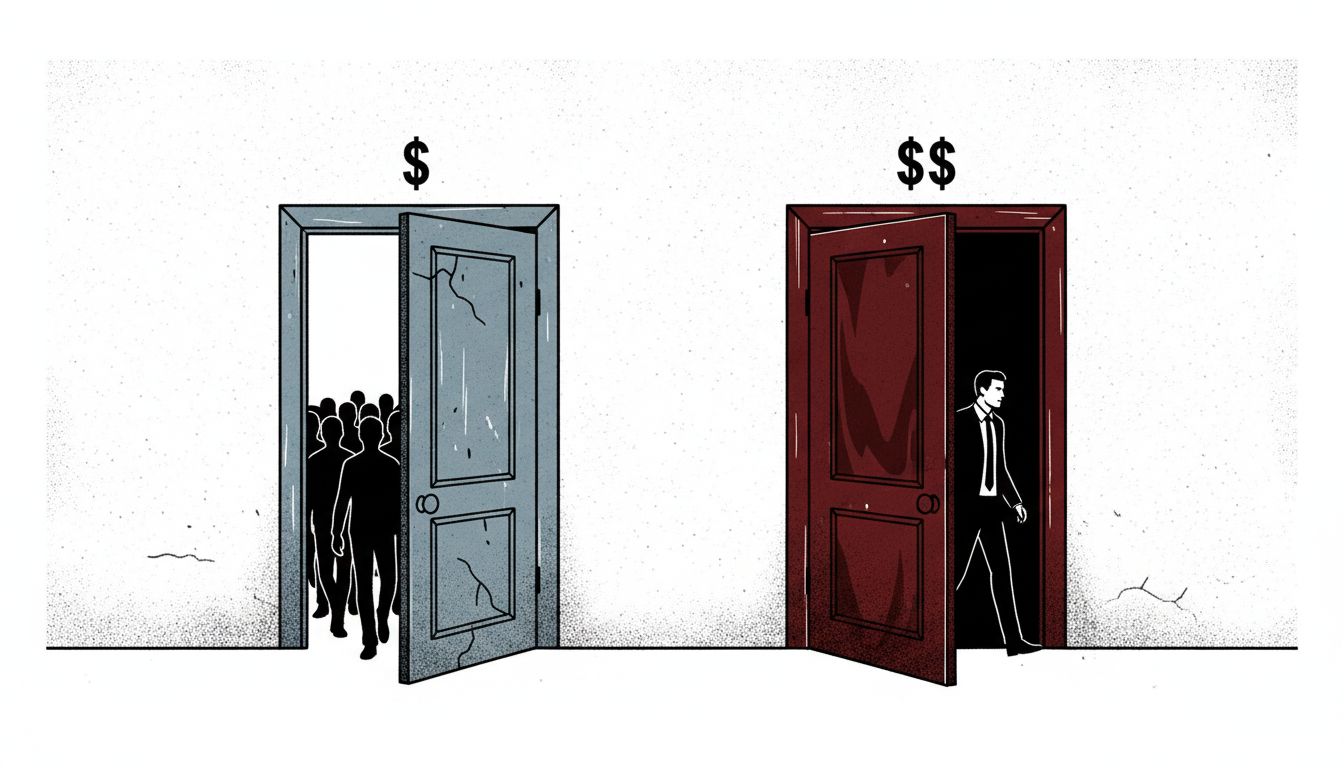

Picture two founders pitching to the same room of investors. The first one says, “There’s no direct competitor. We’ve identified a completely untapped market.” The room nods politely. The second one says, “We’re going after Salesforce’s neglected mid-market segment, and here’s exactly why their product fails those customers.” The room leans forward. If you’ve spent any time around serious investors or operators, you already know which pitch wins. The mythology of the blue ocean, the untapped market, the category you create from scratch, makes for a great TED talk. It makes for a terrible survival strategy.
This is the same instinct that causes founders to deliberately make their first product worse than they could, not out of laziness, but because they’ve learned to read signals from real markets rather than hypothetical ones.
Competition Is a Map, Not a Warning Sign
Here’s the thing nobody tells you when you’re romanticizing the blank canvas: competitors are doing your market research for you, and they’re doing it for free. When Slack entered the workplace communication market, HipChat already existed. When Stripe showed up, PayPal and Braintree were already processing payments. Neither company apologized for entering a crowded room. Both used the existing competition as a detailed map of customer frustration.
This is the actual function of competition that most founders miss. Every product in a market represents years of customer feedback, pricing experiments, and hard-won distribution lessons. The competitors you’re afraid of have spent millions of dollars proving the market exists and identifying every sharp edge customers hate. You get that intelligence for the cost of a few months of serious product research.
Blue oceans don’t have that. In a genuinely untapped market, you’re not just building a product. You’re educating an entire customer base that they have a problem, convincing them the problem is worth paying to solve, and creating distribution channels from nothing. That’s three separate startup problems stacked on top of each other. Most companies can’t survive one.

The Validation Problem Nobody Talks About
When you’re in a blue ocean, you’re constantly flying blind. You can’t tell if slow adoption means your product has the wrong features, or that you’ve mispriced it, or that the market timing is off, or that the problem simply isn’t painful enough to pay for. All of those look identical from the inside, and figuring out which one is killing you takes time you probably don’t have.
In a competitive market, you have benchmarks. You know roughly what customers pay for comparable solutions. You know which features are table stakes and which are differentiators. You know what a reasonable sales cycle looks like. This information is worth more than founders realize. It’s the difference between navigating with GPS and navigating by hoping you eventually hit a coastline.
This is also why most billion-dollar apps launched with only three core functions. The constraint wasn’t accidental. When you’re entering a market with known competitors, you’re forced to be brutally clear about the one or two things you do better. That clarity is a gift the market gives you. Blue ocean founders have no such forcing function. They can keep adding features forever, chasing a customer that doesn’t fully exist yet.
Pricing Is Saner When Someone Else Already Figured It Out
One of the least glamorous but most punishing parts of launching into an untapped market is pricing. You have no anchors. You don’t know if customers expect to pay ten dollars a month or ten thousand. You’ll almost certainly underprice at first (because that feels safe) and then face the brutal economics of trying to raise prices on a customer base that signed up for something else.
Competitive markets solve this. Customers already have a mental model of what solutions cost. They’ve been through a buying process before. They know what budget approval looks like internally. That’s not a constraint, it’s a foundation.
This is actually the same dynamic playing out inside SaaS pricing strategies, where companies use competitor-anchored pricing tiers to move customers toward the plans that actually make money. It only works because customers have reference points. Without those reference points, you’re just throwing numbers at people and hoping something sticks.
The Real Risk Is Irrelevance, Not Competition
Founders who fear competitive markets are often optimizing for the wrong threat. They look at an established player and see a danger. What they should see is a ceiling. A competitor with unhappy customers is an invitation. The risk isn’t that a strong competitor beats you. The risk is that you build something real and then can’t find anyone who cares enough to switch from their current solution, even a bad one, because inertia is a powerful force.
In a competitive market, customers are already in motion. They’re actively evaluating, switching, complaining publicly, and writing reviews. That’s a warm audience. Contrast that with a blue ocean customer who doesn’t know they have a problem yet, and you start to see why “no competition” is often a warning, not a feature.
This is the same logic behind why tech giants lose money on purpose to win markets. They’re not afraid of the fight. They’re using the fight to establish position, because position in a known market is worth more than being first in a market that might not materialize.
What “Winning” in a Competitive Market Actually Looks Like
You don’t need to beat your competitors outright. That framing is the residue of business school case studies. In practice, winning means carving out a defensible segment where you serve a specific customer better than anyone else does. Basecamp didn’t destroy Microsoft Project. It served a different customer (smaller teams who found Project comically over-engineered) better than anyone else was. That was enough to build a durable, profitable company.
The playbook is consistent across successful startups: identify a competitor with a specific customer segment it’s underserving, understand the exact frustration that segment experiences, build a product that’s ten times better for that specific use case (not all use cases), and reach those customers through channels the competitor ignores. Simple to describe, genuinely hard to execute, but infinitely more tractable than convincing a market it has a problem it doesn’t know about yet.
Blue oceans are real. Sometimes they work. But for every Cirque du Soleil there are a hundred startups that died educating a market that eventually bought from someone better capitalized. Competition isn’t the enemy of startup success. Obscurity is.