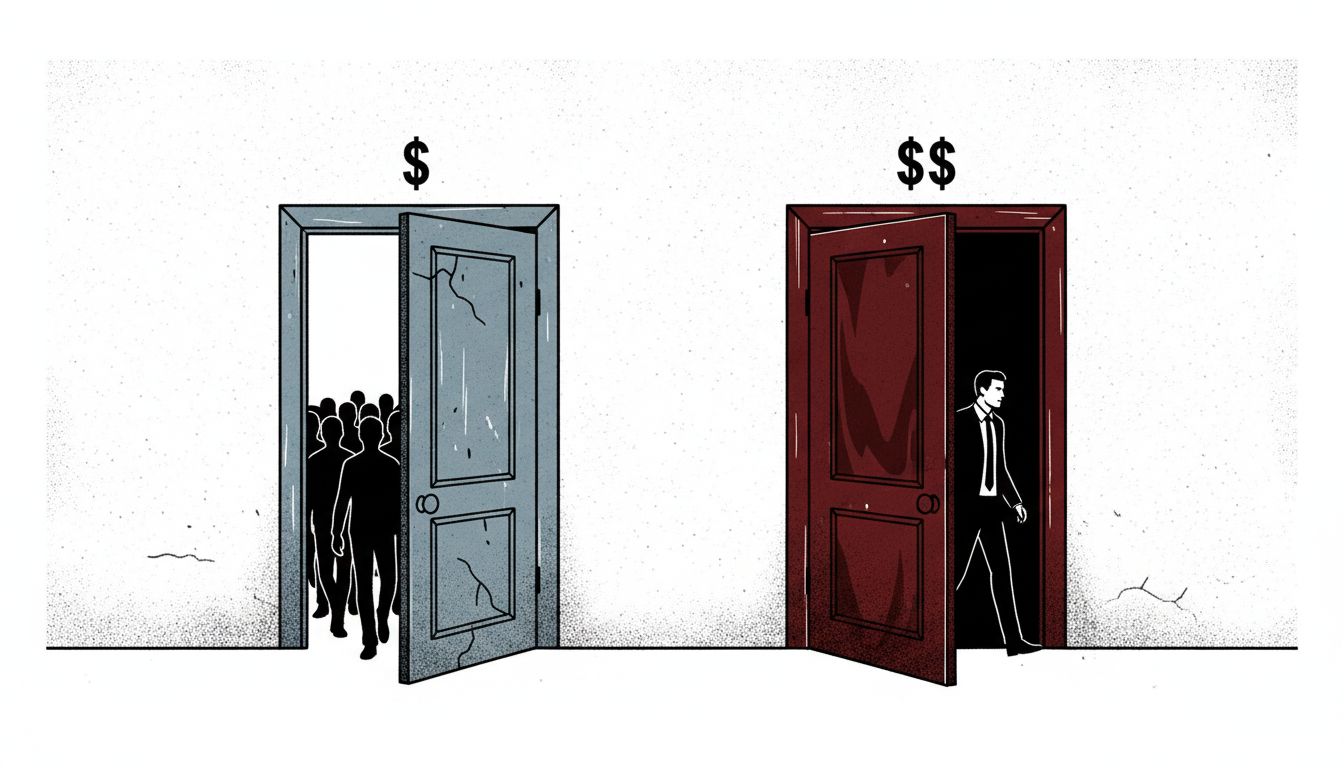

In 2006, if you asked a room full of investors whether people would pay to sleep in a stranger’s air mattress in a city they’d never visited, you’d have gotten polite laughter and a swift exit. There was no market research to cite. No TAM slide that made sense. No comparable company to benchmark against. And that was precisely the point. Airbnb didn’t find a market. It manufactured one out of something that looked, to everyone at the time, like a bad idea dressed up as a worse one.
This is the pattern that keeps getting misread by first-time founders. They’re taught to validate demand, to find product-market fit in an existing category, to look for underserved customers in proven verticals. All of that advice is reasonable if you want to build a decent business. It is almost useless if you want to build a consequential one. The startups that reshape industries aren’t the ones that did the best market research. They’re the ones that decided the map was wrong and drew a new one. Venture capitalists, incidentally, have their own pattern-matching problems here, which is part of why truly category-creating companies often struggle to raise early money.
Why “No Market” Is Actually Good News
Here is something counterintuitive that takes a while to really absorb: the absence of an existing market is not evidence that demand doesn’t exist. It’s often evidence that nobody has organized the demand yet.
Before Uber, people paid for taxis. But nobody thought of idle car-owners as a supply-side asset. The demand for cheap, reliable, on-demand transportation was always there. The market was not, because the coordination mechanism didn’t exist. Uber didn’t discover a need. It created the infrastructure that made a latent need visible and satisfiable at scale.
This is the core logic behind deliberately choosing non-existent markets. You are not betting that people will want something they’ve never heard of. You are betting that people already want something they have no language to ask for, and that you can be the first to hand them the words and the product simultaneously.
The risk is real. But so is the upside: when you create the market, you also write the rules. You define what the category means, which features matter, what pricing looks like, and what good enough feels like. Every competitor that follows is playing catch-up on your terms.
The Incumbent Advantage Is a Trap
Established companies are structurally incapable of seeing non-existent markets clearly. Not because the people inside them are stupid, but because their entire decision-making apparatus is built to serve existing customers, protect existing revenue, and optimize existing processes. That’s not a flaw in their culture. It’s the logical output of being successful.
This is why early-stage startups win not by knowing more than incumbents, but by strategically knowing less. A large company sees a nascent market and calculates that the revenue isn’t worth the distraction. A startup sees the same market and realizes there’s nothing to lose by being first. The asymmetry is enormous.
Blockbuster looked at streaming and saw a threat to their retail model. Netflix looked at the same technology and saw a market that didn’t exist yet. One company was anchored to what they’d already built. The other was free to build toward what customers would eventually want. The rest of that story is a business school case study taught in every MBA program on earth.
What incumbents almost never do is deliberately build toward a future that makes their current product irrelevant. The organizational incentives simply don’t allow it. This creates a window, and the window stays open longer than most founders expect.
How to Tell a Real Emerging Market from a Fantasy
Here’s where the nuance lives, because “markets that don’t exist yet” is also the rallying cry of every founder pitching vaporware. Not every non-existent market is worth creating. Some of them don’t exist for good reason.
The discipline is in distinguishing between latent demand and manufactured demand. Latent demand is real need that lacks a good solution. People were always willing to pay for convenient transportation. The friction was on the supply side. Manufactured demand is when a startup tries to convince people they have a problem they don’t actually have. Most crypto consumer apps fell into this bucket. The technology was looking for a use case, not the other way around.
The test is unglamorous but reliable: can you find a small group of people doing something clunky, expensive, or embarrassing to solve the problem themselves? If yes, you probably have latent demand. If you have to explain the problem before you can explain the solution, you probably have a market that doesn’t exist for reasons that won’t go away.
Small existing workarounds are your best signal. Spreadsheets held together with macros, email chains that substitute for software that doesn’t exist, manual processes that people hate but can’t replace because nothing better is available yet. These are the seams in the current market. Pull on them.
The Patience Problem Nobody Talks About
Creating a market takes longer than entering one. This is the part that kills otherwise good companies. The window is open, the opportunity is real, but the timeline extends far past what most early-stage companies can survive on their initial funding.
Founders who succeed at this learn to treat early adoption as market education, not just revenue generation. They understand that the first customers are teaching the rest of the market how to want the product. This requires a different kind of patience than most startup advice prepares you for.
It also requires a different kind of hiring. Founders who bring in their harshest critics as first employees tend to last longer in this phase, because those employees stress-test assumptions before the market does. When you’re inventing a category, the cost of being wrong about a core assumption is higher than almost anything else. You need people inside the tent who will tell you the map is wrong before you’ve led everyone off a cliff.
The other lever that actually works is partnerships. Early-stage startups that treat partnerships as cheat codes can compress the timeline dramatically. Distribution through an existing trusted relationship gets you in front of potential customers faster than building an audience from scratch. When you’re trying to educate a market, borrowed credibility is one of the most underrated assets available to you.
The Part Where the Mythology Gets Dangerous
There is a romanticized version of this idea that has done real damage to real companies. The mythology says: ignore the skeptics, trust your vision, markets can’t be surveyed before they exist. All of that is partially true and thoroughly dangerous if taken too far.
Ignoring the market entirely, under the belief that you’ll create it on will alone, is how you end up building something technically impressive that nobody buys. The founders who actually pull this off aren’t ignoring feedback. They’re distinguishing between feedback about their current product and feedback about the underlying problem. The first kind is useful data. The second kind is noise from people who can’t imagine what doesn’t exist yet.
That distinction is genuinely hard to make in real time. But it’s the thing that separates founders who create categories from founders who just have expensive opinions.
The market that doesn’t exist yet is the most dangerous place to build a company. It is also, historically, the most rewarding one. The founders who go there aren’t reckless. They’re just reading a different map than everyone else, one they drew themselves.