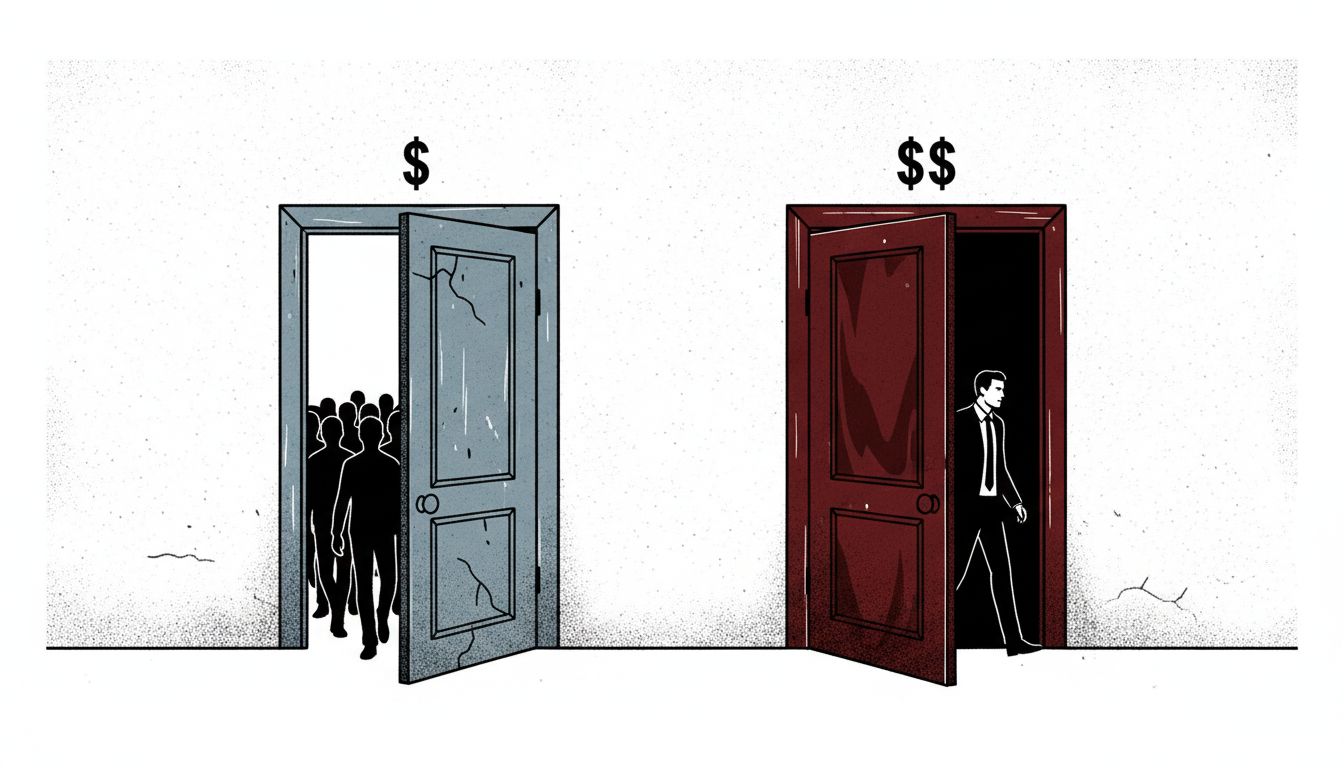

Picture a team of three engineers in 2004 building a scheduling tool for internal college events. Nobody asked for it. Nobody was paying for it. The market, if you could even call it that, was basically a dorm room and a whiteboard. Two years later, that same architecture was powering something used by half a billion people. The “wrong” market wasn’t a mistake. It was the training ground.
This pattern shows up constantly once you start looking for it. The founders who win aren’t the ones who found the right market immediately. They’re the ones who used the wrong market to build something the right market couldn’t ignore. Most successful apps started as internal tools nobody meant to sell, and the reason isn’t accidental. Constrained, low-stakes environments force a kind of product discipline that open, competitive markets rarely produce.
The Wrong Market Is a Pressure Cooker, Not a Mistake
Here’s what nobody tells you about launching into a tiny, weird, or seemingly irrelevant market: it’s one of the most brutally honest feedback environments you can find. You don’t have marketing budgets to cover bad product decisions. You don’t have brand equity to coast on. You have a small group of people who either use your thing or they don’t, and you’re close enough to them to find out exactly why.
Stripe didn’t launch by trying to replace legacy payment infrastructure for Fortune 500 companies. They launched for developers who were frustrated enough to complain loudly on forums. That’s a weird, narrow, opinionated market. But it was a market that gave relentlessly specific feedback, had low tolerance for abstraction, and could immediately tell you when something was broken. By the time Stripe moved upmarket, they had a product that had been stress-tested in ways their eventual competitors simply hadn’t experienced.
This is the hidden logic behind what looks like bad market selection. The wrong market, chosen deliberately, acts as a crucible.

Why Investors Miss This (and Why That’s Actually Fine)
If you’ve ever sat across from a VC and watched their eyes glaze over when you describe your initial market, you know the feeling. The market’s too small. The customer isn’t the eventual customer. The use case seems niche to the point of irrelevance. And here’s the thing: they’re not entirely wrong.
Venture capitalists decide in 30 minutes using pattern recognition most founders don’t know exists, and that pattern recognition is calibrated toward certain shapes of opportunity. A small, unconventional initial market doesn’t fit the pattern. What they’re missing is that the initial market isn’t the destination. It’s the manufacturing process.
The founders who understand this don’t fight the skepticism. They use the wrong market to build something so undeniably functional that the right market becomes obvious later. By the time they’re back in front of investors with traction, they’re not pitching a theory. They’re showing a product that works under conditions that would have broken most competitors.
There’s also a competitive advantage hiding in plain sight here. If your initial market looks unattractive, nobody’s racing you to it. You get time. Time to iterate, time to fail quietly, time to build muscle. Billion-dollar startups win by deliberately ignoring what experts tell them to pay attention to, and this is one of the clearest expressions of that principle.
The Mechanics of a Deliberate Wrong Market
Not every bad market choice is strategic. Plenty of startups are just in the wrong market because they misjudged demand or built something nobody wanted. The difference between a strategic wrong market and a simple mistake comes down to a few specific characteristics.
First, the wrong market should share the core problem with your eventual target. The mechanics of the pain need to be the same, even if the context is different. If you’re building B2B contract management software, starting with freelancers isn’t random, it’s a controlled experiment in contract friction at the smallest possible scale.
Second, the wrong market should be reachable without significant capital. The whole point is low-stakes iteration. If you need to raise a serious round just to access your initial market, you’ve lost the benefit of the strategy.
Third, and this is the part most founders skip: you need a clear thesis for how the wrong market connects to the right one. You’re not just killing time. You’re building toward something specific. Early-stage startups that weaponize customer rejection outlast the ones that avoid it, and the founders who use wrong markets well treat every piece of friction as a signal pointing toward the eventual product.

What Amazon and Slack Actually Teach Us
Amazon started as a bookstore. Not a reluctant bookstore, a genuinely focused bookstore that got very good at shipping a physical product quickly and reliably. Books were the wrong market in the sense that nobody investing in Amazon in 1994 was betting on books as the endpoint. But books were the right wrong market because they forced Amazon to solve logistics, customer trust, and inventory management at a scale that translated directly to everything that came later.
Slack started as the internal communication tool for a video game company called Glitch, which failed. The game was the wrong market in the most literal sense: it stopped existing. But the tool built for that wrong market was so useful that the team pivoted to selling the tool itself. The most revolutionary software features were discovered by accident, and the pattern is hiding in plain sight. Slack wasn’t discovered by accident exactly, but it was discovered by people who were building for the wrong market and paying close enough attention to notice what they’d actually created.
These aren’t flukes. They’re the product of founders who stayed close to real usage, in real conditions, with real constraints, long enough to understand what they were actually building.
The Strategic Takeaway
The startup mythology says you need to find the right market, nail product-market fit, and scale. The actual pattern in successful companies is messier and more interesting. The right market often only becomes clear after you’ve spent serious time in the wrong one.
This isn’t an excuse to avoid thinking about where you’re going. The deliberate wrong market strategy only works if you’re honest about what you’re learning and disciplined about when to move. The founders who get stuck in wrong markets forever aren’t being strategic, they’re being comfortable.
But the founders who sprint straight to the “right” market without developing product instincts in a lower-stakes environment? They’re often the ones who build something technically correct and completely unused.
The wrong market, chosen with intention, isn’t a detour. It’s the fastest path to building something that actually lasts.