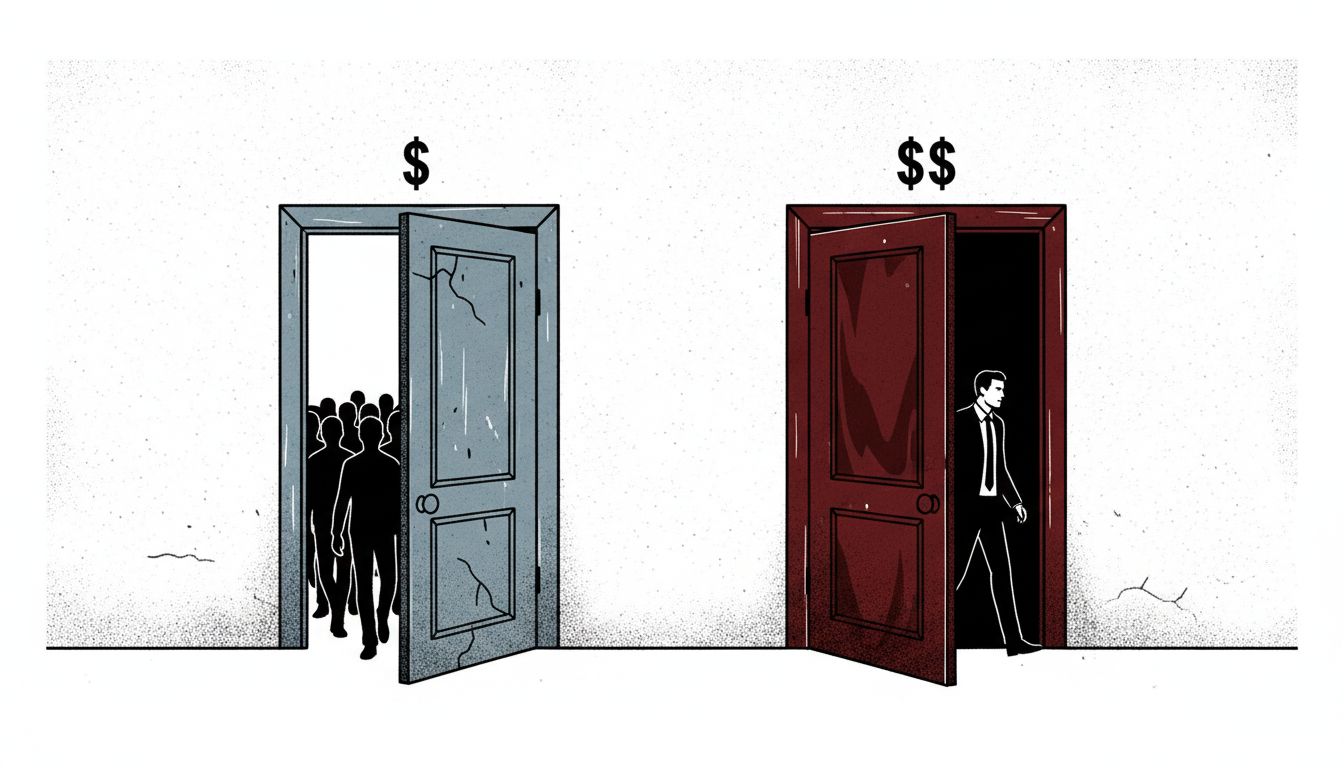

A few years before Stripe became the infrastructure backbone of the internet economy, every serious person in payments told you the same thing: this market is locked up. Visa, Mastercard, the legacy processors, the banks. You’d need regulatory relationships, fraud teams, compliance departments. The friction was the whole point. Patrick and John Collison looked at that friction and saw something different. They saw that nobody had bothered to make payments easy for developers because everyone building in the space assumed the hard part was the regulations, not the experience. The market looked terrible. It was, in fact, perfect.
This is not a lucky exception. It’s a pattern that shows up so consistently in startup history that you have to wonder why the conventional wisdom still points founders toward hot markets with lots of activity and obvious demand signals.
Why Crowded Markets Feel Safe and Aren’t
The logic for chasing validated markets is straightforward: if lots of companies are competing there, the demand must be real. You’re not making a bet on whether the problem exists. You’re just betting you can execute better.
The problem is that this logic is mostly backwards. Validated demand in a crowded market means you’re buying a lottery ticket at full price. You need to be meaningfully better than established players who already have distribution, brand recognition, customer relationships, and institutional knowledge. Not a little better. Dramatically better, in ways that are defensible before they can copy you.
Most startups can’t do that. Not because the founders aren’t talented, but because the structural advantages of incumbents in a validated market are real. The rare startups that win those fights (think Notion competing with Evernote, or Figma competing with Adobe) usually succeed by changing the fundamental unit of the product rather than just building a better version of the same thing. That’s its own strategy, and it’s genuinely hard.
Empty markets feel risky because the absence of competition reads as the absence of demand. But those are completely different things, and confusing them is one of the most expensive mistakes a founder can make.
The Three Reasons Good Markets Look Bad
When a market looks empty or unattractive, it’s usually for one of three reasons. Understanding which one you’re looking at determines whether you should run toward it or away.
The first: the market is genuinely bad. The problem isn’t real, or the people who have it aren’t willing to pay to solve it, or the economics never work out. These exist. Don’t romanticize them.
The second: the market is too early. The infrastructure or behavior change that would make the market viable doesn’t exist yet. Google existed before widespread broadband, and the search experience was fine. It became extraordinary once most users had fast connections. Timing risk is real and gets founders killed even when their underlying thesis is right.
The third, and most interesting: the market looks bad because of factors that are about to change, or that only look like barriers from the outside. This is where the best startup opportunities concentrate. The payments market looked impossible until it turned out the hard parts (regulations, fraud) were solvable, and the overlooked part (developer experience) was the actual lever. The AI market looked like a research project until inference costs fell off a cliff and made consumer products economically viable.
The skill is distinguishing reasons two and three from reason one. That’s not always possible in advance, which is why smart founders treat the evidence they collect, including rejection, as real data rather than noise to ignore or an obstacle to overcome.
What Incumbents Are Actually Protecting
When you look at markets that established players dominate, the thing they’re protecting is rarely what they claim. They say they’re protecting quality, or relationships, or their investment in infrastructure. Sometimes that’s true. More often, they’re protecting the specific configuration of the market that makes their business model work.
This creates a systematic blind spot. Incumbents will defend their core business aggressively and rationally avoid anything that threatens its economics. This means entire categories of innovation become structurally invisible to them, not because they’re stupid, but because acting on those opportunities would require undermining what’s already working.
Amazon Web Services is the obvious example. The cloud threatened to commoditize servers, which was terrifying to most companies selling hardware. Amazon had no hardware business to protect, so they could look at the same market that looked terrifying to Dell and HP and see only upside. The incumbents weren’t wrong about the threat. They were right. They just couldn’t act on it.
Startups that find genuinely durable advantages often do it by picking business models that their direct competitors find structurally difficult to replicate. Charging per API call when everyone else charges per seat. Selling to developers instead of procurement departments. Building for a customer segment that doesn’t fit the incumbent’s sales motion. These aren’t tricks. They’re structural protections, and they often emerge naturally from launching in a market the incumbents have already decided isn’t worth fighting for.

The Underserved Segment as a Beachhead
One of the most reliable versions of this strategy is finding a customer segment within a large market that the main players have collectively decided to under-serve. Not a segment too small to matter, but a segment with a specific set of needs that the dominant product handles poorly because serving them well would require compromising the product for the main customer base.
Salesforce ignored small businesses for years. Not out of negligence, but because their sales motion, their pricing, and their implementation requirements were all built around enterprise deals. That created a persistent opening that eventually produced an entire category of lighter-weight CRM products. HubSpot didn’t beat Salesforce. It won a segment Salesforce wasn’t really competing for.
This pattern repeats in market after market. Bloomberg serves institutional finance with a product that costs tens of thousands per seat per year and requires dedicated training. That leaves a massive segment of non-institutional financial professionals who need real data but can’t justify Bloomberg’s price or complexity. That gap has been filled repeatedly and profitably.
The trap founders fall into is assuming that because incumbents have ignored a segment, the segment must be undesirable. Sometimes that’s right. But often the incumbents have a very specific reason for ignoring it that has nothing to do with the segment’s actual value, and everything to do with the fact that serving them requires a different business model or product motion than what’s already working.
Why Being First in a Bad Market Is Often Better Than Being Second in a Good One
There’s a compounding effect to building in an empty market that doesn’t show up in early metrics and gets founders into trouble with investors. When you’re the only real option in a market, every customer who has the problem comes to you. You get to define what good looks like. You build product knowledge and customer relationships that are hard to replicate. Your costs of customer acquisition start low and stay low because you’re not bidding against anyone for attention.
Contrast this with entering a validated, competitive market. Your CAC is high from day one because you’re competing for every customer. Your product has to be noticeably better than something people already find acceptable. Your positioning has to explain why they should switch. All of that friction exists before you’ve even proven the model works.
The early years in an avoided market feel uncomfortable because growth metrics look bad compared to what you’d see in a hot market, even if the underlying business is stronger. Many founders and investors mistake the noise of a crowded market for signal about where real opportunity lives.
The flip side is real: empty markets can stay empty. You can be first and only because you’re wrong, not because you’re early. The discipline required is to distinguish between a market that’s empty because nobody’s tried and a market that’s empty because many have tried and all failed. The second kind is a graveyard, not an opportunity.
The Specific Conditions That Make Avoided Markets Worth Entering
Not all bad-looking markets are diamonds in the rough. The ones worth building in tend to share a few characteristics.
First, there’s a concrete explanation for why the market is avoided that isn’t “the problem isn’t real.” Regulatory complexity, high upfront capital requirements, the need to build a non-software component, a customer base that requires high-touch sales. These are all structural reasons a market looks hard that have nothing to do with whether the business can eventually work.
Second, something is changing, or is about to change, that makes the structural barriers smaller than they appear. Technology shifts are the most common version of this. The cost of building a financial services product dropped dramatically with Plaid and Stripe making banking infrastructure accessible. The cost of building on top of AI dropped dramatically when APIs made model access cheap. These shifts don’t eliminate the barriers, but they change the economics of navigating them.
Third, you have a specific advantage in navigating whatever makes the market hard. If the barrier is regulatory complexity, you need domain expertise or relationships that make you genuinely better positioned than a generic tech team. If the barrier is the need for high-touch sales, you need to either have that motion or a credible plan to build it. The advantage doesn’t have to be permanent, but it needs to be real enough to survive the early period before the market starts generating its own momentum.
Founders who get this right are not contrarians by temperament. They’re not avoiding popular markets because of ideology. They’re making a specific, evidence-based case that the risk they’re taking is smaller than it looks, and that the opportunity is larger than the market’s current emptiness suggests.
What This Means
The markets worth building in rarely look like it. Stripe’s opportunity looked like a nightmare. AWS looked like an experiment in eating your own lunch. The pattern isn’t that avoided markets are always good. It’s that the best companies very often started where everyone else refused to look, not despite the difficulty but partly because of it.
The structural protection of an avoided market is real and undervalued. When you’re early and largely alone, you get to build product knowledge, customer relationships, and operational muscle without a competitive bidding war for every resource. By the time the market looks attractive to everyone else, you’ve built the kind of lead that’s genuinely hard to close.
The question isn’t whether a market looks good today. The question is whether the reasons it looks bad are permanent, or whether they’re exactly the kind of barriers a well-positioned startup can get over first.