In 2011, a small team in San Francisco decided to build software for the funeral industry. Not fintech. Not social. Not mobile-first anything. Funerals. Their investors thought they were joking. Their friends thought they had lost it. Five years later, that company had locked up a market with virtually zero competition, sticky enterprise contracts, and margins that would make a SaaS darling weep with envy. The founders had not stumbled into this. They had chosen it, deliberately, because nobody else wanted it.
This is the pattern that keeps showing up when you actually study how durable startups get built, and it runs completely counter to what most first-time founders believe. Venture capitalists use pattern recognition to predict which industries get automated next, and founders who understand that pattern early enough can get into unglamorous markets before the money arrives and inflates everything.
The Crowded Room Problem
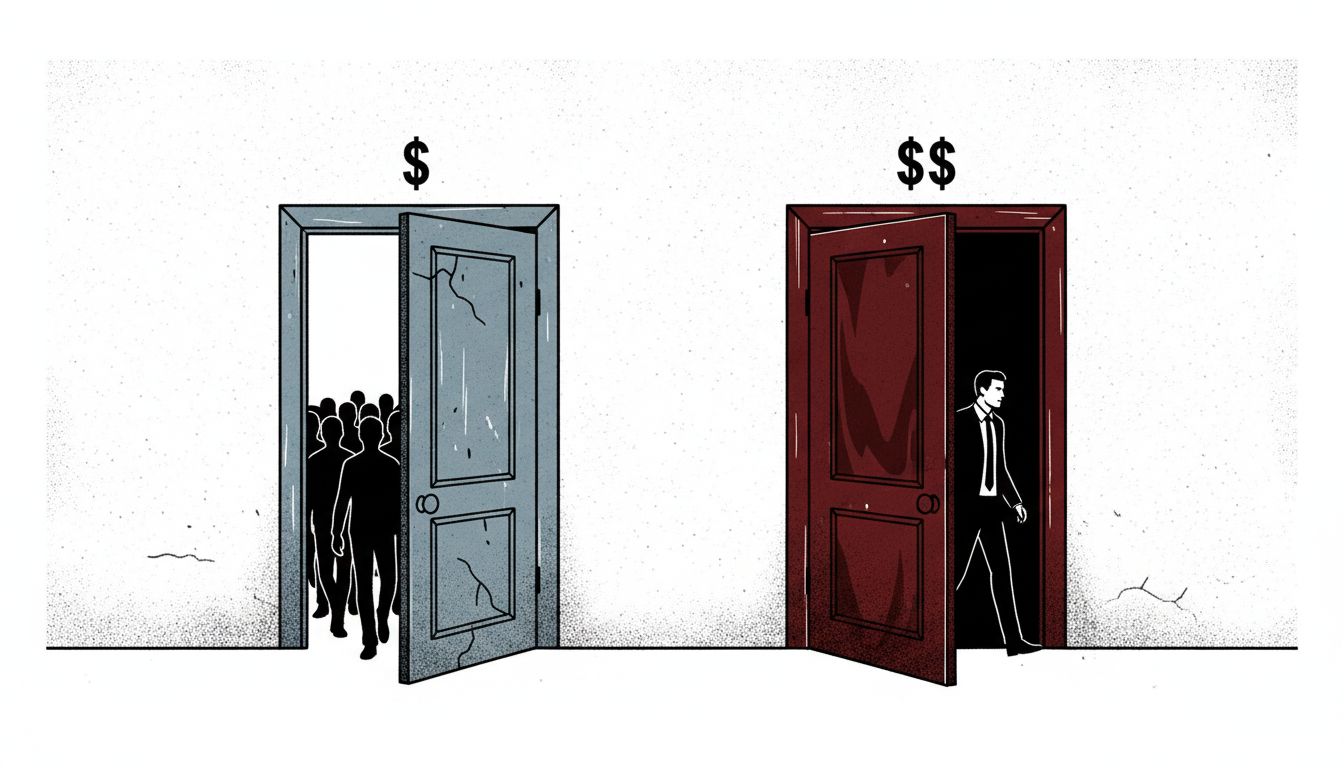
Here is what actually happens when a market gets hot. A few genuine innovators identify a real problem and start building. Press covers them. Investors get excited. Then fifty more startups pile in chasing the same customers, the same headlines, and the same funding rounds. Customer acquisition costs explode. Differentiation collapses. Everyone is racing to build the same features at the same time with money they do not have yet.
The founders who entered that market eighteen months earlier, before the wave, are now trapped in a war of attrition with well-funded competitors who have better PR and more runway. Meanwhile, in some quiet corner of the economy, there is a regional distribution company still running logistics on spreadsheets, a veterinary clinic chain paying absurd licensing fees for software built in 2003, or a niche manufacturing segment where the dominant player has not updated their product in a decade.
Those are not boring opportunities. Those are protected ones.
Why Unpopular Markets Are Actually Easier to Win
When you enter a market nobody cares about, several things happen simultaneously that dramatically improve your odds.
First, your competition is legacy software and manual processes, not a dozen well-funded startups with growth teams. Beating a ten-year-old desktop application built on outdated architecture is a very different fight than going head-to-head with a company that raised thirty million dollars last quarter.
Second, customers in neglected markets are genuinely grateful. They have been ignored for so long that a founder who actually listens to them becomes memorable fast. This is not a small thing. Early customer relationships in these markets tend to become long-term partnerships, which is how you build defensible revenue rather than churn-heavy growth metrics that impress nobody who has been around long enough.
Third, pricing power is real. When you are the only modern solution in a room full of bad options, you do not have to race to the bottom on price. Software licenses in enterprise markets cost more than the hardware they run on precisely because switching costs and workflow dependency matter more than sticker price. Unglamorous markets understand this intuitively.
The Visibility Trap
Most founders fall into what I call the visibility trap. They mistake industry attention for market opportunity. If everyone is talking about a space, it feels like validation. It feels like proof that a real problem exists. And technically, it is. But what that visibility also signals is that smart, well-resourced people are already working on it.
This is related to a broader problem with how founders make decisions under social pressure. The same cognitive pattern that makes digital minimalists ignore most tech trends on purpose and outperform their peers is what separates founders who build lasting companies from founders who build compelling pitch decks.
The best founders I have met are almost suspicious of enthusiasm. When everyone in their network tells them a market is exciting, they slow down. When people tell them an idea sounds boring or hard to explain at dinner parties, they lean in.
What This Actually Looks Like in Practice
Toast, the restaurant management platform, did not invent the idea of restaurant software. They entered a market everyone considered solved, dominated by legacy players, and won by actually understanding how restaurants operate rather than how software companies think restaurants should operate. Veeva Systems built a CRM specifically for pharmaceutical sales reps, a market Salesforce could have owned but never focused on. Both companies made deliberate, almost contrarian market choices that looked unambitious from the outside.
The common thread is not that they avoided competition entirely. It is that they chose competition they could actually beat. Legacy software vendors defending old architectures are not nimble. Large platform companies are not going to retool their entire product for a niche vertical. That is the window.
This connects to something worth reading about more broadly: successful startups sometimes deliberately choose markets that do not exist yet, but the smarter variation on that strategy is choosing markets that exist but have been abandoned or ignored. The former requires creating demand. The latter just requires showing up.
The Counter-Intuitive Founder Mindset
Building in an unpopular market requires a specific kind of psychological tolerance. You will not have a cohort of peers to benchmark against. You will not be able to point to recent funding rounds in your space as proof of concept. Your story will be harder to tell quickly, which matters more than founders realize when venture capitalists decide if your startup is worth millions before you finish your first sentence.
But the founders who are willing to accept that friction upfront tend to arrive at something the trend-chasers almost never do: a genuine monopoly on a real market. Not a winner-take-all fantasy dressed up in TAM slides, but actual pricing power, actual retention, actual word-of-mouth within an industry that talks to itself constantly because it has always been ignored by outsiders.
The startup mythology says go where the excitement is. The actual evidence says go where the excitement is not, before anyone else figures out why they should have been there all along.