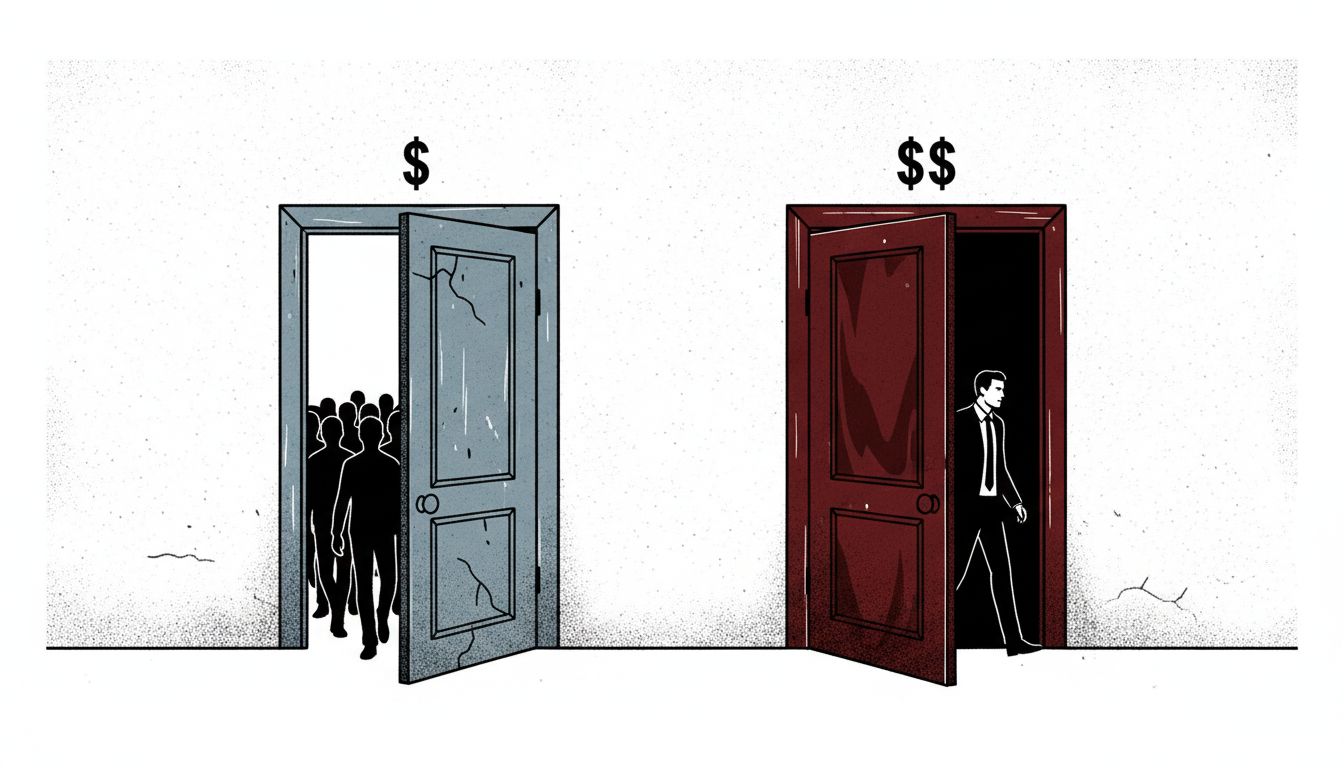
A few years ago, a product manager at a large software company was tasked with responding to a competitive threat. The upstart competitor wasn’t winning on features. They weren’t cheaper. Their technology wasn’t meaningfully better. The competitor was winning because their pricing model was structured in a way that the incumbent’s finance team couldn’t approve without rewriting their entire revenue recognition process. So the incumbent did nothing. The startup kept growing. That is the whole story of obscure business models in one paragraph.
The Real Moat Is Organizational Incompatibility
When founders talk about moats, they reach for the usual suspects: network effects, proprietary data, switching costs. These are real, but they’re also well-understood. Every serious competitor knows how to think about them, which means they know how to attack them.
The underappreciated moat is something different. It’s a business model so structurally strange, so alien to the way established players are organized, that copying it would require those players to break themselves apart and reassemble. Not because they lack the talent or capital, but because every large organization is a frozen set of past decisions. Finance teams have reporting structures built for subscription revenue or transaction fees. Sales teams are compensated in ways that make certain deal structures impossible to pitch internally. Legal teams will flag any arrangement that doesn’t match a template they recognize.
The startup that builds its core around something none of those templates accommodate has found genuine protection, not from intellectual property law but from organizational physics.
Costco Figured This Out in 1983
The clearest non-tech illustration of this principle is Costco. Their core revenue isn’t product sales. Costco makes most of its profit from membership fees, and it sells goods at near-zero margins, sometimes below cost on certain items. This sounds insane until you understand what it does competitively: it makes Costco almost impossible for a traditional retailer to replicate.
A traditional retailer looking at Costco can’t just copy the model. Their entire organization, their buyer incentives, their vendor relationships, their real estate strategy, their investor expectations, all of it is built around margin on goods sold. Switching to a membership-first model would require dismantling and rebuilding the company from the financial statements outward. It’s not technically difficult. It’s organizationally catastrophic. So nobody does it.
Amazon has done variations of this repeatedly. The Kindle hardware was sold below cost because the product was never the product. Selling hardware at a loss to lock in content purchases was so structurally backwards from how consumer electronics companies operated that it took years for competitors to even accept that it was the actual strategy.

The Counterintuitive Pricing Trap
Pricing is where this gets most interesting, because pricing is the thing competitors study hardest. If you’re cheap, they undercut you. If you’re premium, they match your positioning. But there’s a category of pricing that competitors observe and genuinely cannot decide whether it’s a mistake.
Consider Basecamp. For years, they charged a flat monthly fee regardless of the number of users. Every competitor in project management charged per seat. Per-seat pricing is logical, scalable, and defensible to any finance team. Flat pricing looked, to a competitor’s VP of Revenue, like money left on the table. The problem with copying it is that per-seat models are deeply embedded in how SaaS companies forecast, report, and are valued by investors. Moving to flat pricing isn’t a pricing change. It’s a business model change with downstream effects on everything from sales quotas to ARR calculations.
Basecamp’s model attracted a specific customer segment: companies that hated the anxiety of per-seat billing, that wanted predictable costs regardless of growth, that had been burned by SaaS bills that ballooned as they hired. That segment was genuinely underserved precisely because the model required made every normal SaaS growth metric look worse.
How Obscurity Gets Built Into Operations, Not Just Pricing
The most durable versions of this aren’t just pricing quirks. They’re operational structures that create the pricing inevitability.
Stripe’s original differentiation wasn’t price. Their API pricing was comparable to alternatives. The moat was that they’d made payment integration something a developer could do in an afternoon without calling a sales rep. The sales-free, developer-first go-to-market was the weird business model, not the percentage points on transactions. Established payment processors had entire relationship-management departments, enterprise sales teams, lengthy integration processes. That infrastructure was profit-generating and also completely incompatible with what Stripe was doing. You cannot have a developer-first, self-serve model when you employ armies of enterprise sales people whose compensation depends on managed accounts.
Stripe’s competitors weren’t oblivious. They understood what Stripe was doing. They just couldn’t undo their own organizations fast enough, because the organizations that needed to be undone were profitable.
This is the key insight: the best obscure business models aren’t obscure because they’re hidden. They’re obscure because they only make sense if you’re willing to destroy a revenue stream that’s currently working.
The Danger of Becoming Legible
Here’s the uncomfortable flip side. Obscure business models stop being obscure when they become successful enough. Success creates legibility. Legibility creates competition.
Once Stripe’s model proved itself at scale, a new generation of payment infrastructure companies emerged that built developer-first from day one, with no legacy enterprise sales teams to protect. The model had become the template.
This means the obscure business model buys time, not permanent safety. The question is what you build with that time. Stripe used the runway to establish the developer relationships, the geographic coverage, and the product depth that made switching costs real. The model got you in the door; the product kept you there.
Founders who rely on model obscurity alone, without building the subsequent advantages, tend to find themselves explaining to investors why they’re losing to someone who figured out the same model two years later with better execution.
What Makes a Model Genuinely Hard to Copy
Not all counterintuitive models are equally defensible. There’s a difference between a pricing structure that’s weird and a business model that’s structurally incompatible with how competitors are organized.
The checklist worth running: does copying this model require a competitor to hurt a currently profitable business unit? Does it require their finance team to accept metrics that look worse in the short term? Does it require dismantling a compensation structure that their sales team depends on? Does it require their investors to accept a different growth narrative?
If the answer to most of those is yes, you have something worth building around. If the model is just unfamiliar but a well-capitalized competitor could copy it without internal trauma, it’s a head start, not a moat.
The goal is to find the intersection of genuinely better for your customers and genuinely disruptive to your competitors’ internal politics. That intersection is narrower than founders want it to be, which is exactly why it’s valuable when you find it.
What This Means in Practice
If you’re building something, the exercise worth doing isn’t just asking whether your product is better. It’s asking whether the way you make money from your product is something a competitor’s CFO could approve at a board meeting without rebuilding how they report revenue.
The most durable startups aren’t the ones with the best technology. They’re often the ones where the business model itself was the invention. The technology was the vehicle; the model was the thing that mattered.
And the model only has to stay weird long enough for you to build everything else that makes the weirdness unnecessary to explain.