Picture this: a well-funded tech company with hundreds of engineers, seasoned executives, and reams of market research rolls out a product that nobody asked for, prices it poorly, and watches it quietly die within eighteen months. Then the postmortem blog post goes up, full of phrases like “we learned a lot” and “this informed our future direction.” Everyone nods. The team moves on. And somehow, two years later, the company is stronger than before.
This is not incompetence. It is a playbook. And once you see it, you cannot unsee it. Tech companies launch products they know will fail on purpose, and the logic behind it is more coherent than most people want to admit.
The Failure That Was Never Really a Failure
Let me give you a concrete example. Google has launched and killed dozens of products: Google Wave, Google Glass (consumer version), Google+, Stadia, and a graveyard’s worth of messaging apps. Each one looked, from the outside, like a catastrophic misjudgment. Analysts wrote the obituaries. Tech journalists dunked on them with glee.
But look at what came out the other side. Google Docs came partly from lessons learned in Wave’s real-time collaboration experiments. Material Design was stress-tested across failed products before it became the standard. Google’s understanding of social graphs, even after Google+ collapsed, shaped how it thinks about identity and authentication across all its products.
The failures were expensive. They were also deliberate reconnaissance.

What Companies Actually Learn From Killing Products
Here is the thing that traditional business school thinking gets wrong: it treats product failure as waste. The startup world has gradually figured out that failure, under the right conditions, generates a specific kind of intelligence that success cannot.
When a product fails in the market, companies learn three things they could not have learned any other way.
First, they learn where the real friction is. No amount of user research, surveys, or focus groups replicates what happens when actual humans try to use something they actually paid for (or chose not to pay for). The behavior gap between what people say they want and what they actually do is enormous, and you only close that gap by shipping.
Second, they learn which competitors respond and how. Launching a product, even a bad one, flushes out the competitive landscape in ways that internal strategy sessions never can. You find out who is scared of you, who ignores you, and who copies you badly.
Third, they learn what their own organization is capable of. A failed launch is a stress test of internal systems: engineering velocity, sales alignment, support capacity, marketing coordination. The dysfunction that surfaces during a failing product launch is dysfunction that would have eventually torpedoed a successful one.
This is not so different from how tech companies build features they never release and the reason is more strategic than you think. The artifact matters less than the organizational and competitive intelligence gathered in the process of building or launching it.
The Capital Allocation Angle That Nobody Talks About
There is a financial dimension to deliberate failure that gets almost no coverage, and it is surprisingly rational.
For large tech companies, a failed product launch is often a more efficient use of capital than the alternatives. Consider what a company gains from spending, say, fifty million dollars on a product that fails in eighteen months versus spending that same money on acquisitions, advertising, or internal research.
An acquisition comes with integration risk, culture conflict, and golden handcuffs. Advertising produces returns that evaporate the moment you stop spending. Internal research produces papers and patents that may never connect to customer reality.
A product launch, even a doomed one, produces engineers who have shipped under pressure, a brand signal to the market about where the company is looking, a set of real customer interactions, and organizational scar tissue that makes the next launch cheaper and faster.
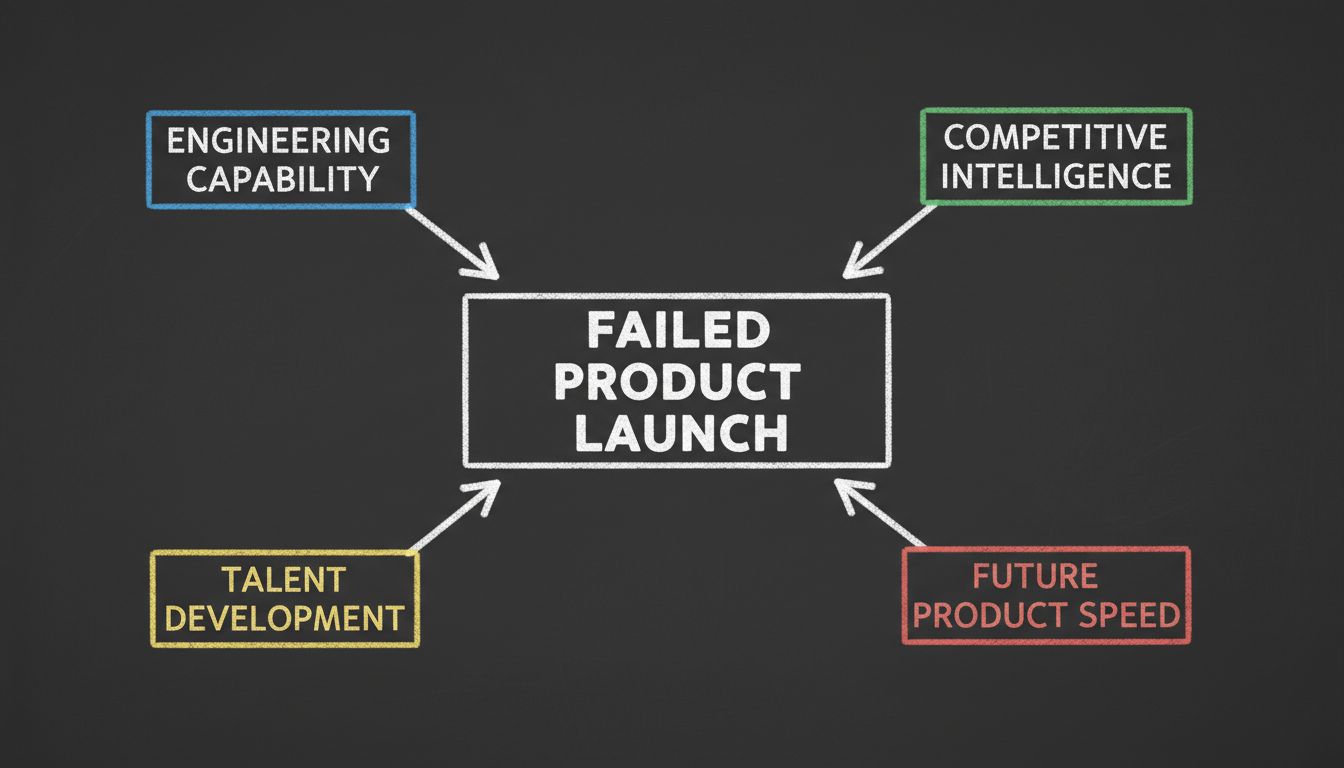
This connects directly to the broader pattern of tech giants losing money on purpose to win markets. The math looks terrible in the short term. Over a five-to-ten year horizon, it often does not.
The Talent Strategy Hidden Inside Every Bad Launch
Here is the angle that almost nobody talks about publicly but that every serious operator understands: product launches, including the ones expected to fail, are talent development and talent retention tools.
The engineers, designers, and product managers who work on a new product initiative are getting something that cannot be manufactured in any other way. They are getting ownership. They are getting the experience of building something from zero. They are getting resume lines that read “launched” rather than “contributed to.”
For a company trying to hold onto its best people against the gravitational pull of startups, being able to say “you can work on something new here” is worth more than almost any compensation adjustment. The failed product was, among other things, a retention mechanism.
This is why the smartest companies do not just tolerate these launches. They design them. They pick the right scope, the right team size, and the right level of internal visibility to maximize what gets learned without catastrophically burning anyone out. There is a reason elite software teams use specific strategies to ship faster: they have been through enough launches, good and bad, to know what discipline looks like under real conditions.
When This Strategy Becomes an Excuse for Dysfunction
I want to be honest here, because this whole framework can be weaponized to justify genuinely bad decision-making.
There is a meaningful difference between a company that launches a product with clear hypotheses it is trying to validate, honest internal acknowledgment that success is uncertain, and a real plan for extracting learning when it ends, versus a company that greenlights bad ideas because nobody wants to say no, then retrofits a “strategic learning” narrative after the fact.
The first is sophisticated. The second is the same failure mode that kills most digital transformation projects: solving the wrong problem while telling yourself you are being strategic.
The tells are usually obvious in hindsight. Intentionally educational failures tend to be scoped tightly, staffed leanly, and killed quickly once the signal is clear. Accidental failures dressed up as strategy tend to run long, consume enormous resources, and generate postmortems full of vague lessons that never actually change anything.
What This Means If You Are Building Something
If you are a founder or a product leader, the takeaway here is not “launch things carelessly and call it learning.” The takeaway is narrower and more useful: define what you are trying to learn before you launch, set a timeline for when you will stop and evaluate, and build the organizational infrastructure to actually extract value from what you find out.
Failure without a learning structure is just waste. Failure with a real hypothesis and an honest postmortem is competitive advantage, compounding over time, one dead product at a time.