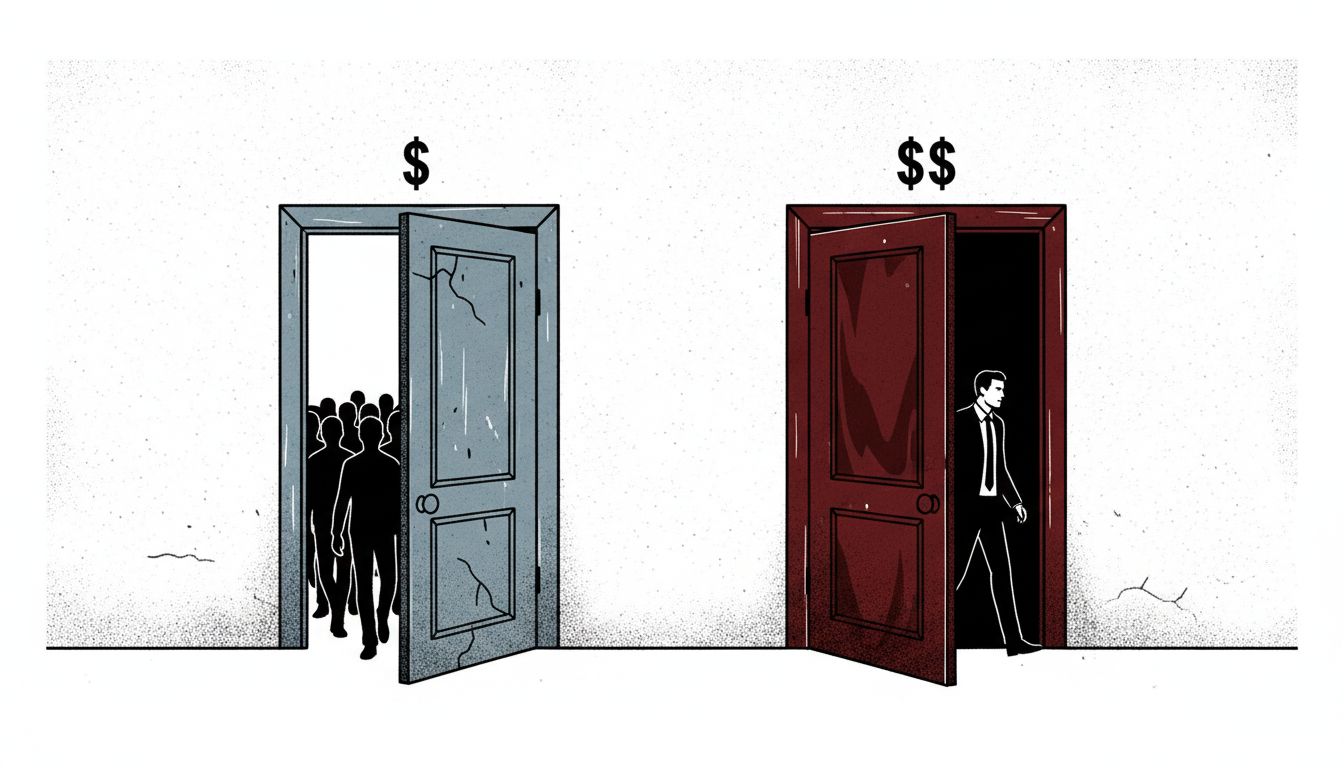
Picture this: a team of thirty engineers spends eighteen months building a product. The launch event is polished. The press release is optimistic. And somewhere in a conference room three floors up, the people who approved the budget already know it isn’t going to work. Not because they’re incompetent. Because they planned it that way.
This isn’t cynicism. It’s one of the most misunderstood strategic moves in the tech industry, and once you see it, you can’t unsee it. Successful startups ignore trending markets on purpose, and the same counterintuitive logic applies here: the companies that look like they’re failing on purpose are often the ones playing the longest game.
The Real Cost of Not Knowing
Here’s the problem that nobody talks about honestly. You can run focus groups. You can build prototypes. You can survey your existing users until your survey platform sends you a bill that makes you wince. None of it tells you what actually happens when a real product hits a real market with real money and real friction involved.
The gap between what people say they’ll do and what they actually do is enormous. It’s not that users lie. It’s that they genuinely don’t know how they’ll behave until they’re in the moment. And the only way to find out is to put something in front of them and watch.
This is why you’ll occasionally see a large company ship something that feels half-finished, gets mediocre adoption, and quietly disappears within a year. The obituaries write themselves: poor execution, wrong timing, bad product-market fit. What those obituaries miss is that the company walked away with something more valuable than a successful product. They walked away with a map.
What the Map Actually Shows
When a product fails, it generates data that no amount of pre-launch research can replicate. You learn which users showed up at all. You learn where they dropped off. You learn what they were actually trying to accomplish versus what you assumed they were trying to accomplish. You learn which competitors they mentioned when they left. You learn what price point made them hesitate.
This is signal. Expensive signal, yes. But signal that companies then fold into their next product, their next feature, their next pricing model.
There’s a related principle at work in how tech companies test new features on millions of real users without telling anyone. The engineering behind A/B testing at scale exists precisely because the alternative, which is guessing, costs more in the long run. Intentional product failures work on the same logic, just at a larger unit of analysis.
The company isn’t launching a product. It’s running an experiment. The experiment is expensive. The alternative, which is staying ignorant, is more expensive.
The Talent Acquisition Angle Nobody Mentions
Here’s one that will make you rethink some acquisitions you’ve watched from the sidelines.
Sometimes a company launches a product that was never really about the product. It was about building the team that could build the product. The launch is the proof of work. A credible product in market, even one that underperforms commercially, signals to the engineering and design community that this company can ship. It attracts talent. It gives recruiters something concrete to point at.
There’s also the acqui-hire angle. A product that fails gracefully but demonstrates genuine technical sophistication is a calling card. It says: we know how to build things. We just need more resources, or a different distribution channel, or a parent company with an existing user base. The failure becomes the pitch deck.
This connects to something worth understanding about tech founders who pay themselves a dollar. The public-facing move and the strategic reality are often completely different things. What looks like sacrifice or failure from the outside is frequently a calculated position.
The Competitive Positioning Play
This one is a little darker, and it’s real.
Sometimes companies launch products specifically to occupy space in a market they don’t actually want to compete in yet, but don’t want a competitor to dominate. You ship something minimal, maybe something you internally know is underpowered. It creates just enough noise to slow down a competitor’s fundraising, or to muddy their category narrative, or to give enterprise buyers a reason to pause before signing a three-year contract with someone else.
You’re not trying to win that market. You’re trying to make it harder for someone else to win it cleanly while you build the thing you actually want to launch.
This is aggressive and not every company has the resources to do it. But the ones that do understand something fundamental: markets are easier to enter when your competitors have been fighting each other for two years and neither one has achieved the kind of dominant position that makes a new entrant look foolish.
The Honest Internal Conversation
What makes all of this work, when it works, is that someone in the room is being honest about what success actually looks like for a given launch.
Not every product launch needs to become a revenue line. Some launches are research. Some are recruiting. Some are competitive positioning. Some are learning exercises that will eventually inform the product that does become a revenue line. The problem is that most companies don’t have that conversation explicitly. They ship a product with vague optimism, it underperforms, and everyone is quietly embarrassed rather than actively mining what happened for data.
The companies that use intentional failure well are the ones where leadership is clear-eyed about the goal before the first line of code gets written. They define what they’re trying to learn. They instrument the product specifically to capture that learning. And when the product doesn’t achieve commercial success, they have the discipline to call that a win if the learning targets were hit.
That’s a different culture than most startups have, and building it requires the kind of deliberate strategic thinking that most founders only develop after their first expensive mistake.
The Part That Actually Requires Courage
None of this is easy to execute. Telling your team that you’re building something partly as a learning exercise requires a level of organizational honesty that makes most people uncomfortable. Engineers want to build things that matter. Designers want to build things people use. Telling them the product is an expensive experiment feels like a morale problem.
The companies that navigate this well find ways to make the learning goal feel as meaningful as the commercial goal, because in a well-run organization, it genuinely is. What you learn from a calculated failure can shape the next five years of product development.
The next time you watch a tech company ship something that seems obviously underpowered, or launches in a market they seem weirdly unprepared for, slow down before writing the postmortem. Ask what they might have been trying to learn. Ask what competitor they might have been watching. Ask what team they were trying to build.
The answer won’t always be strategic genius. Sometimes a bad product is just a bad product. But sometimes the failure was the point all along.