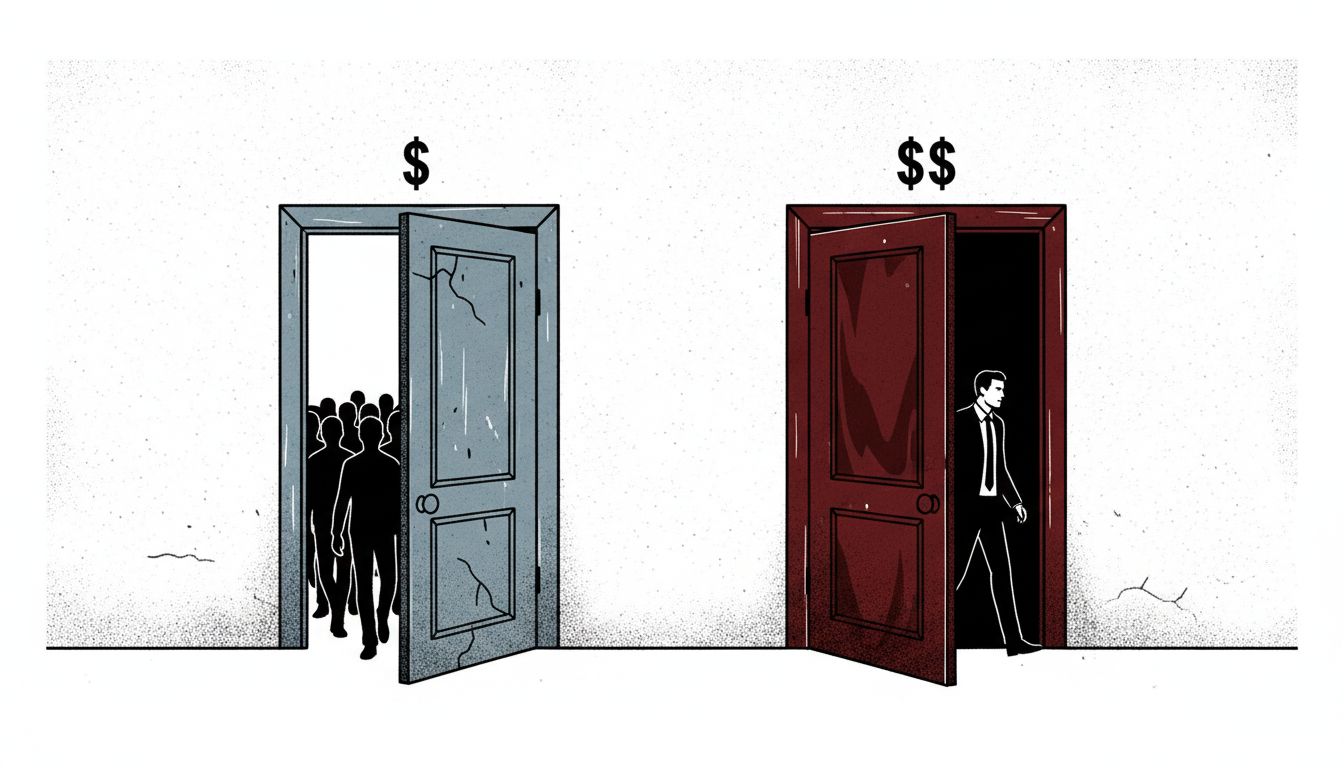

I was in a product review meeting once where the VP of Product stood up, clicked through a slide deck for a new consumer app, and then said something that stopped the room cold: “We know this probably won’t make money. That’s not why we’re building it.” Nobody flinched. Not the engineers, not the designers, not the finance guy in the corner. Everyone nodded. Because everyone in that room already knew the real reason the product existed, and it had nothing to do with the product itself.
This is the part of startup strategy that almost never gets written about honestly. We celebrate launches, eulogize failures, and hand out post-mortems like consolation prizes. But we rarely talk about the products that were designed to fail from the beginning as a feature, not a bug. Once you see this pattern, you cannot unsee it.
The Market Reconnaissance Play
Here is the most common version of the intentional failure: a company launches a product not to win a market, but to read it.
Think about how expensive real market data is. You can run focus groups. You can survey users. You can hire consultants to build you a 90-page deck full of TAM projections. Or you can ship something lightweight, point real customers at it, and watch what actually happens. The second approach is almost always cheaper and almost always more accurate.
Google has done this dozens of times. Amazon does it constantly. Even smaller startups do it, though they rarely admit it publicly. You launch a minimum-viable version of a product into a space you are curious about, not to capture that space, but to gather intelligence about it. Which users show up? What do they actually use? What do they complain about? What do they tolerate?
This is why tech companies test new features on millions of real users without telling anyone. The real product being built is often not the one users think they are testing. The data is the product.
Competitive Disruption as the Actual Goal
Sometimes a product is launched not to succeed, but to bleed a competitor.
This sounds cutthroat, and it is, but the logic is straightforward. If your biggest competitor is about to dominate a new category, you have a few options. You can try to out-build them. You can try to acquire them. Or you can launch a competing product that forces them to split their attention, slow their roadmap, and spend capital defending territory instead of expanding it.
Your product does not have to win. It just has to make winning expensive for them.
Microsoft did this repeatedly in the 1990s and 2000s. So did Google with social networking. The products were not failures in the traditional sense because they were never really supposed to succeed on their own terms. They were deployed as resources in a larger competitive battle, the same way you would use a chess piece you are willing to sacrifice to open up the board.
The internal metrics for these products are almost never public-facing ones like revenue or active users. They are things like “competitor’s engineering headcount shifted to this problem” or “competitor delayed their Q3 launch by two quarters.” You will never see those numbers in a press release.
Patent Portfolios and Platform Signaling
There is a quieter version of this strategy that does not require a competitor at all.
Launching a product, even a doomed one, establishes prior art. It stakes a claim. It generates IP. In patent-heavy industries, shipping something, anything, even something that barely works, can be worth millions of dollars in defensive legal value years down the road. The product is not the point. The legal timestamp is the point.
Related to this is platform signaling. When a company launches into a new category, even unsuccessfully, it sends a message to the market: we are watching this space. That signal is enough to make some smaller competitors nervous. It is enough to make some acqui-hire targets suddenly more interested in a conversation. It is enough to make enterprise customers feel comfortable betting on your roadmap, because they believe you are serious about a direction even if the first attempt did not land.
The Talent and Culture Argument
This one is underappreciated. Ambitious engineers do not want to work on mature, stable products forever. They want to build new things. They want hard problems.
Launching a product that is likely to fail, as long as it is technically interesting, is one of the best recruiting and retention tools a company can deploy. It signals that the organization still has a startup metabolism even as it grows. It gives senior engineers something to chew on. It keeps teams sharp.
This connects to something I think about a lot: the best tech leaders succeed by knowing less than you think, partly because they trust teams to make real decisions on real problems. Giving engineers a greenfield project, even a strategically sacrificial one, is one of the fastest ways to find out who your best operators actually are. Failure in a controlled environment is a stress test with a safety net.
The companies that understand this tend to institutionalize it. They build internal labs, skunkworks teams, and “innovation sprints” that are, if you squint, just structured programs for launching products that might fail, on purpose, for strategic reasons.
What This Means If You Are Building Something
If you are at a startup or inside a bigger company trying to make sense of why a product exists, it is worth asking some blunt questions before assuming the organization is just being dumb.
Who benefits if this fails gracefully? What data gets collected during this launch that could not be collected any other way? What signal does this send to the market, to competitors, to potential hires? What IP gets created even if the product gets shelved?
Not every failed product is a strategic masterstroke. Most of them are just failures, born from bad assumptions, missed markets, or plain old poor execution. Software always takes longer than estimated because engineers are often solving the wrong problem from the start, and plenty of products collapse under the weight of that reality with no deeper strategy involved.
But the ones that feel inexplicably well-funded despite obvious market indifference, the ones that get launched with real engineering effort and then quietly shelved without much drama, those are worth a second look. Someone in that room knew something the press release was not going to say.
The VP of Product in that meeting I mentioned? That app she described did get launched. It lasted about fourteen months. It had maybe thirty thousand users at peak. By conventional metrics, it was a complete failure.
Two years later, the company used data from that app to build a feature set that became their most profitable product line. The failure was the R&D budget in disguise.
That is the version of startup strategy they do not teach in business school, because it requires admitting that you planned to fail. And nobody wants to put that in a slide deck.