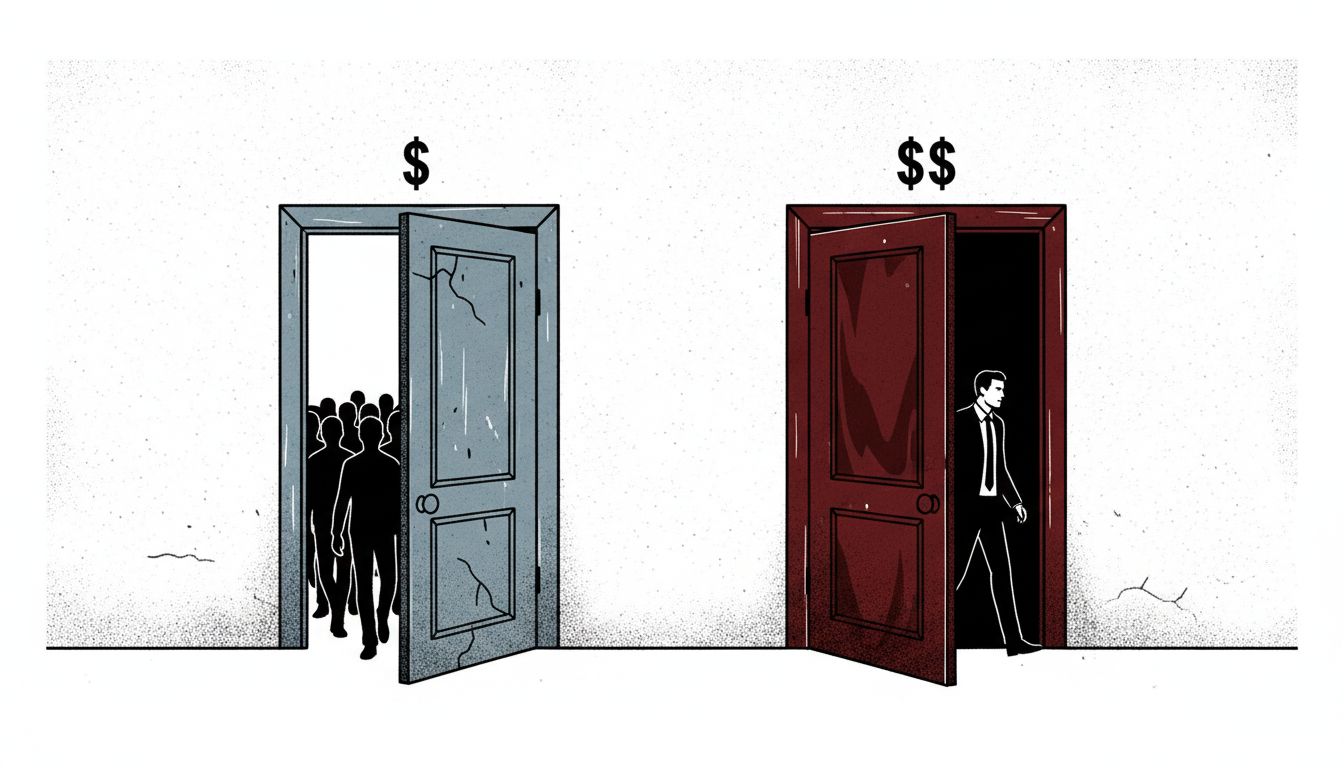
Picture this: you’re sitting in a product strategy meeting at a mid-sized tech company. The VP of Product slides a deck across the table. The roadmap includes a new consumer app, one that three people in the room privately believe has maybe a 10% chance of surviving its first year. Nobody says this out loud. The launch date gets circled. The press release gets drafted. And six months later, the product dies quietly, right on schedule, as if the whole thing was planned that way.
It was.
Tech companies launch products they know will fail, and the strategy is coldly rational. What looks like corporate incompetence from the outside is often a deliberate, calculated move from the inside. The question is: why would any rational organization knowingly ship something destined for the graveyard? The answer is more interesting than you’d expect, and understanding it will change how you read every product announcement from here on out.
The Real Product Is the Data, Not the Thing
Here’s the core of it. When a tech company launches a product, the thing they’re selling to consumers is often not the thing they actually care about. The actual deliverable is information. Market intelligence. Behavioral data. Real-world signal that no focus group or internal brainstorm can manufacture.
Think about how many times a major platform has launched a feature, watched it flatline, and then quietly applied what it learned to a completely different part of the business. The failed feature wasn’t a mistake. It was a probe. A controlled experiment run at scale, on real users, with real money on the line.
Tech companies test new features on millions of real users without telling anyone, and the engineering behind it is genuinely sophisticated. A/B tests, gradual rollouts, dark launches. The infrastructure for deliberate experimentation is deeply baked into how modern tech products are built. A product launch is just a large-scale version of the same instinct: ship something, watch what happens, extract the lesson.
Google has done this for decades. Google Wave, Google+, Google Glass, Stadia. Each one was pronounced a failure. Each one generated enormous amounts of data about user behavior, market readiness, and infrastructure limitations. The lessons from Stadia quietly informed Google’s cloud infrastructure strategy. The lessons from Google+ shaped how they think about identity and social graphs. None of that shows up in the obituaries.
Killing a Product Can Be the Point
There’s a second, less obvious reason companies ship things they know won’t survive: competitive misdirection.
When a well-resourced company enters a market, even with a mediocre product, it forces competitors to react. They divert engineering resources. They rush roadmap changes. They second-guess their positioning. A product launch from a big player is a strategic move on a competitive chessboard, regardless of whether that product ever achieves meaningful adoption.
This is why startups deliberately choose expensive solutions when cheaper ones exist. The choice signals something. It shapes perception. It forces other players to respond. A product launch, even a doomed one, does the same thing at a larger scale.
Amazon has been particularly ruthless about this. Amazon Destinations. Amazon Local. Amazon Spark. Products that came and went so fast most people never knew they existed. But each one staked out territory, made competitors nervous, and quietly fed internal learnings back into the mothership. The competitive pressure alone justified the expense.
The Internal Politics Nobody Talks About
Let’s be honest about something the strategy articles usually skip: internal politics is a massive driver of this behavior.
Product teams need launches to justify headcount. Executives need proof points for their next board presentation. Engineers need portfolio pieces. A product that launches and fails publicly still accomplished something inside the organization. It gave people a thing to ship, a metric to report, a narrative to tell.
Software bugs multiply when teams grow because of a communication problem, not a coding problem, and the same dynamic applies to product strategy. As organizations scale, the distance between the people who make decisions and the people who execute them grows. Products get launched partly because the machinery of a large organization needs to keep moving, and stopping is more disruptive than shipping something imperfect.
This isn’t cynicism. It’s organizational physics. If you’ve ever worked inside a company with more than a few hundred people, you’ve felt this. The momentum of a product in motion is hard to stop, even when everyone privately knows the numbers don’t work.
What Separates Strategic Failure From Accidental Failure
Here’s where it gets important. Not all product failures are created equal. There’s a massive difference between a company that ships a product knowing it probably won’t work but extracts maximum learning from the experience, and a company that ships a product, watches it fail, and learns nothing.
The former is a strategy. The latter is just waste.
The companies that do this well build failure into the architecture of the project from day one. They define success metrics that go beyond revenue. They identify the specific hypotheses the launch is meant to test. They create explicit review processes to extract and document learnings before the product is shut down. They treat the post-mortem as the actual deliverable.
Tech companies deliberately launch broken features and fix them later, and the best ones do it with a clear framework for what they’re learning and why. The broken launch is a draft. The real version comes later, informed by what real users actually did.
The companies that do this badly just launch, fail, and move on without capturing anything. The product dies and takes its lessons with it. That’s not strategy. That’s expensive confusion dressed up as boldness.
What This Means If You’re Building Something
If you’re a founder or a product leader, the practical takeaway here isn’t to go out and deliberately ship something bad. It’s to recognize that the binary of success and failure is almost always too simple.
Before you launch anything, ask yourself what you’re actually trying to learn. Define it explicitly. Write it down. Then, when the product doesn’t perform the way the original pitch deck suggested, you’re not just staring at a failure. You’re looking at data. Possibly very valuable data.
Successful founders use strategic ignorance to avoid analysis paralysis. They move before they’re certain because certainty is a fantasy. But the smart ones move with a clear sense of what they’ll learn from moving, win or lose. That’s the difference between courage and recklessness.
The tech companies that seem to fail constantly and still win over the long run aren’t lucky. They’ve built a machine for converting failure into signal. Every dead product feeds the next living one. The graveyard isn’t a monument to incompetence. It’s the research budget.