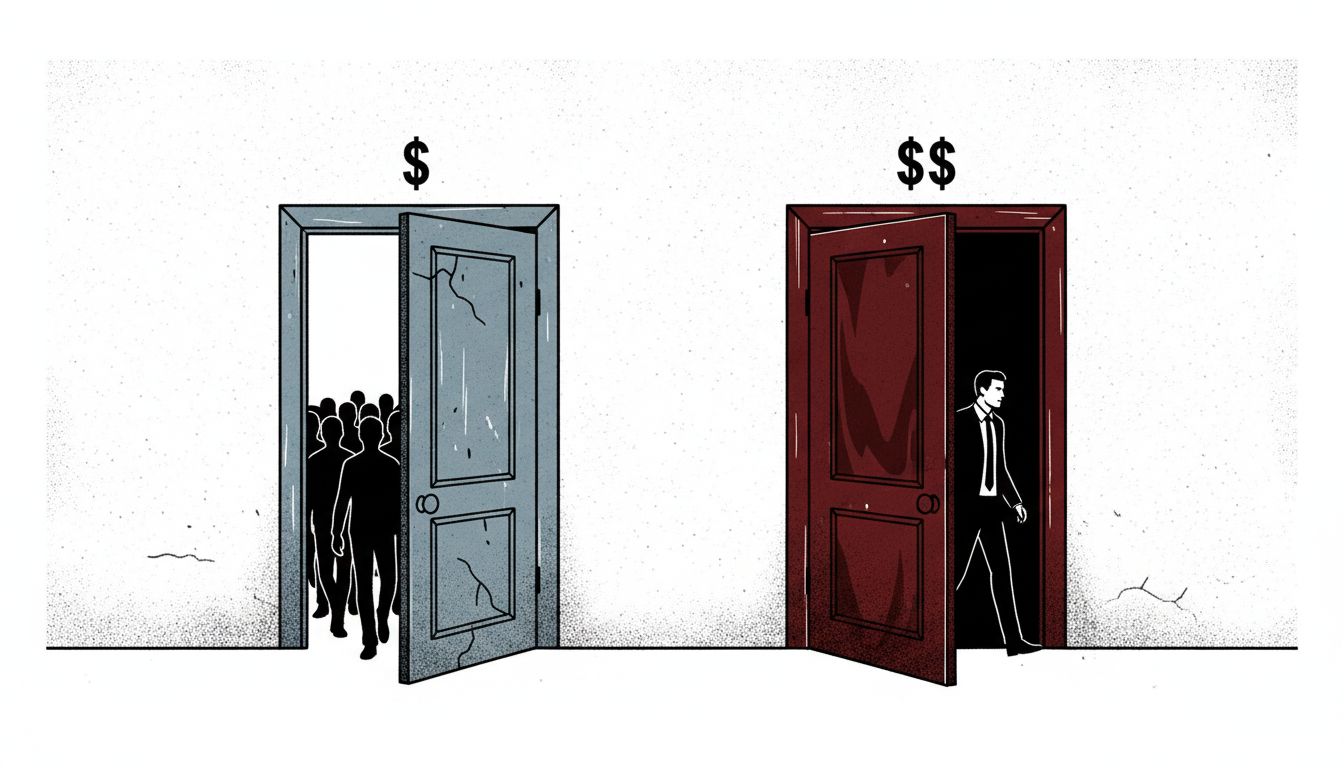

Picture a product launch. Big stage, bright lights, a CEO talking about changing the world. The product ships, gets middling reviews, limps along for eighteen months, and quietly disappears. Everyone inside the company knew it would happen. Some of them knew it before the keynote was written. And here’s the thing: that failure was the plan.
This isn’t a cynical take or a conspiracy theory. It’s a strategic reality that most coverage of the tech industry completely misses. When you understand why companies deliberately launch products they expect to fail, a lot of behavior that looks irrational suddenly makes perfect sense. As we’ve covered before, tech companies launch products they know will fail on purpose, and the strategy is coldly rational. But the deeper question is: what are they actually buying with that failure?
The Market Occupation Play
Here’s the first and most important reason: occupying a market category costs less than ceding it.
If a competitor is gaining traction in a space you care about, the instinct is to build a competing product and ship it fast. That product might not be good. It might not even be close to good. But its job is not to win customers. Its job is to exist.
A product that exists forces your competitor to spend marketing budget explaining why their thing is better than yours. It creates confusion in the minds of enterprise buyers who now have to run a procurement process. It gives your sales team something to point to during deals: “We have a solution in that space.” The product is a placeholder, a flag in the ground, and the flag doesn’t need to be pretty.
Google has done this repeatedly. Microsoft has built entire product lines around this logic. You ship something mediocre into a category that a smaller, nimbler competitor is trying to own, and suddenly that competitor is fighting on two fronts: building a real product and winning a perception battle against a company with ten times the distribution.
The Intelligence Harvest
The second reason is information, and it’s more valuable than most people realize.
When you launch a product, even a bad one, you learn things you cannot learn any other way. You find out who actually buys, what words they use to describe their problem, what features they complain about, and how much they’re willing to pay before they stop complaining and just leave. A failed product is a funded research operation.
This connects to something counterintuitive about the best startups. We’ve written about how the most valuable startups solve problems that don’t exist yet, and the only way to know what problems are emerging is to ship things into the market and watch what happens. A deliberately limited launch in a new category is not a commitment to that category. It’s a sensor.
Amazon has been explicit about this philosophy. The ratio of failed products to successful ones in their history is remarkable, and it’s not because they’re bad at shipping. It’s because they’re extraordinarily good at learning from what doesn’t work. The Fire Phone was a disaster by every conventional metric. It was also a masterclass in what consumers don’t want from a smartphone, and some of that learning ended up in products that did work.
The Competitor Drain
There’s a third move that’s less talked about and, honestly, a little ruthless.
Launching a product into a space where a competitor is raising money forces that competitor to respond. They have to ship faster than they want to. They have to spend investor capital defending their position instead of expanding it. They have to write blog posts and give interviews explaining how they’re different from the big company that just entered their market, which is time and energy not spent on building.
This is the tech industry equivalent of forcing a chess opponent to play defensively. You don’t necessarily need your piece to do anything brilliant. You just need it to be on the board in a threatening position. Tech giants lose money on purpose to own entire industries, and the math is ruthless, and this is one of the mechanisms that makes that math work. A product that costs you fifty million dollars to build and maintain, but costs your competitor two hundred million in fundraising and distracted execution, is a product with a positive return on investment.
The Talent and Patent Wrapper
Failing products often come wrapped in two assets that outlast the product itself.
First, talent. Building something, even something that doesn’t work, requires hiring people who know how to build things. Those people stay at the company after the product is shuttered. The team that built a failed enterprise collaboration tool now understands enterprise collaboration deeply. They become the foundation for the next attempt, or the next adjacent product.
Second, patents. The work done during a product’s development generates intellectual property that can be used offensively or defensively for years. The most valuable tech patents protect ideas that sound completely obvious, and a lot of those obvious-sounding ideas get documented during development cycles that lead nowhere commercially.
What This Means If You’re Building Something
If you’re a founder or a product leader, this should recalibrate how you think about competition.
When a large company enters your space with something that looks half-baked, don’t dismiss it because the product is bad. Ask what they’re actually trying to accomplish. They might be trying to drain your fundraising momentum. They might be building a talent pool. They might be running a market intelligence operation at your expense.
The correct response is usually not to panic and over-invest in differentiation marketing. The correct response is to move faster toward the customers who are already committed to you, deepen those relationships, and make your core product so good that the big company’s sensor reads “this market is owned” and moves on.
And if you’re thinking about deliberately launching a scoped product into a new category yourself, be honest about what success looks like. Define the intelligence you’re trying to gather before you ship. Set a real kill date. Otherwise you end up with a zombie product that drains resources and morale without delivering the strategic returns that made it worth building in the first place.
Failing on purpose only works when you’re honest about the fact that failure is the plan.