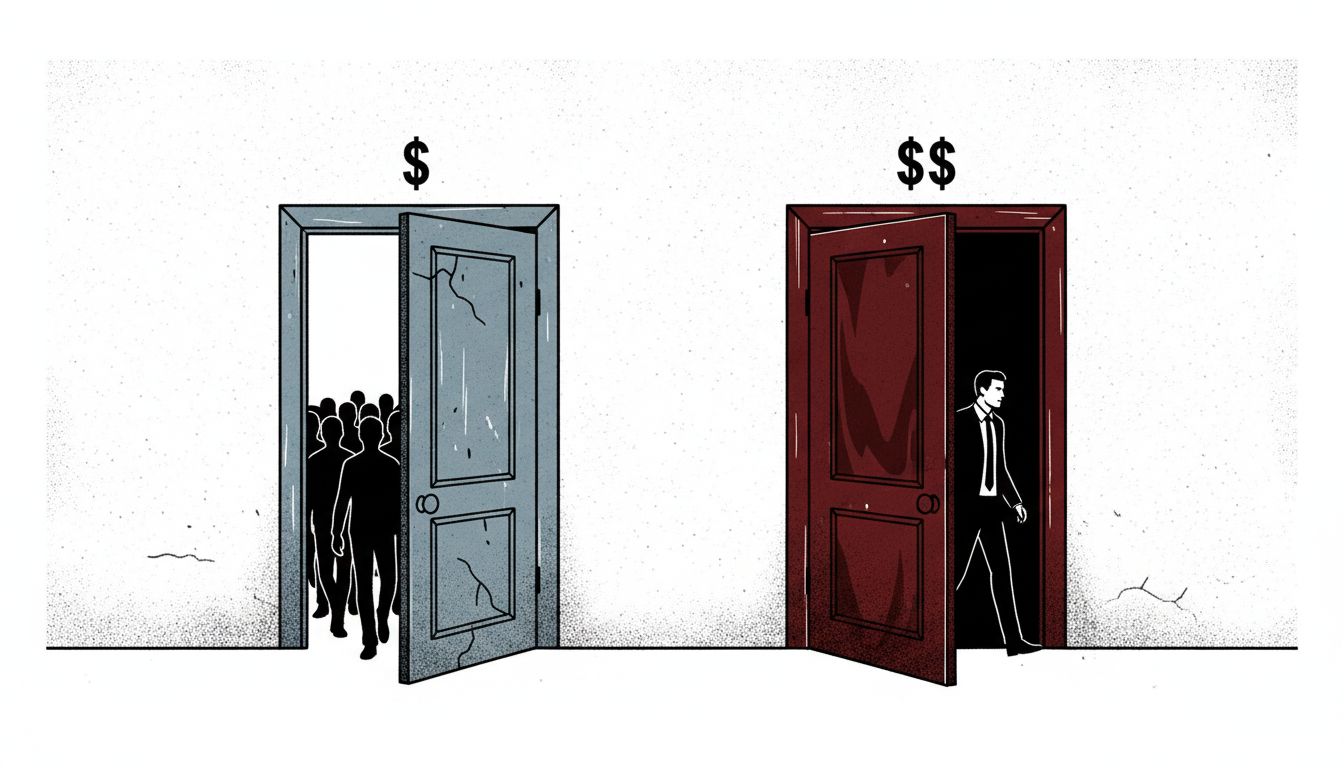

I was in a product review once where a director walked in with a slide deck for a new consumer app. The market research was thin, the differentiation was nonexistent, and three of the six people in the room had previously built nearly identical things that had died quietly. Nobody said any of this out loud. The launch was approved. Eighteen months later, the app was gone.
What I didn’t understand at the time, and what took me years to really internalize, is that the director probably knew. Not knew-and-didn’t-care, but knew-and-launched-anyway, because the failure was doing something useful.
Tech companies are not bad at predicting failure. They are very good at extracting value from it. Here are the real reasons they keep pulling the trigger anyway.
1. The Product Is a Probe, Not a Bet
When Google launches something into the market and kills it two years later, the obituary narrative is always about hubris or distraction. That framing misses the point. The launch was a structured information-gathering exercise with a fixed budget and a clear expiration date.
You learn things from a live product that you cannot learn any other way. You learn what users will actually pay for versus what they say they want in a focus group. You learn which competitors respond and how fast. You learn where your internal teams hit walls. A failed product that cost five million dollars and ran for eighteen months can generate strategic intelligence that would have cost ten times that to buy through consulting engagements, and it still wouldn’t be as clean.
This is distinct from “failing fast,” which has become a mantra so overused it’s lost all meaning. The companies doing this well aren’t celebrating failure. They’re treating launches the way a researcher treats a controlled experiment: the null result is still a result.

2. It Keeps Competitors Busy Responding to the Wrong Thing
A launch, even a doomed one, commands attention. Competitors staff up response teams. They accelerate their own roadmaps. They write blog posts. They brief analysts. They sometimes pivot whole products to address the perceived threat.
While they’re doing all of that, the company that launched the decoy has moved on to the thing that actually matters. Amazon has done this repeatedly in retail and logistics, announcing initiatives that appear to be the main event but function more as misdirection. The competitor who chases the announced thing arrives to find the real competition already happened somewhere else.
This isn’t conspiracy-level strategic genius. It’s often emergent. A company launches something, notices the competitive response, and quietly decides to double down somewhere the competitors aren’t looking. The failed product becomes an alibi.
3. Failed Products Are Recruiting Tools
Here’s one nobody talks about openly: companies use high-visibility launches to attract talent, even when the product has no real commercial future.
An engineer who wants to work on consumer hardware will take a recruiter’s call if that company has shipped a real consumer device, even if it sold poorly. The product proves organizational capability. It proves the company has the infrastructure and culture to actually ship things, not just talk about shipping things. Failed products sit on résumés and in company histories as evidence of ambition and execution.
Apple’s product graveyard, from the Newton to the original HomePod’s market position, has never hurt their ability to recruit people who want to build hardware. If anything, it signals a company willing to take swings. Tech companies keep dead features alive because corpses are useful for shaping what you do next, and the same logic applies to whole products.
4. The Real Asset Is the Patent Portfolio, Not the Product
Many tech product launches are primarily IP acquisition vehicles. A company builds and ships a product, collects the patents that come from actually solving the engineering problems involved, and then sunsets the product when it becomes clear the commercial returns don’t justify continued investment.
The patents remain. They become defensive assets, licensing revenue sources, or ammunition in future litigation. This is especially common in hardware, where the act of engineering a physical product forces you to solve problems in specific, patentable ways. The product might disappear from store shelves, but the IP layer it generated sticks around for twenty years.
This isn’t unique to big companies. Smaller startups sometimes launch products specifically to generate the intellectual property that makes them acquisition targets, with the product itself functioning mainly as a demonstration of what the patents cover.
5. Regulatory and Reputational Positioning Requires a Presence in the Market
When regulators are writing rules about a product category, they talk to the companies already operating in it. A company without a live product has no seat at the table. This matters enormously in categories like fintech, health tech, autonomous vehicles, and AI products, where the regulations being written now will govern the market for a decade.
A product that loses money commercially can still pay for itself if it earns the company a chair in the regulatory conversation. The same logic applies to analyst coverage, press relationships, and standards bodies. You need a shipping product to be taken seriously as a participant in the industry, not just a vendor of components or infrastructure underneath it.
This is one reason venture capitalists fund competing companies simultaneously, placing bets across a category rather than on a single winner. The goal isn’t to pick the surviving product. It’s to own a position in whatever the category becomes.
6. It Trains the Organization
Building and shipping a product is one of the most intensive organizational training exercises that exists. Deadlines become real. Coordination across teams becomes necessary rather than theoretical. Customer feedback stops being abstract. People who can’t execute get exposed in ways that internal reviews never expose them.
A product that fails in the market may have been a complete success as an organizational development tool. The team that shipped it now knows how to ship. That capability compounds. The companies that ship frequently, even when individual products fail, tend to get better at shipping over time in ways that companies with long, careful development cycles do not.
This is uncomfortable to say out loud in post-mortems, which is why you rarely hear it there. But ask senior people at companies with high launch cadences whether the failures were worthless, and most of them, off the record, will tell you the failures were where they learned the most.
The mythology around failed launches is that they represent poor judgment or wasted resources. Sometimes that’s true. But when a company with smart people and real data keeps launching things that don’t work commercially, the more interesting question isn’t what went wrong. It’s what they were actually trying to get out of it.