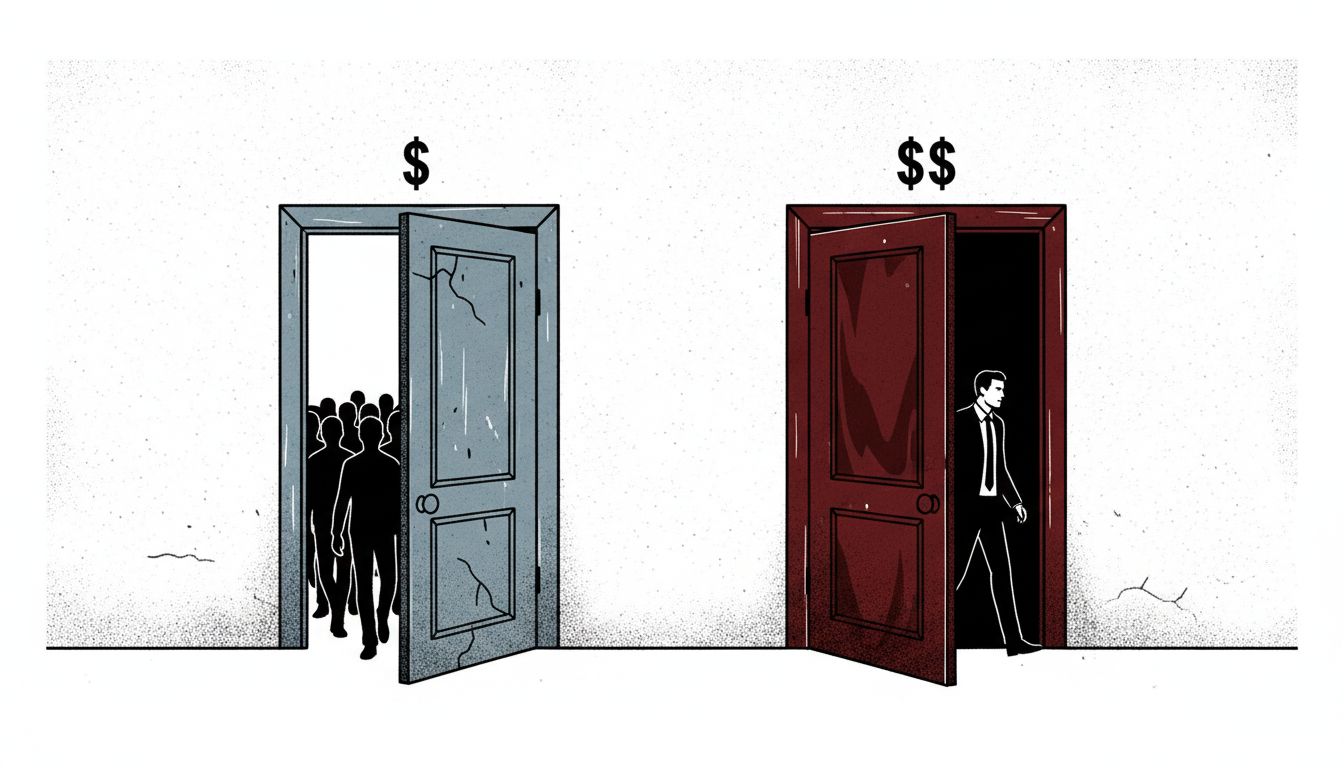

Picture a product launch you actually remember. Not because the product was good, but because it was spectacularly, almost impressively bad. Google Glass. Amazon Fire Phone. Microsoft Zune. You look at these things and think: how did a room full of smart, well-paid people greenlight this? The answer that most people land on is hubris, or groupthink, or some failure of imagination. But that answer is wrong, or at least incomplete. In a lot of cases, the people in that room knew. They shipped it anyway, and they had very good reasons to.
This isn’t a story about incompetence. It’s a story about strategy that looks like failure from the outside but is coldly rational from the inside.
The Map Is Worth More Than the Territory
Here is the thing about launching a product: the product itself is often not the point. What you actually get from a launch, even a failed one, is data. Real-world, unfiltered, impossible-to-simulate data about how people interact with an idea when money and attention are actually on the line.
Market research is a lie detector test that never works. People tell you what they think they want, or what they think you want to hear, or what they think a reasonable person would want. They do not tell you what they will actually pay for at two in the morning when their back hurts and they are half-watching television. The only way to find that out is to put something real in front of them and watch.
This is why most revolutionary software features were discovered by accident. You build one thing, you launch it, and you watch what people actually do with it. The users who stick around do something unexpected. They use a minor feature like a major one. They ignore the flagship functionality entirely. That signal, gathered from a product that might look like a failure on a slide deck, is often the seed of the next thing that actually works.
Amazon did not invent AWS because someone had a brilliant vision for cloud computing. They built internal infrastructure out of necessity, noticed it was useful, and then realized other companies had the same problem. A “failed” internal tooling effort became one of the most profitable businesses in the history of software. The map they drew while doing something else turned out to be the treasure.
Occupying Competitive Space Without Betting the House
There is another reason to launch something you expect to fail, and it is more aggressive than it sounds: category occupation.
If you do not have a product in a space, a competitor owns that space. Even a mediocre product with low market share creates a presence. It establishes patents, brand associations, and customer relationships that cost real money to dislodge. This is why the most valuable tech patents protect ideas that sound completely obvious. You are not always patenting a breakthrough. You are filing a claim on territory.
Google Glass was not a consumer product. It was a flag planted in the augmented reality landscape while the technology was still maturing. It generated years of data on user behavior, interface design challenges, and social friction, and it cost Google a fraction of what it would have cost to cede that ground and then try to buy it back later. The “failure” was the product. The success was the position.
This is also why venture capitalists deliberately fund your competitors. A VC firm with horses in multiple races is not confused. They are hedging and learning simultaneously, using each company’s stumbles to inform their thesis about where the market is actually going.
The Deliberate Sacrifice Play
Some products are launched specifically to be killed, and the killing is the strategy.
Consider what happens when you launch a product in a new pricing tier. You are not just selling a thing. You are running a psychological experiment on your existing customer base. You are finding the ceiling of what people will pay. You are discovering which features justify premium pricing and which ones nobody actually cares about despite what focus groups told you.
This connects to something deeper about how successful companies are built. Most successful startups abandon their original business model within 18 months, and it is not because they failed at execution. It is because the real business only becomes visible after you have launched something and watched the market react. The original product is the instrument, not the destination.
The same logic applies to apps that launch in obscure countries first. You are not starting small because you lack confidence. You are running a contained experiment in a market where failure has limited consequences. If the product dies, it dies quietly. If it lives, you have a proof of concept that is real, not theoretical.
The Talent and Culture Argument
There is one more reason that rarely makes it into strategy decks, and it is about people, not products.
Building something, even something that fails, is how you build a team. Engineers who have shipped a product, watched it struggle, diagnosed what went wrong, and iterated through the noise are categorically different from engineers who have only ever worked on internal tools or pre-launch projects. The experience of being in the market, of watching real users bounce off your product and trying to figure out why, is not replicable in any other way.
Tech companies build features they never release on purpose for similar reasons. The act of building, even without shipping, develops capability and surfaces problems. A product that launches and fails is the external version of that same logic. You are investing in the team’s experience and judgment, not just the product’s market share.
This is why the best engineering organizations treat failure differently than the press does. Software bugs don’t kill products. How companies respond to them does. The same is true of product failures. A team that launches something, watches it struggle, and extracts every possible lesson from the wreckage is a stronger team than one that only ever ships winners, because eventually every team ships something that struggles.
What This Means If You Are Building Something
If you are at a startup or inside a larger company trying to figure out whether to ship something uncertain, the calculus looks different once you understand this. The question is not just “will this succeed?” The question is “what will we learn that we cannot learn any other way, and is that worth the cost of launching?”
Sometimes the answer is no. Some products are just bad bets dressed up as experiments. But more often than the mythology of Silicon Valley admits, the product graveyard is not a monument to failure. It is a filing cabinet, full of data that shaped the products that actually changed things. The companies that look clairvoyant from the outside are often just the ones who ran the most experiments and paid attention to what came back.