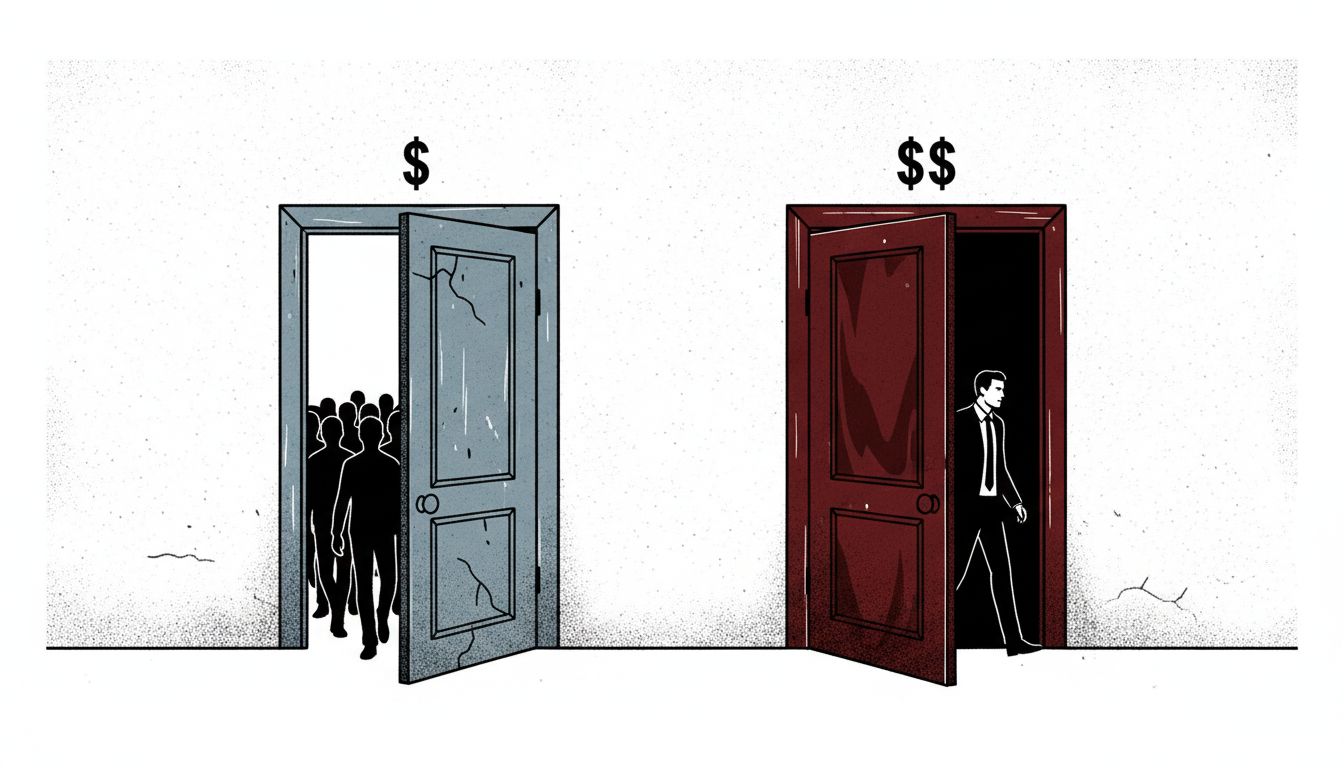
A few years ago I watched a founder I knew raise a seed round on the back of a slide that said her TAM was $40 billion. The deck was slick. The investors were excited. Eighteen months later the company was dead, not because the market wasn’t real, but because she spent that money trying to become the default choice for everyone and ended up being the first choice for no one.
Around the same time, a different founder I knew was building a project management tool specifically for independent film productions. No outside funding. Maybe three thousand potential customers in the entire country. He was profitable inside a year. He still runs the business today.
The difference between these two stories is not luck or hustle or product quality. It’s a strategic choice about who you are actually for. The second founder, whether he would have named it this way or not, was running a minimum viable audience strategy. And it is one of the most consistently misunderstood competitive advantages in the startup playbook.
Big money creates big blind spots
Venture capital has a structural problem that founders rarely talk about openly. The math requires enormous outcomes. A fund that writes ten checks needs one or two of those bets to return the whole fund, which means every portfolio company is quietly expected to go after a market large enough to justify a billion-dollar valuation. This pushes founders toward broad positioning almost by default.
When you take institutional money, you are not just taking capital. You are committing to a growth trajectory that demands you appeal to the widest possible audience as fast as possible. That’s not a criticism, it’s just the deal. The problem is that broad appeal in the early stages is almost always a fiction. You can’t be meaningfully better than an entrenched competitor for everyone. You can be meaningfully better for someone.
Venture-backed competitors are often structurally forbidden from going narrow. A bootstrapped or lightly-funded founder has no such constraint.
Specificity is a product advantage, not just a marketing one
Here’s where most founders get the minimum viable audience concept wrong. They think it’s about targeting a niche for go-to-market purposes and then expanding. That’s part of it. But the deeper advantage is that when you build for a specific audience, you build a fundamentally different (and often better) product.
The film production tool I mentioned didn’t just market differently to that audience. It had features that only make sense in that context: call sheet integration, shoot scheduling tied directly to tasks, budget tracking that matched how line producers actually think. A general project management tool can’t ship those features because they’d confuse everyone else. The specificity of the audience directly caused the specificity of the product, and that specificity is genuinely hard to copy.
Basecamp did something similar, refusing to bolt on every feature enterprise customers asked for and staying focused on a particular philosophy of how work should be organized. That stubbornness, which looks like a marketing choice, is actually an engineering and product choice. It’s why the product has retained a coherent identity for two decades while better-funded competitors have become bloated and confusing.

Word of mouth scales differently in tight communities
When your target audience is fifty thousand people who all attend the same trade conferences, read the same three newsletters, and follow each other on LinkedIn, your customer acquisition dynamics are completely different from a company targeting the general public.
A single enthusiastic customer in a tight community is worth more than a hundred satisfied customers scattered across a broad market. The film production tool founder got a review from one respected line producer on an industry forum and saw his trial signups triple in a week. That kind of density of trust and communication doesn’t exist in a general market. You can’t buy it with a paid acquisition budget. It has to be earned inside a community that already talks to itself.
Venture-backed competitors often have customer acquisition costs that make this kind of organic, community-driven growth look unimpressive on a dashboard. But when you’re running lean, a channel that converts at thirty percent because it’s a trusted peer recommendation beats a channel that converts at two percent at massive scale every time.
Pricing power follows specificity
General-purpose tools compete on price. Specialized tools compete on fit. These are completely different businesses.
The film production tool charged more per seat than Asana or Monday.com and had virtually no churn among active productions, because the switching cost wasn’t just learning a new interface. It was rebuilding a workflow that was woven into how an entire crew operated. Specificity creates stickiness that generic products can’t manufacture.
This also means the minimum viable audience strategy is often more capital-efficient than it looks on paper. Lower churn means lower spend to maintain revenue. Higher prices mean profitability comes sooner. The math that looks unimpressive on a VC’s TAM slide often looks excellent on an income statement. As venture capitalists already understand, the fund model optimizes for outlier outcomes, not sustainable businesses. Those are not always the same thing.
The counterargument
The obvious pushback is that small markets produce small businesses. If you build for three thousand film productions, you’re capped at whatever revenue three thousand film productions can generate. At some point the question of whether you can expand to adjacent markets becomes real and urgent.
This is fair. The minimum viable audience strategy isn’t a permanent business plan. It’s a beachhead strategy. The question isn’t whether you eventually expand, it’s whether you expand before or after you have real leverage. Most venture-backed startups try to expand before they’ve earned it. They’ve acquired a thin layer of users across a huge market who aren’t deeply committed to the product, and they’re trying to grow on top of a foundation that doesn’t actually hold.
The founders who use this strategy well pick the smallest market they can dominate, dominate it completely, then use that position and those product learnings and that revenue to move into adjacent territory. Interestingly, this is also how the most successful startups approach market selection more broadly. The minimum viable audience approach just applies the same logic at the customer level.
You can build something large this way. It just takes longer, and it requires believing that depth before breadth actually works. Most founders, especially those with money on the table and investors expecting hypergrowth, aren’t in a position to believe that.
The real competitive advantage
The founders who beat venture-backed competitors using this strategy aren’t doing it by accident. They are making a deliberate choice to be indispensable to a small group of people rather than adequate for a large one. That choice has downstream consequences for product, pricing, sales, and culture that compound over time.
The well-funded competitor has to be many things to many people. You only have to be the right thing for the right people. In a fair fight, resources win. This strategy is about not fighting fair.