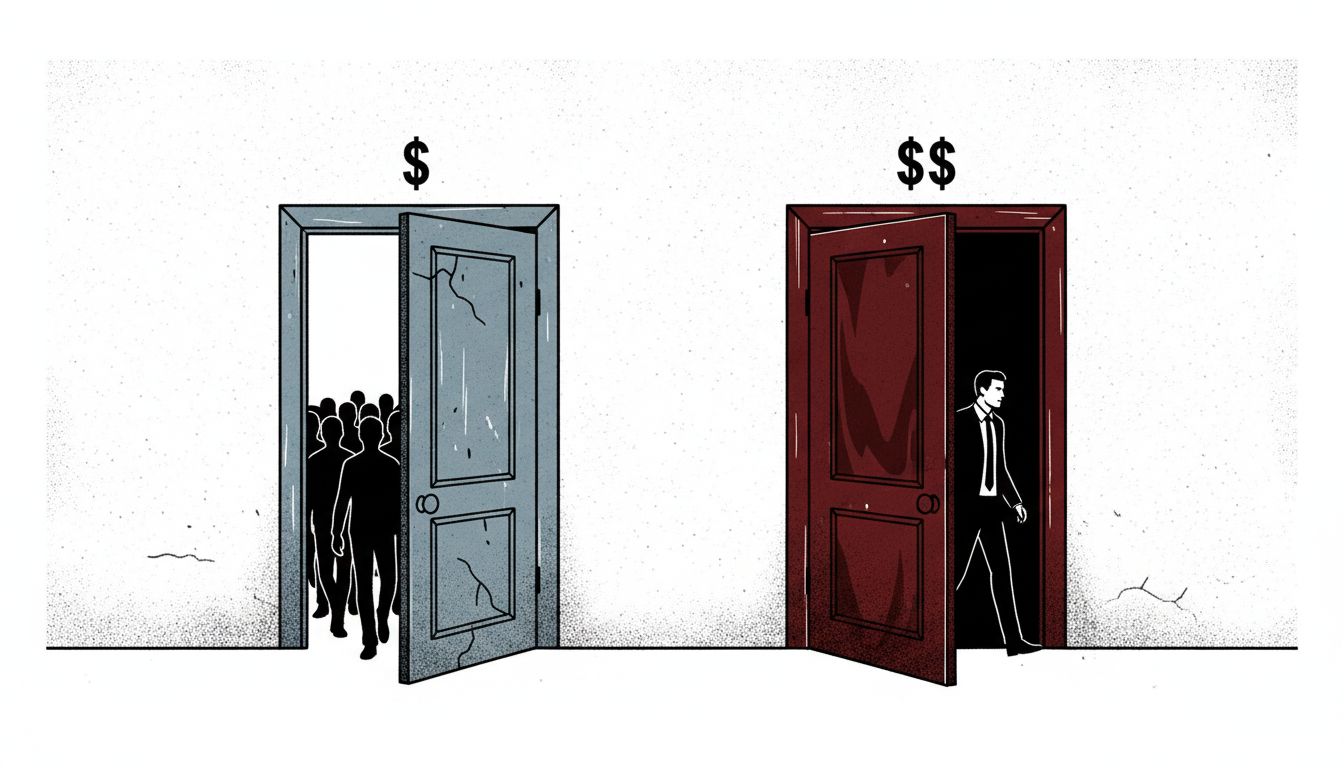
In 2007, nobody was complaining that they couldn’t hail a cab from their phone. Cab-hailing wasn’t a problem people articulated. You walked to the curb, you waved your arm, sometimes you got lucky, sometimes you didn’t. That was just how cities worked. Nobody filed a complaint. Nobody wrote a strongly worded letter. And then Uber showed up and, within eighteen months, an entire generation forgot that waiting in the rain was ever considered acceptable. The problem didn’t exist until the solution did.
This is the uncomfortable truth about startup strategy that most accelerators won’t put in their curriculum: the biggest opportunities aren’t hiding inside existing pain points. They’re hiding inside futures that customers can’t yet describe, because they’ve never lived in them. Venture capitalists don’t predict the future so much as they recognize the past, which is exactly why the most disruptive companies so often get passed over in early rounds.
The Trap of the Customer Survey
The entire lean startup orthodoxy is built on a reasonable-sounding idea: talk to your customers, find out what they need, build exactly that. And for incremental improvement, this is solid advice. But it contains a hidden ceiling.
Henry Ford’s apocryphal quote about faster horses is overused, but the underlying point is real. When you ask people to articulate their problems, they describe them in the vocabulary of existing solutions. They don’t say “I want to coordinate with twelve people across four time zones without losing context.” They say “email is annoying.” The distance between those two statements is where billion-dollar companies live.
The most successful founders aren’t ignoring their customers. They’re listening differently. They’re watching behavior more than they’re listening to feedback. They’re looking at the workarounds people build, the spreadsheets people maintain, the hacks people duct-tape together to make existing tools do things they weren’t designed to do. A spreadsheet full of customer contacts that someone manually updates every Friday is not a request for a better spreadsheet. It’s a request for something that doesn’t exist yet.
Future Problems Are Already Happening Somewhere
Here’s the thing about “problems that don’t exist yet”: they almost always exist somewhere already. The future isn’t evenly distributed, which means if you look in the right places, you can find people already living in the world your startup is trying to build.
This is exactly why successful apps launch in obscure countries first. It’s not just about regulatory arbitrage or cheaper user acquisition. It’s about finding pockets of the future where your solution already makes sense, where the underlying conditions (infrastructure, behavior, regulation, culture) have already evolved to the point where your product isn’t premature. You’re not experimenting. You’re time traveling.
The same logic applies within industries. Enterprise software companies often find their early adopters not among the biggest, most sophisticated buyers, but among mid-sized companies that have outgrown their current tools but can’t afford the incumbent’s solution. These companies are living in the future of what smaller companies will need in three years. Build for them, and you’re building for a problem that’s about to become universal.
Why “Obvious” Opportunities Are the Real Ones
One of the most persistent myths in startup culture is that great ideas have to be secret, contrarian, or counterintuitive. The reality is closer to the opposite. The most valuable problems tend to be the ones that look obvious in retrospect and get dismissed as “too simple” or “already solved” in the present.
This connects directly to a pattern in intellectual property law: the most valuable tech patents protect ideas that sound completely obvious. The reason is the same. Ideas that seem obvious are often obvious only because they’re correct. The defensibility isn’t in the obscurity of the insight. It’s in the execution, the timing, and the willingness to pursue something that everyone else has decided is beneath them.
Stripe is the classic example. Payments were a solved problem. Every programmer building a product knew this. And then Stripe launched with seven lines of code and became one of the most valuable private companies in history. The problem wasn’t secret. It was just that everyone assumed it was already solved, which is a different thing entirely.
The Timing Problem Is Actually a Discovery Problem
Most failed startups aren’t wrong about the problem. They’re wrong about when the problem becomes acute enough to pay for a solution. This is where the mythology of “visionary founders” does the most damage. It implies that success comes from seeing further than everyone else. But seeing further doesn’t matter if the infrastructure, behavior, or market isn’t ready.
General Magic, the company that essentially invented the smartphone concept in the early 1990s, is the most brutal case study in this. The vision was correct. The timing was off by a decade. The company collapsed.
The real skill isn’t prediction. It’s calibration. Most successful startups abandon their original business model within 18 months not because they were wrong about the problem but because they were refining their understanding of when and how that problem manifests in ways customers will actually pay to solve. The pivot isn’t a failure. It’s a precision adjustment.
This is also why most revolutionary software features were discovered by accident. You build something for one version of a future problem, and users reveal the actual future problem by using your product in ways you didn’t anticipate. The founders who win are the ones paying close enough attention to notice when that happens.
How to Build for a Problem That Doesn’t Exist Yet
This isn’t a call to ignore your users or build in a vacuum. It’s a call to change the questions you’re asking.
Instead of “what problem do you have today,” ask “what do you do when your current tools fail you.” Instead of “what would you want us to build,” watch what people build on top of your product without being asked. Instead of validating demand for your solution, validate the conditions that will make the problem acute.
The specific tactics matter less than the underlying orientation. The founders building the most valuable companies right now aren’t solving the problems on everybody’s list. They’re watching the edges of existing systems, finding the places where behavior has already evolved past what current tools can support, and building infrastructure for a world that’s arriving faster than the market has acknowledged.
The problem doesn’t have to exist yet. It just has to be inevitable. Your job is to be ready when it arrives.