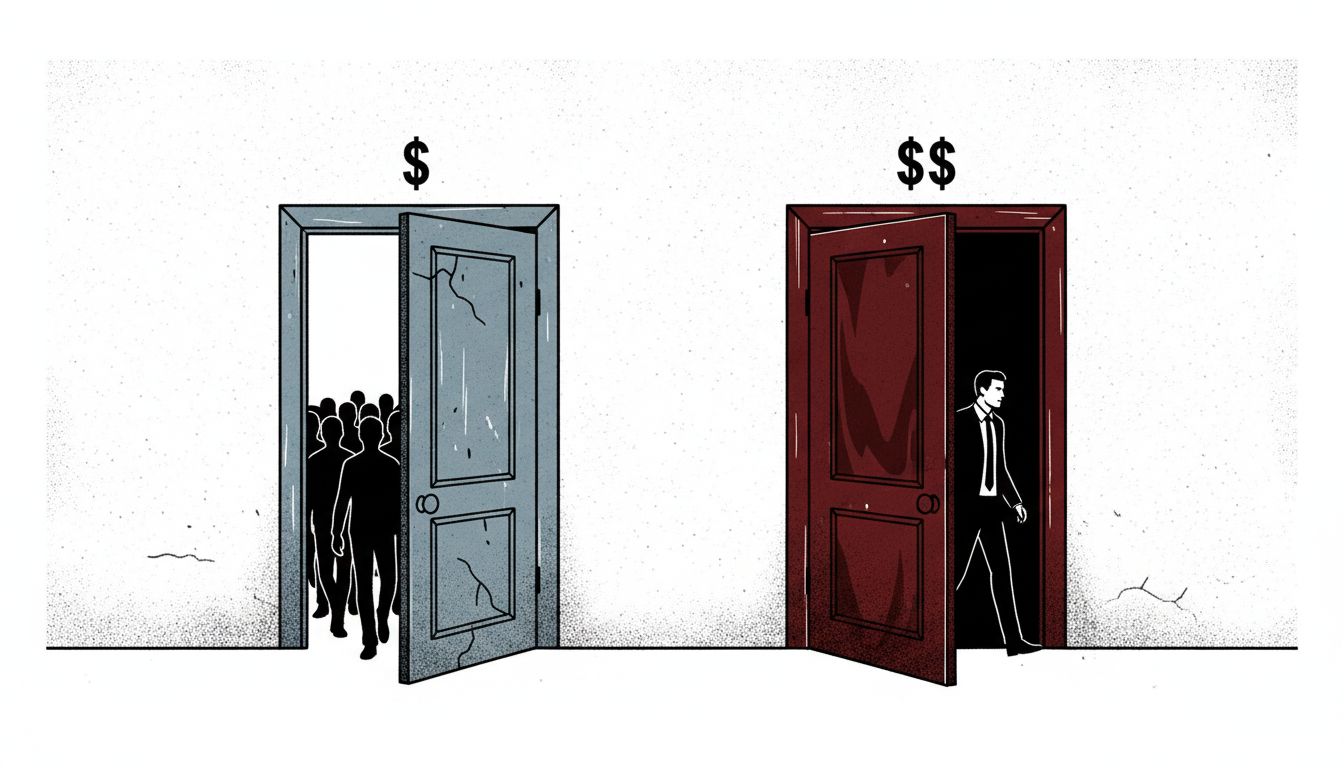
A partner at a well-known venture firm once told me, off the record, that the best investment they ever made almost didn’t happen because the founder kept saying things that sounded wrong. The market was ‘too small.’ The product was ‘too weird.’ The go-to-market was ‘too slow.’ Three out of three boxes checked for a pass. They funded it anyway because one junior partner wouldn’t shut up about it. That company is worth billions now.
This isn’t a story about lucky gut calls. It’s about a structural problem in how we evaluate startups, one that consistently rewards the companies best at performing fundability over the ones most likely to actually work.
The Pitch Deck Is Optimized for the Wrong Outcome
When founders raise money, they learn fast what investors want to hear. Big TAM. Clear monetization. Proven team. Fast growth. So founders learn to say those things. They expand their TAM slides until the numbers sound impressive. They paper over distribution uncertainty with confident projections. They emphasize credentials rather than conviction.
The problem is that genuinely interesting companies often can’t do any of that convincingly at the early stage, because the thing that makes them interesting is precisely that they’re going after something that doesn’t fit existing mental models. The market looks small because nobody has measured it correctly yet. The monetization is unclear because the product category barely exists. The team looks thin on paper because the people who actually understand the problem aren’t the ones with the right logos on their LinkedIn.
Investors have optimized their pattern-matching for a world where the signals are visible early. But the best companies are specifically the ones where the signals are invisible early. That’s what makes them uncrowded.
Small Markets That Aren’t
When Airbnb was raising its first real money, investors kept pointing out that renting an air mattress in a stranger’s living room was not a serious business. The market for ‘budget accommodation for people who don’t mind sleeping in someone else’s house’ was, generously, tiny. What they missed was that Airbnb wasn’t entering that market. It was creating a new behavior, and behaviors don’t have markets until they exist.
This pattern repeats constantly. The addressable market for ‘software that manages conversations across multiple customer support channels’ was small until it wasn’t, because Zendesk helped define the category. Slack’s TAM for ‘business messaging that isn’t email’ was hard to calculate in 2013 because most enterprise buyers didn’t think they had that problem yet.
The companies doing genuinely new things can’t point to an existing market because there isn’t one. They have to argue that a market will exist, which sounds like speculation, because it is speculation. It’s just well-reasoned speculation grounded in behavior that’s already happening at small scale. Investors who need a pre-existing market to underwrite are systematically filtering out the most interesting opportunities.
The Unsexy Problem Advantage
Some of the most defensible businesses solve problems that are boring or embarrassing to talk about. Nobody wanted to give a TED talk about accounts payable software in 2005. Nobody wanted to be known as the company that finally fixed dental billing. These problems are real, they’re painful, the incumbents are terrible, and the customers will pay well because the alternative is worse. But they’re hard to get excited about in a pitch meeting.
The venture model, at its best, is supposed to fund things that are hard to do but worth doing. In practice, the social dynamics of pitch meetings push toward things that are easy to describe and easy to get excited about. The founder who can tell a compelling story about changing how people think about work gets more meetings than the founder who can tell a compelling story about why accounts payable reconciliation is broken and how they’ve fixed it. The second company is often the better investment.
The most successful apps got big by solving problems nobody was willing to admit they had follows the same logic at the consumer level. The pattern holds in enterprise too, just with less social stigma and more spreadsheets.

The Slow Growth That Signals Deep Roots
Growth metrics in the early stage are mostly noise dressed up as signal. A company that grows from 10 to 100 users in a month looks better on a slide than a company that grows from 100 to 130 users in the same period. But the second company might be doing something far more important: building customers who won’t leave.
The companies with the most durable competitive positions often grow slowly at first because they’re doing things that don’t scale by design. They’re doing intense customer onboarding. They’re customizing the product for specific use cases. They’re building relationships that will become the foundation for referrals and expansions two years later. None of that shows up well in a seed-stage pitch. It looks like inability to grow rather than deliberate prioritization.
The paradox is that the behaviors that make a startup look weak in the short term, high touch, slow expansion, narrow focus, are often exactly the behaviors that compound into strong businesses. The startup that brute-forces its way to impressive early metrics often hasn’t built anything underneath them.
Why Crowded-Looking Markets Are Often the Safest Bet
Conventional pitch advice says to minimize competitive risk. Show a market map where you’re in the middle of a white space with nobody near you. What this ignores is that white space is often white for a reason. If nobody is competing there, there’s a decent chance nobody is buying there either.
The counterintuitive truth is that a crowded market proves demand. If you can articulate why you’re going to win despite the competition, that’s a much better foundation than arguing that no competition exists. Salesforce entered a market with established CRM players. Stripe entered payments, one of the most regulated and entrenched spaces imaginable. Figma took on Adobe.
Founders who choose genuinely crowded markets because they have a specific, real advantage are often doing better thinking than founders who’ve engineered a market map to look uncrowded. The former requires actual conviction. The latter just requires a good PowerPoint.
The Team That Doesn’t Look Right
Venture firms often talk about backing founders, not ideas. In practice, the founders they back tend to look a lot like founders they’ve already backed successfully, which means ex-Google, ex-McKinsey, Stanford CS, ideally with a previous exit. This isn’t entirely irrational. Those backgrounds do correlate with certain skills.
But some of the most important companies get built by people who understand the problem from the inside in ways that polished credentials can’t replicate. A former warehouse worker who builds logistics software understands friction that no amount of consulting work would reveal. A nurse who builds clinical documentation tools knows where the current products fail in ways that no product manager from a prestigious firm would spot in user research.
Domain expertise that comes from lived experience rather than institutional pedigree often looks wrong in a pitch because it doesn’t match the template. The founder can’t name-drop the right companies. They might not tell their story with practiced polish. They might push back on investor assumptions in ways that feel uncomfortable rather than deferential. These can all be signals of exactly the kind of founder who is going to be very hard to dislodge once they find traction.
What Actually Predicts Success
If the standard signals are unreliable, what actually matters? From watching a lot of companies up close, a few things stand out.
First, the quality of customer conversations. Not ‘do customers like it’ but ‘do customers change their behavior for it.’ Are they reorganizing workflows around this product? Are they bringing it up unprompted when you talk to them? Are they angry when it goes down?
Second, the founder’s understanding of why they’ll lose. The founders who can clearly articulate their own weaknesses and the scenarios in which their company fails are usually doing more rigorous thinking than the ones with unshakeable confidence. Confidence is easy to perform. Honest risk assessment is harder.
Third, the precision of the problem statement. Not ‘small businesses struggle with marketing’ but a specific, granular account of what actually happens when a specific type of person tries to do a specific thing and fails. Vague problems produce vague solutions. Precise problems indicate a founder who has been paying close attention.
None of these show up well in a standard pitch format. They emerge from conversations, from reference calls, from watching how a founder responds when you poke at their assumptions. The investors who consistently find the companies that look unfundable on paper tend to be the ones who do the work to see past the paper.
What This Means
If you’re a founder, the takeaway is not to make your company look unfundable. It’s to understand that if your company genuinely has strong fundamentals and still isn’t getting traction with investors, the problem might be communication rather than business quality. Learn to translate what you’re actually building into terms that surface the real signals, without papering over genuine weaknesses.
If you’re an investor, the takeaway is that your pattern-matching is probably filtering out some of the best opportunities available. The companies that fit your template cleanly are the companies every other investor is also looking at. The edge is in learning to read signals that aren’t legible through the standard template, which requires spending time with founders in ways that go beyond the pitch meeting.
The institutional pressure in venture is toward fundability theater, and it has been for a long time. The investors who’ve built the best track records are usually the ones who found ways to resist it.