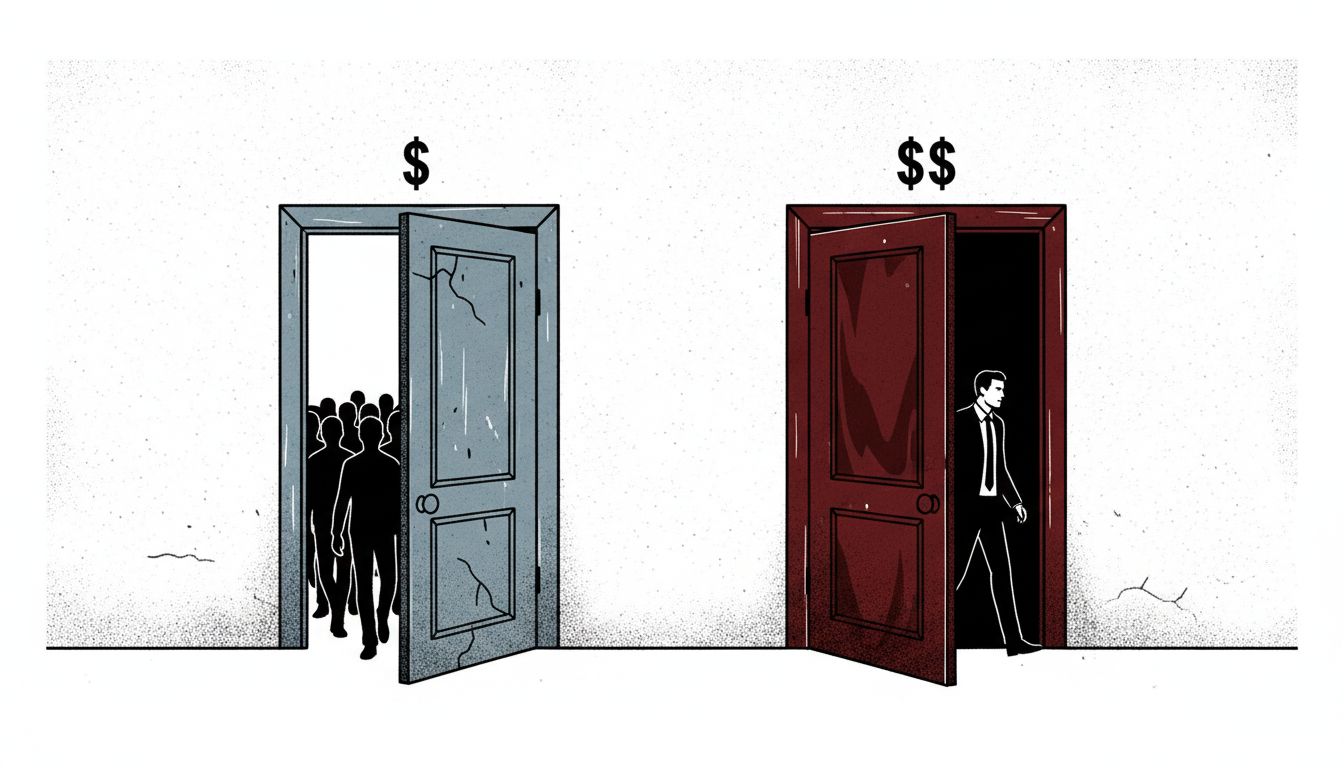

A founder I know spent six months pitching Sand Hill Road for her B2B analytics company. She got meetings, got interest, got the runaround. Eventually she stopped pitching and started selling. Three years later, she had a profitable company with no outside investors, full ownership, and the freedom to turn down an acquisition offer that would have made her rich but left her miserable. The VCs who passed on her, she told me, did her a genuine favor.
This is not a story the venture capital industry tells about itself. The dominant mythology around startups treats outside funding as a milestone, a validation, proof that you are building something real. But the data on startup outcomes, and the track records of some of the most durable software companies, tells a different story. Many of the most profitable technology companies spent their early years growing on revenue, kept ownership concentrated, and reached escape velocity before a single institutional investor got involved. That sequencing was not accidental.
The Problem With Early Capital Is the Clock It Starts
Venture capital is not inherently bad. It is a specific financial instrument with specific terms, and those terms create specific pressures. When you take institutional money, you are accepting, explicitly or not, a return timeline. Your investors need an exit. That exit needs to be large enough to justify the fund economics. This means you are now optimizing for a particular outcome, at a particular scale, on a particular schedule, regardless of whether that outcome makes sense for your actual business.
For companies in markets that reward patience, that clock is poison. Basecamp (formerly 37signals) is the clearest example in software. Jason Fried and David Heinemeier Hansson have written extensively about their decision to stay small and profitable rather than scale aggressively on outside capital. The result is a company that has operated profitably for over two decades, ships products on its own terms, and has never been forced into a sale or a pivot by investor pressure. They beat better-funded competitors by refusing to play the spending game, and the refusal was not stubbornness. It was strategy.
The clock problem compounds in another way. Early-stage VC money almost always comes with dilution. A founder who raises a seed round and a Series A before reaching product-market fit can easily find themselves owning less than half their company before they have figured out what they are actually building. If the company then needs to pivot, which most do, the incentive structures get complicated fast. The investors own a piece of something specific. Changing that something requires convincing people who have already written a check based on the original thesis.

Revenue-First Companies Learn Things That Funded Companies Don’t Have To
When you cannot spend your way to growth, you have to understand your customers in a way that funded competitors rarely bother with. Every sale is critical. Every churn event is an emergency. You learn, faster than any survey could teach you, what your product is actually worth to the people buying it.
This is not a romantic notion about suffering building character. It is a practical observation about information. A company running on its own revenue gets accurate price signals from day one. A company burning investor capital can subsidize customer acquisition indefinitely, which means it can scale without ever proving that customers value the product at a price that sustains the business. Many of the most spectacular startup collapses follow exactly this pattern: growth that looks real because it was bought, and a business model that never actually worked.
The founders who bootstrap through the early stages also develop a specific muscle that is genuinely hard to build later: they learn how to sell. Not pitch decks and demo days, but actual selling, finding customers who have a problem, convincing them your solution is worth money, and closing the deal. This sounds obvious. You would be surprised how many funded founders have never done it, because they never had to.
What Venture Capital Actually Optimizes For
Here is the part that gets glossed over in the founder media: venture capital funds are not trying to build great companies. They are trying to generate returns for their limited partners. These goals can align, and sometimes they do. But the alignment is not guaranteed, and in the early stages it is often weakest.
A VC fund with fifty portfolio companies needs a small number of them to return the entire fund. This means the incentive is to push every company toward swinging big, because the modest success is nearly worthless to the fund even if it is life-changing for the founder. From the fund’s perspective, a company that grinds to a $20 million acquisition is a rounding error. From the founder’s perspective, it might be a genuine win. The mismatch is structural, not a failure of character on anyone’s part.
Accelerators run on similar pattern-matching logic, selecting for the kinds of companies that have historically returned venture funds rather than the kinds of companies that have historically been profitable and durable. These are genuinely different populations.
When Outside Capital Does Make Sense
None of this means venture capital is always wrong. It means early-stage venture capital is frequently wrong for companies that do not have the specific characteristics that make the model work.
The model works when you are in a winner-take-all market where speed of scale determines the outcome. Social networks, marketplaces with strong network effects, certain categories of infrastructure software. In these cases, the company that gets to scale first often wins permanently, and the capital that enables that speed is genuinely valuable even at the cost of dilution and timeline pressure.
The mistake is treating this exception as a general rule. Most software businesses are not winner-take-all. Most B2B SaaS companies can be built profitably on revenue, grown deliberately, and sold or held on the founder’s own terms. For these companies, the VC model is not just unnecessary. Taking the money early actively makes the business harder to build, because it installs incentives that point in the wrong direction.
The Real Question Founders Are Not Asking
The question most founders ask is: can we raise money? The question worth asking is: what does this business actually need to succeed, and is outside capital on a fixed return timeline part of that?
For my friend with the analytics company, the answer was no. She needed customers, feedback, and time to refine her product. None of those things come from a term sheet. The six months she spent pitching VCs was, in retrospect, six months she was not selling, not learning, and not building. The investors who passed on her did not validate her business. Her customers did.
That is the thing about profitable companies built without early capital. They tend to have one thing in common with each other and almost nothing in common with the funded startups that flamed out: they found someone willing to pay for what they built before they scaled it. That turns out to be a more reliable foundation than a good pitch deck and a wire transfer.