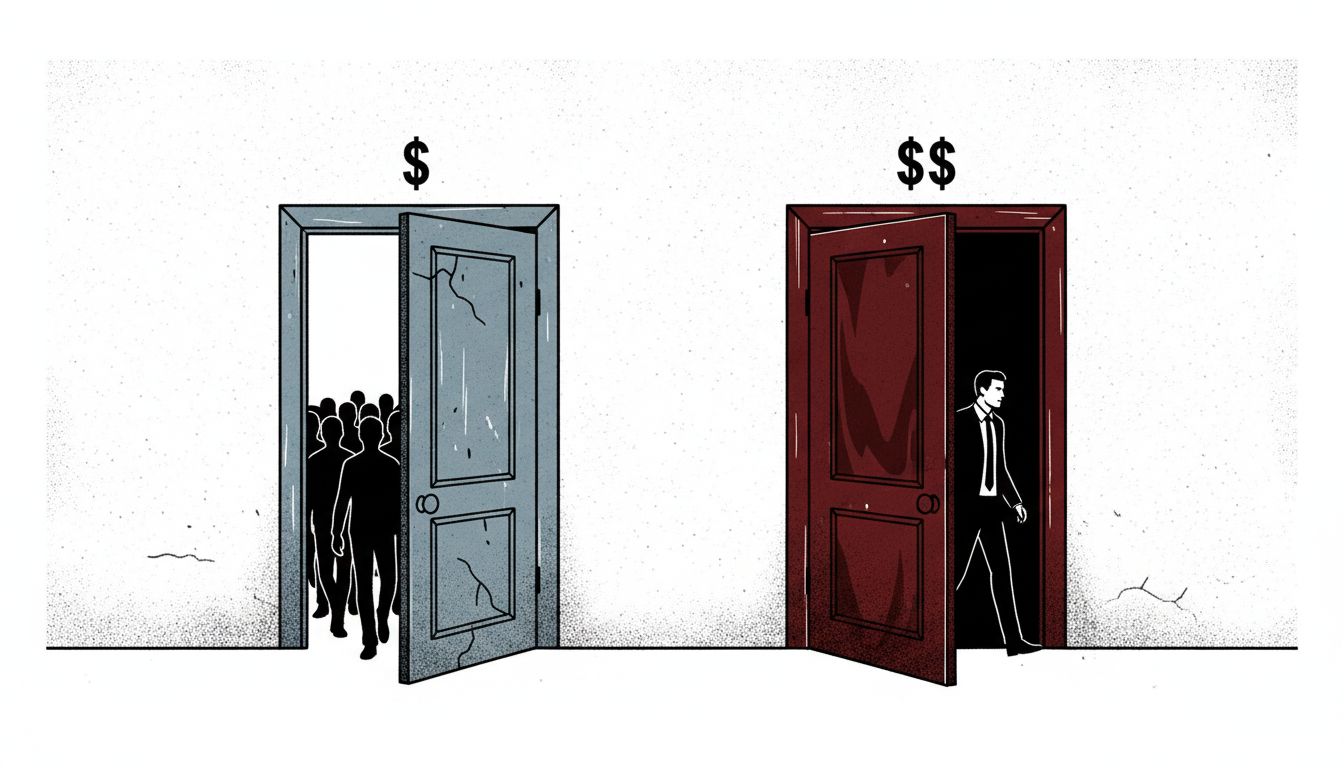

Imagine you’re the CEO of a startup that just closed a $40 million Series B. Congratulations are coming in. Your investors are excited. You now have the runway to hire aggressively, build out that enterprise sales team, expand into three new markets, and finally tackle the product roadmap you’ve been deprioritizing. You have options.
This is where many startups quietly begin to die.
Not from the obvious causes. Not from bad product or bad market timing. From the subtler rot that sets in when a company no longer has to make hard choices, because money can defer those choices indefinitely. The relationship between funding and performance is not linear, and the startup world has spent years pretending otherwise.
The Illusion of Optionality
Funding buys optionality. That’s the pitch. More capital means more paths you can pursue, more experiments you can run, more talent you can attract. In theory, options are valuable. In practice, organizations that have too many options open simultaneously become worse at making decisions.
This isn’t a soft observation about culture. It’s structural. When money is scarce, you are forced to rank your bets. You have to articulate which initiative matters most, which customer segment to serve, which feature to build. That process of forced prioritization produces clarity that no strategy offsite can replicate.
When money is abundant, you can say yes to all of it. And you will, because every VP will make a compelling case for their budget, and there’s no forcing function to deny them. The result is a company pursuing six strategies with middling commitment instead of one strategy with full conviction.
Basecamp is the case study that defenders of this thesis keep returning to for good reason. The company has been profitable almost from the start, operates with a deliberately small team, and has refused outside capital while competitors raised hundreds of millions. What that actually looked like from the inside is more instructive than the summary: constraints forced ruthless product decisions that kept the software coherent while competitors bloated their products into incoherence chasing enterprise customers.
Why Overhead Is the Silent Killer
Here’s something founders don’t talk about enough: hiring is a form of technical debt. Every person you add to an organization increases coordination costs, slows decisions, and creates a constituency for the status quo. The more people you have, the harder it becomes to change direction.
A well-funded startup hires fast because that’s what the growth narrative demands. You need headcount to signal momentum, to fill out the org chart that makes enterprise customers comfortable, to justify the valuation. So you hire, and then you hire people to manage the people you hired.
A constrained startup hires slowly and reluctantly. Every hire has to justify itself against the alternative: could we solve this problem differently? Could the two people we already have figure it out? The result is a leaner team where everyone is close to the work, communication loops are short, and context doesn’t get lost in a chain of handoffs.
The data on small teams shipping faster than large ones is consistent across the software industry. Small teams move faster not because the individuals are better but because the coordination overhead is lower. A two-person team making a product decision takes a conversation. A twenty-person team requires a meeting, a follow-up meeting, a document for alignment, and a stakeholder review.
The Feedback Loop That Capital Breaks
The most underappreciated consequence of too much funding is what it does to the feedback loop between a company and its market.
When a startup is running lean, every dollar has to come from customers. This creates an intimate, sometimes brutal connection to whether what you’re building actually solves a real problem. You are constantly hearing from the people who pay you, adjusting based on what they say, killing features that aren’t earning their keep. Revenue is feedback.
A well-funded startup can defer this reckoning. You can spend two years building toward a vision that never gets validated because you don’t need customers to survive yet. You can maintain pricing that doesn’t reflect what the market will actually bear. You can ignore churned users because you have the resources to acquire new ones and paper over the underlying problem.
This is why underpricing your product is often as dangerous as overpricing it. A startup that charges real money forces an honest conversation about value. A startup that gives everything away cheap, funded by venture dollars, never learns whether anyone would pay for what it builds. When the funding eventually stops, there’s nothing there.

Focus as a Competitive Weapon
When Craigslist launched, it was aggressively unambitious. Craig Newmark started it as a local email list in San Francisco, and the company expanded slowly and reluctantly into new cities. It never raised meaningful venture capital. It stayed lean. It didn’t try to be everything to everyone.
The companies that raised money to build “Craigslist killers” over the years built more features, had better design, launched national marketing campaigns, and hired product teams that made thoughtful UX decisions. They all lost. Craigslist kept winning because it was already embedded where it mattered and refused to overextend.
Focus is not just about doing fewer things. It’s about doing the right things with the intensity that only comes from not having the option to spread your attention across fifteen initiatives. Underfunded companies are forced to identify where they’re genuinely strong and double down there. The constraint produces a sharper competitive position than most strategy consultants could derive from six months of market analysis.
What Abundance Does to Accountability
There is a specific cultural failure mode that emerges in well-funded startups, and it is almost never discussed honestly: the erosion of accountability that happens when nobody’s job is to make the numbers work right now.
At a lean startup, everyone knows what the burn rate is. Everyone knows what the revenue target is. There’s no ambiguity about whether the company is working. At a well-funded startup, the separation between spending money and generating revenue becomes wide enough that large parts of the organization operate without any clear connection to business outcomes. Teams optimize for internal metrics, output metrics, activity metrics. Something always looks like it’s working.
This produces a special kind of learned helplessness where smart people work hard and nothing compounds. The metrics they control go up and to the right but the company doesn’t get meaningfully stronger. Leaders in this environment get very good at presenting progress narratives. They get less good at confronting whether what they’re doing actually matters.
The constraint of limited capital doesn’t just force prioritization. It forces honesty about what’s working.
The Moment the Constraint Becomes Real
None of this means staying underfunded is the goal. Raising money at the right moment for the right reasons accelerates a company that already has product-market fit and a clear theory of how additional capital creates compounding value. The problem is that most startups raise before they’ve earned that clarity, and the money prevents them from developing it.
The founders who navigate this well tend to share a specific characteristic: they treat every dollar as expensive even when it isn’t. They maintain the decision-making discipline of a constrained company even after raising. They resist the organizational pressure to build headcount as a proxy for progress. They stay close to the work.
This is harder than it sounds. Investors want to see the money deployed. Employees want to see investment in their teams. The entire cultural gravity of a well-funded startup pushes toward spending. Resisting that requires a founder who is clear-eyed about what the money is supposed to accomplish and willing to be unpopular about protecting that clarity.
What This Means in Practice
If you’re running lean right now, the competitive disadvantage you feel is probably real in some ways and illusory in others. You can’t outspend the competitor with more funding. You can outfocus them, outprioritize them, and stay closer to your customers than they’re capable of being.
The companies that beat better-funded competitors tend to win on specific vectors: faster decision-making, deeper understanding of a narrower customer base, pricing discipline that forces honest feedback, and a culture where everyone understands what success actually looks like. None of these require money. Some of them become impossible when there’s too much of it.
The funding advantage is real. But so is the funding trap. The startups that figure out which one they’re in, early enough to do something about it, are the ones that tend to still be standing when the well-capitalized competitors have done their third round of layoffs and are trying to figure out why the model never worked.