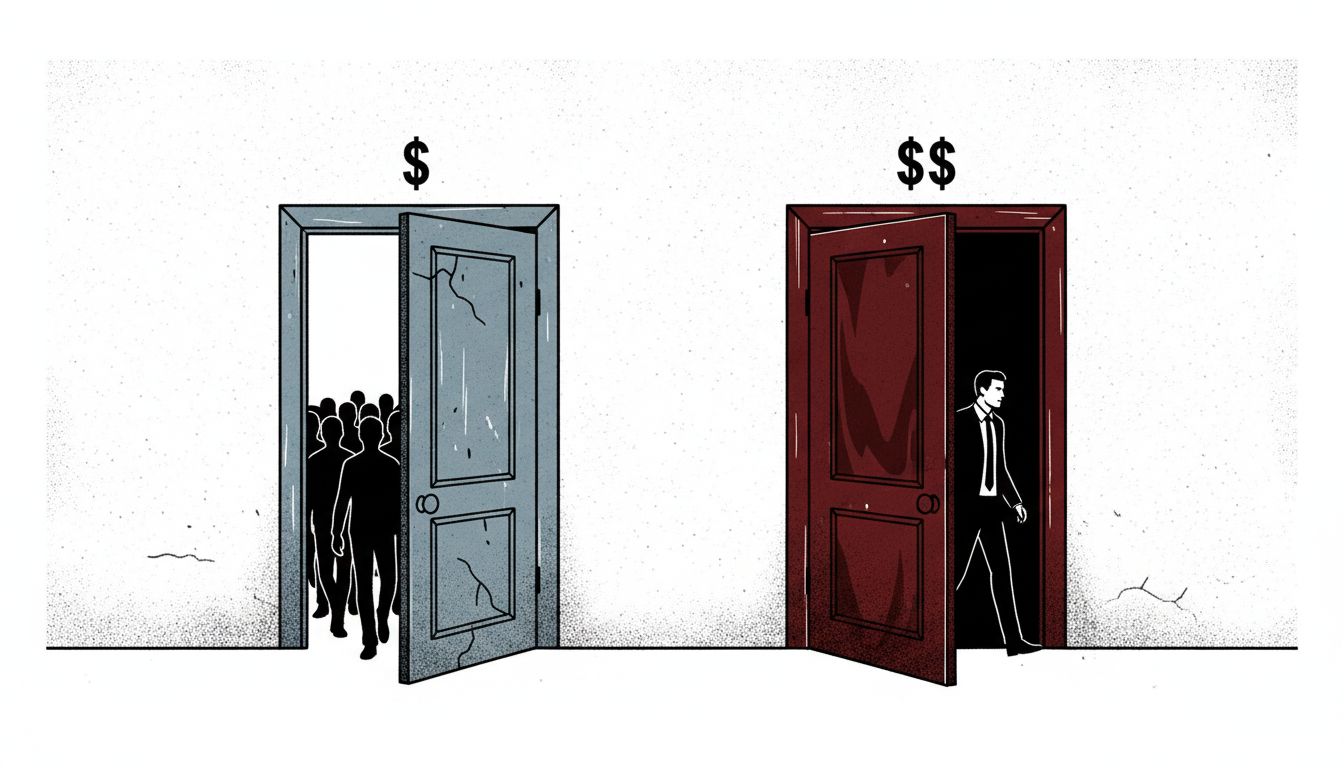

In 2011, a founder I know raised a $1.2 million seed round on the strength of a demo, a whiteboard diagram of a market, and a warm introduction to a partner at a small fund. The product was a B2B workflow tool for mid-market logistics companies. The demo was slick. The story was tight. The only thing missing was a single customer who had paid a single dollar.
He thought he’d won. He’d accelerated the timeline, skipped the scrappy months of bootstrapped hustle, and now had runway to build the right way. Eighteen months later he was back in market trying to raise a Series A with $18K in monthly recurring revenue, a cap table that made sophisticated investors wince, and terms in his seed documents that gave his early backers pro-rata rights that complicated every subsequent conversation. He eventually sold the company for parts.
This is not a story about bad luck.
The Setup
The mythology around early fundraising is deeply entrenched in startup culture. The founding story that circulates is almost always the one where the visionary founder pitches a napkin sketch and walks out with a check. We celebrate those stories because they’re dramatic. We don’t talk enough about what the check actually costs when you take it before you’ve earned any negotiating position.
Leverage in a seed round comes from a few things: evidence that people want what you’re building (ideally money they’ve paid for it), options (other investors who are interested, or the credible ability to keep going without outside capital), and time (not being desperate). When you raise before any of those are in place, you are negotiating from the weakest possible position, and the terms you accept will follow you for years.
Valuation is the obvious one. A pre-product, pre-revenue company raising at a $4 million post-money cap is giving away a very different slice of the future than a company with $30K MRR and a waitlist raising at the same cap. But valuation is actually the least of your problems.
What Actually Happened
The founder I mentioned had taken a note with a $5 million cap and 20% discount, which was fine on its face. What he hadn’t scrutinized carefully were the pro-rata rights, the information rights that required quarterly financials within 30 days of each quarter close, and a most-favored-nation clause that his early investors had quietly included.
When he went to raise a Series A, two things happened. First, the MFN clause meant that when a new investor wanted slightly different terms, it triggered a renegotiation with the seed holders. Second, the pro-rata rights meant that his seed investors had the right to participate in future rounds, which sounds fine until one of them had become difficult to work with and a lead Series A investor didn’t want them on the cap table. Killing the pro-rata required buying it out, which cost time and goodwill he didn’t have.
None of this was illegal. None of it was even unusual. It was just the normal consequence of negotiating while you needed the money more than the investor needed to give it to you.
There’s also the governance overhead. A startup with outside investors has obligations, formal or informal, that a bootstrapped company doesn’t. You’re explaining yourself. You’re managing expectations. You’re spending founder-hours on investor relations when you should be figuring out whether your product has a real market. That overhead is small when things are going well. When you’re still searching for product-market fit, it’s a tax on the exact work that matters most.

Why This Pattern Keeps Repeating
There’s a social pressure dynamic that doesn’t get discussed honestly. When your peer founders are announcing rounds on LinkedIn, when your accelerator cohort is comparing check sizes, when VCs are doing coffee meetings and dropping hints about interest, raising money starts to feel like the goal instead of the means. The signal that you’ve built something people want gets replaced by the signal that investors think you might build something people want. Those are not the same signal, and confusing them is expensive.
Investors are also, rationally, trying to get in early. The best time to invest in a company is before it has leverage, because that’s when you get the best terms. A good investor will tell you this openly. Some will tell you that taking their money early is a partnership and they’ll help you figure out the product. Sometimes that’s true. But the terms they’re writing still reflect the reality of when you’re taking the money, not the narrative about what they’ll help you become.
You also don’t know yet what you don’t know. Raising early locks in investors, advisors, and sometimes strategic assumptions (the deck you raised on often becomes a soft commitment to a roadmap) before you’ve done the messy exploratory work that actually tells you what to build. Your first hundred customers reveal things about your real market that no investor conversation will, and you want to learn those things before you’ve told a room full of people with financial stakes what the business is.
What You Can Learn From This
The companies that raise seed rounds on strong terms are usually the ones that didn’t desperately need to. That’s not a paradox, it’s just leverage. A founder with three months of paying customers, a clear retention signal, and the ability to keep going on revenue has a fundamentally different conversation with investors than a founder who needs the check to build the product that might get the customers.
The path to that position is uncomfortable because it requires doing things that don’t feel like “startup progress.” Charging early customers, even small amounts. Pricing based on value rather than fear of losing the sale. Staying lean long enough to actually learn something before you go build it at scale. Taking consulting work or doing things that don’t scale to extend your runway without dilution.
None of this means never raise a seed round. It means understand what you’re trading when you do. Every point of dilution you take before you have evidence is a point you’re giving away at the lowest possible valuation of the company’s life. Every governance right you hand over before you know what the company is costs you optionality you may badly want later.
The founder I mentioned rebuilding his logistics tool eventually started a second company. He bootstrapped it to $40K MRR before taking any outside money. When he did raise, he had three term sheets, turned one down, and negotiated a clean cap table with no MFN clauses and limited pro-rata rights. He told me the difference wasn’t the product or the market. It was just the order of operations.
Raise money to accelerate something that’s already working. Don’t raise it to find out if anything works at all. The check feels like a shortcut. Usually it’s just a more expensive way to take the same road.