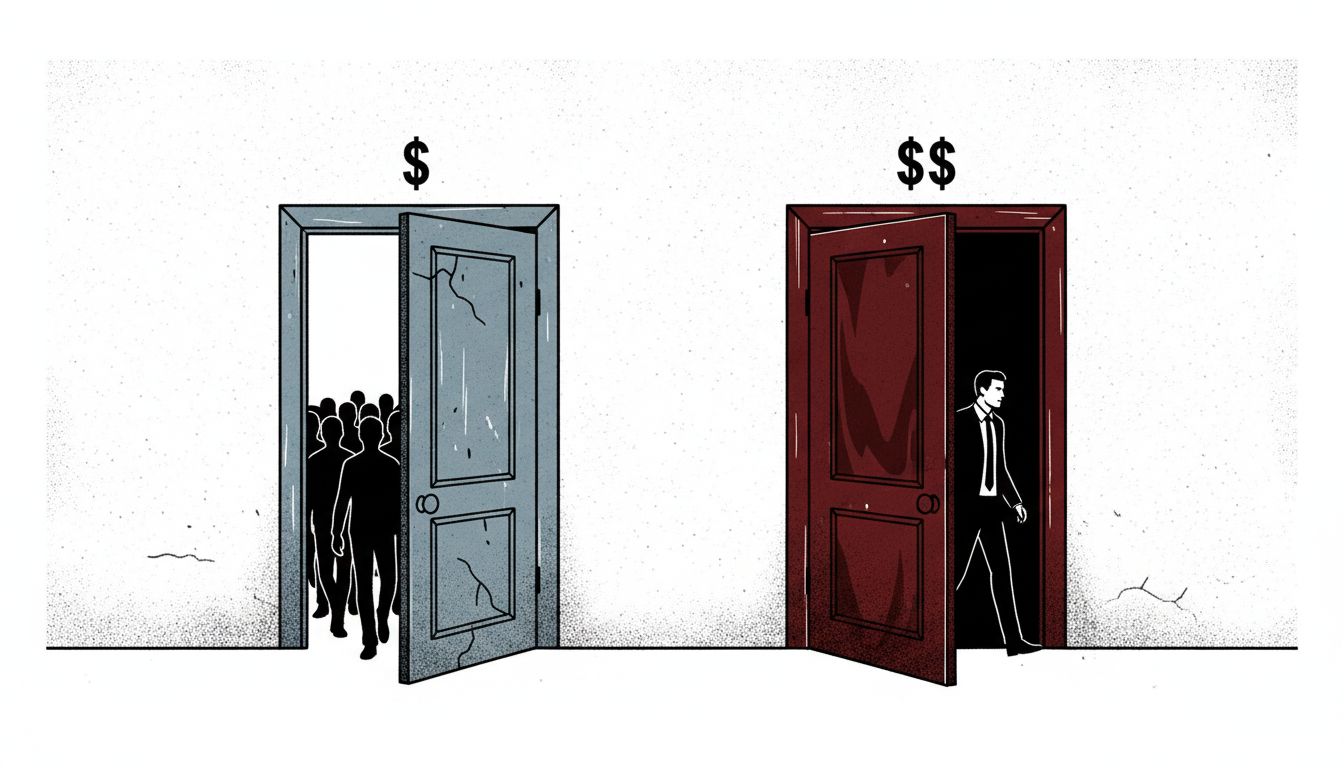

Picture a founder you know. Maybe it’s someone from your alumni network, or someone you follow on LinkedIn who seems to announce a new venture every eighteen months. Company one: a B2B SaaS tool that quietly disappears. Company two: a marketplace that raised a seed round and then went silent. Company three: somehow, inexplicably, a rocket ship. Everyone around them calls it luck. The founder calls it inevitable. They’re both wrong about why it happened.
The tech industry loves a clean origin story, but the messy truth is that most celebrated founders left a graveyard of failed companies behind them before hitting their defining win. Stewart Butterfield failed with a game called Game Neverending before accidentally building Flickr. He then failed again with another game called Glitch before the team built what would become Slack. Max Levchin’s first four companies went nowhere before PayPal. This pattern is so consistent that dismissing it as coincidence is its own kind of willful blindness. The mythology around overnight success is one of the most corrosive forces in startup culture, and it obscures something genuinely useful about how companies actually get built.
The Failure Isn’t the Point. The Residue Is.
Here’s what most post-mortems miss. When a startup fails, the founder doesn’t just lose money and time. They accumulate something that has no line item on a balance sheet: pattern recognition about human behavior, organizational dynamics, and market timing that you simply cannot read out of a book or learn in an MBA program.
The first failure teaches you what a bad co-founder relationship feels like from the inside, usually around month fourteen when the pressure gets real. The second failure teaches you that building a product users say they want and building a product users actually pay for are completely different disciplines. By the third attempt, you stop mistaking enthusiasm in customer discovery calls for purchasing intent. This is not abstract wisdom. It’s scar tissue, and scar tissue is load-bearing.
Founders who skip this process, typically because they got lucky early or because they raised a large enough round to paper over their mistakes for a few years, often build fragile companies. They hit a wall the moment conditions change and they have no prior map for navigating it.
The Market Feedback Problem
There’s a deeper mechanism at work here that goes beyond personal growth. Serial founders are essentially running cheap experiments on market structure, and each failed company is a data point.
Consider what actually changes between a founder’s failed attempt and their successful one. It’s rarely the quality of the idea in isolation. More often, it’s their ability to read what the market is actually doing versus what it’s saying. Early customers are notoriously unreliable narrators of their own needs. They describe problems in the vocabulary they already have, which means they often send you in the wrong direction if you listen too literally. Understanding why your first customer is often pointing you toward a dead end is one of those counter-intuitive lessons that almost no one learns without burning a company on it first.
Founders who have been through two or three cycles develop a specific skill: they learn to extract the signal from customer feedback while discarding the noise. They stop optimizing for what users say they want in interviews and start watching what users actually do with their time and money. That discrimination is worth more than any amount of product sense you’re born with.
The Network Effect of Failure
There’s also a structural advantage that accumulates with each attempt, and it has nothing to do with personal psychology. Every failed company leaves behind a network. Ex-employees who respect the founder even though the company didn’t work out. Investors who passed but remember the quality of the thinking. Potential customers who liked the vision but couldn’t commit at the time. Journalists who covered the first attempt and will take your call for the second.
When Butterfield launched Slack’s early beta, he wasn’t starting from zero. He had relationships from Flickr, from Glitch, from years of operating in the industry. The product still had to earn its own success, but the distribution surface area was completely different from what a first-time founder had access to. This compounding of relational capital is one of the most underrated advantages in venture-backed startups, and it’s essentially impossible to shortcut.
Why Investors Quietly Know This
Venture capitalists publicly celebrate the visionary solo founder with the perfect zero-to-one insight. Privately, most experienced investors will tell you they weight prior operational experience heavily, including prior failures, when evaluating founders. Not because failure is inherently valuable, but because the specific failures that teach market reading, team dynamics, and capital discipline are hard to fake in a pitch meeting.
This is also why the VC model tolerates, and arguably requires, a high failure rate across a portfolio. The firms aren’t just betting on individual companies. They’re subsidizing the education of a class of founders, knowing that the ones who survive the early losses will build the companies worth owning a decade from now. It’s an uncomfortable thing to say out loud, but the economics make it plain.
This dynamic also explains something odd about how successful companies often price themselves. The strategy of offering free tiers to capture users before monetizing later is frequently pioneered by founders who already burned through a company trying to charge too early. They learned the hard way what the market would bear and restructured their entire business model around that painful lesson.
What to Do With This If You’re Still in the Middle of It
If you’re currently running a company that feels like it might be turning into one of these formative failures, a few things are worth sitting with.
First, be ruthless about documenting what you’re learning. Not the sanitized version for investors, the actual version. What did your initial customer thesis get wrong? Where did your team break down under pressure? What did the market tell you through its behavior that your research never predicted? That documentation is the asset you’re building even when the company isn’t.
Second, resist the urge to immediately reframe the failure as a pivot. Sometimes a company is just done, and pretending otherwise keeps you from fully processing what happened and carrying the right lessons forward.
Third, stay in the industry. The network effects of staying visible, staying curious, and staying in the conversation compound quietly. The founder who disappears after a failure has to rebuild from scratch. The one who stays in the room walks into their next attempt with real momentum.
The founders who succeed on their third or fourth try aren’t luckier than the ones who quit after their first failure. They’re just running a longer game, and they figured out that the tuition you pay in failed companies is the most efficient education the industry has ever invented.