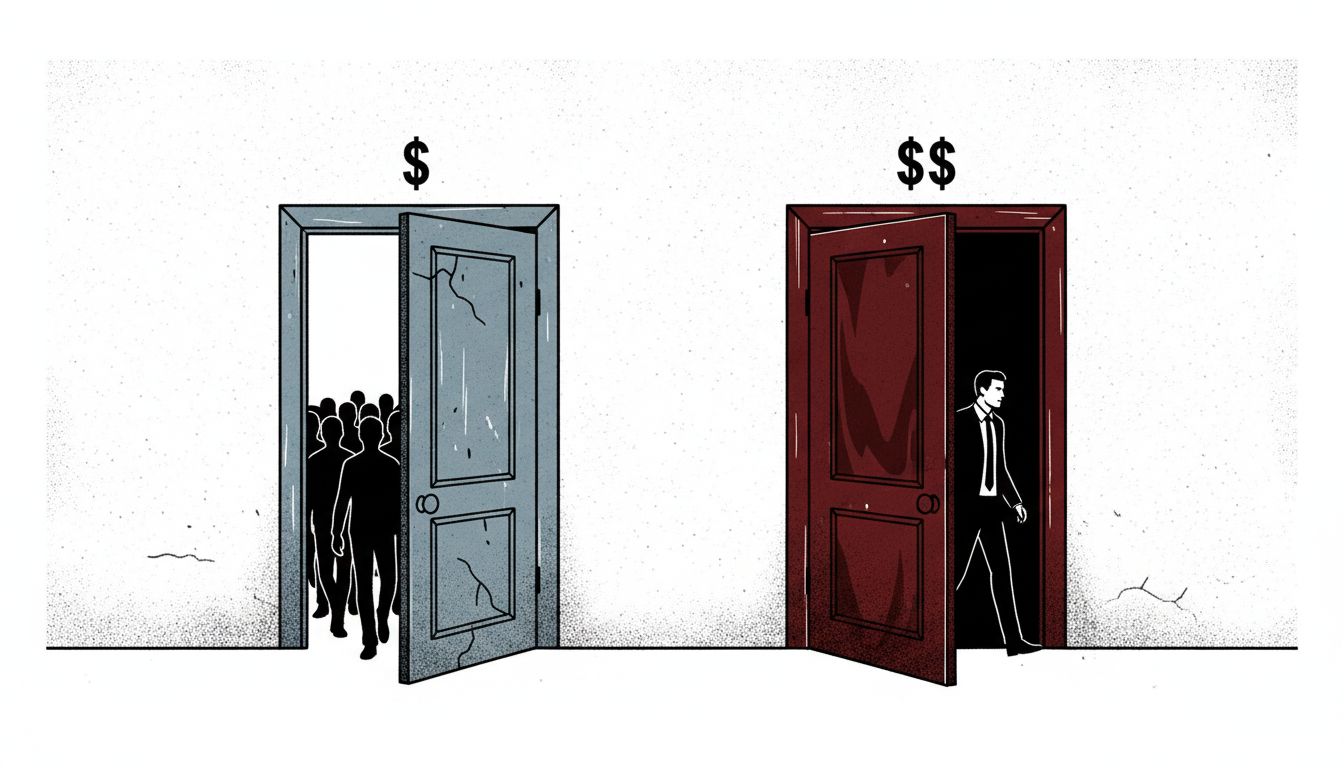

Picture two founders in a conference room at 11pm, six months into building their startup. One wants to pivot the product toward enterprise clients. The other thinks that’s a slow death and wants to double down on consumer. They’ve been arguing for three hours. An outside observer might call this a dysfunction. Anyone who has actually built a company knows this is the job.
Successful startups deliberately choose crowded markets because they understand that the real competitive advantage is rarely the idea itself. The same logic applies to co-founder selection. The advantage isn’t in alignment. It’s in the argument.
The Myth of the Visionary Duo
Startup lore loves a good origin story. Two friends in a dorm room, a shared obsession, a perfectly synced vision. The mythology insists that great co-founders finish each other’s sentences. The reality is messier and more interesting.
Research from Noam Wasserman at Harvard, documented in his book The Founder’s Dilemmas, found that founding team conflict is not an aberration. It is a near-universal condition. What separates successful companies from failed ones isn’t the absence of disagreement. It’s the quality of the disagreement.
The founders who struggle most aren’t the ones who fight. They’re the ones who agree too easily.
There’s a term for what happens when a founding team is too aligned: groupthink with a pitch deck. Everyone nods at the product roadmap. Nobody questions the customer acquisition assumptions. The deck looks beautiful. The business quietly fails.
What Productive Friction Actually Looks Like

The founders who deliberately seek out disagreement aren’t masochists. They’re playing a longer game.
Stewart Butterfield and Cal Henderson at Slack are a useful case study. Butterfield came from design and product. Henderson came from engineering and systems. Their instincts frequently clashed during the build phase. Butterfield wanted to prioritize onboarding experience. Henderson wanted infrastructure that could scale before the growth hit. Both were right. Both were also wrong without the other.
What made that tension generative rather than destructive was something specific: they disagreed about approach, not about what success looked like. This is the distinction that almost nobody talks about when they advise founders on co-founder selection.
Misalignment on values or end goals is corrosive. Misalignment on tactics, priorities, and methods is fuel.
This pattern shows up elsewhere in the startup ecosystem too. Think about how early-stage founders win by pretending they don’t know the rules. The co-founder who challenges conventional thinking is doing the same thing internally. They’re the person who asks why you’re following the playbook when the playbook was written for a different game.
Why Echo Chambers Kill Companies Quietly
Here’s the thing about a founding team that agrees on everything. They’re incredibly efficient right up until they’re catastrophically wrong.
A team of true believers moves fast. They make decisions quickly. They don’t waste time relitigating fundamentals at every meeting. This looks like a strength during the early sprint. It becomes a liability the moment the market sends a signal they didn’t expect.
A dissenting co-founder is the mechanism by which that signal gets heard.
Think about what happens when a startup builds a product roadmap nobody internally challenged. The assumptions baked into that roadmap have never been stress-tested by someone with genuine skin in the game and a different perspective. When reality diverges from the plan (and it always does), there’s no internal language for processing that divergence. The team hasn’t practiced disagreeing productively, so when the real disagreements show up, they’re unprepared.
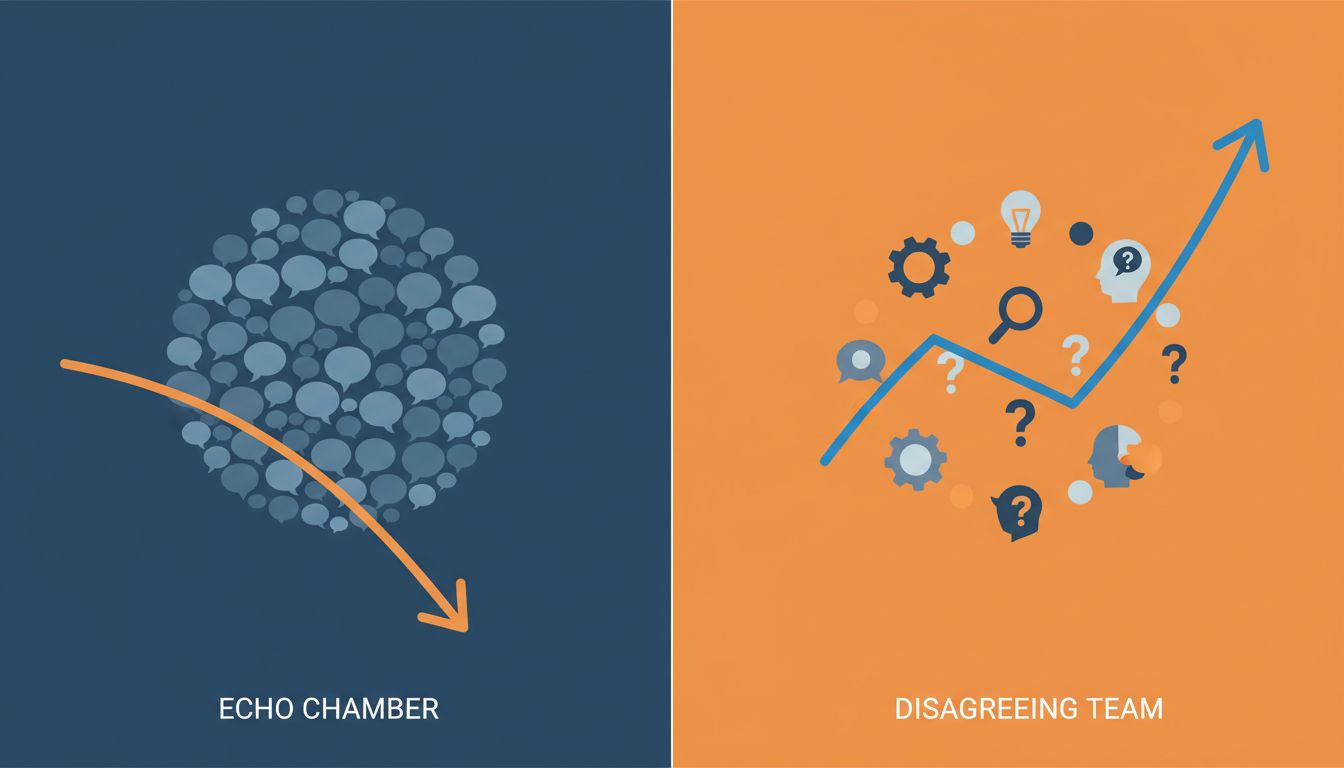
This is related to a broader dynamic that plays out across the tech industry. Companies that build products using only internal consensus tend to create things that feel internally coherent and externally irrelevant. The best teams have deliberately introduced friction into their process. As we’ve covered before, the most productive teams stopped using real-time collaboration tools precisely because constant agreement and constant sync can flatten the individual thinking that produces breakthroughs.
The Right Kind of Disagreement
Not all disagreement is useful. This is where the nuance lives.
Founders who disagree about execution are valuable. Founders who disagree about whether to be honest with investors are not.
The best co-founder pairings share a specific set of things in common while diverging on others. They typically share: risk tolerance, ethical standards, the definition of what winning looks like, and a baseline commitment to the company over ego. They typically diverge on: how to prioritize the product roadmap, which metrics matter most right now, how aggressive to be with hiring or spending, and how to read the market.
One useful framing I’ve heard from founders who got this right: they describe their co-founder as the person who makes them defend their thinking. Not someone who tears down ideas for sport. Someone who won’t let a bad idea slide just because you’re tired or excited.
That’s a harder person to find than someone who shares your vision. It’s also a much more valuable one.
How to Use Disagreement as a Due Diligence Tool
If you’re evaluating a potential co-founder, the smartest thing you can do is find something you disagree on and watch what happens.
Do they get defensive? Do they dismiss your concern without engaging it? Do they change their position immediately just to smooth things over? Any of these is a red flag. What you’re looking for is someone who takes your disagreement seriously, pushes back with specifics, and arrives at a position that’s genuinely better than either starting point.
This is also a useful filter for the founding team dynamics you should build over time. The startups that last are the ones where nobody is afraid to be the person who says the thing everyone is thinking but nobody wants to say.
That person is uncomfortable to have around. They’re also the reason you catch the fatal flaw in the business model before it costs you everything.
The startup mythology wants you to find a co-founder who believes in your vision as much as you do. The actual job is to find someone who believes in the mission and is willing to fight you on everything else. That’s not a worse partnership. It’s the only one that actually works.