A founder I know built a project management tool for creative agencies. His first hundred customers loved it. They sent referrals. They left glowing reviews. They paid on time. By all conventional startup metrics, he had product-market fit.
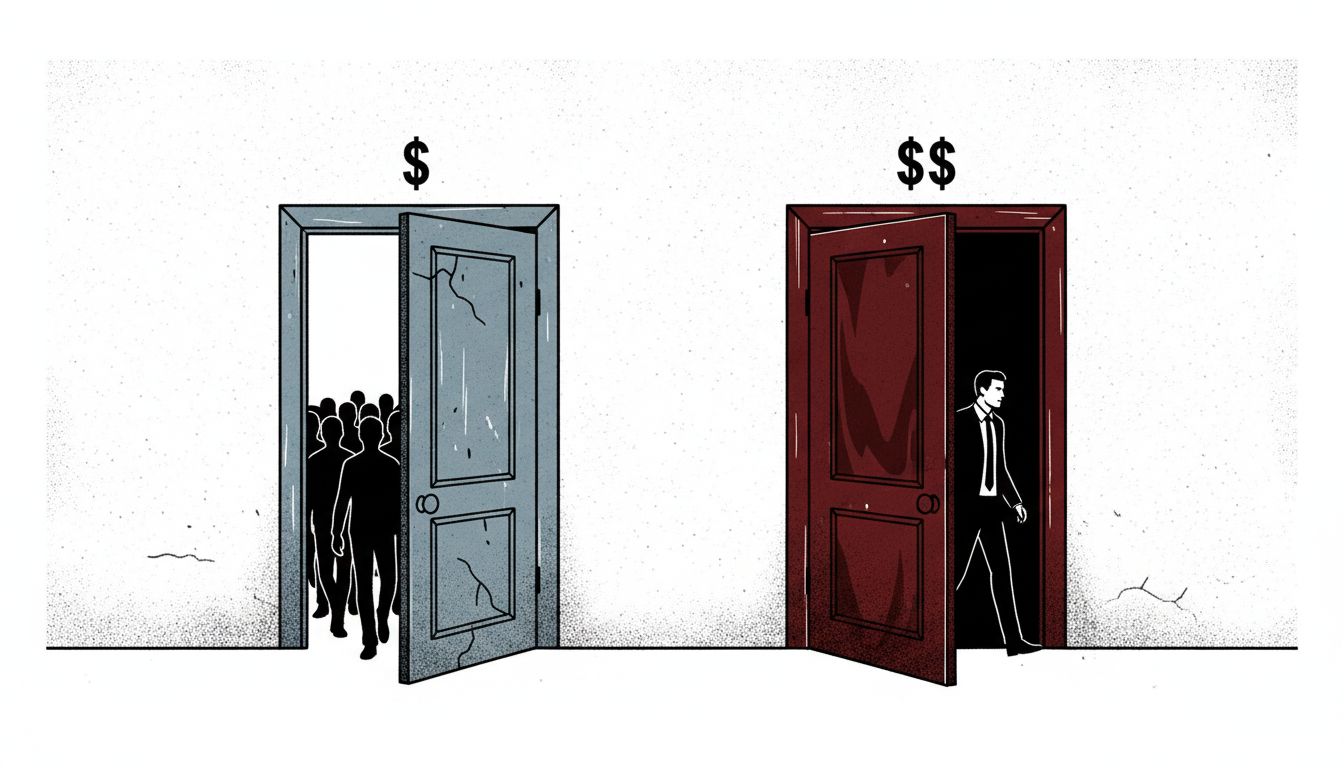
Then he tried to grow. Sales cycles stretched. Churn crept up. The features his best early customers demanded made no sense to anyone outside boutique creative shops. Three years in, he had a product perfectly optimized for a market too small to build a real company on. His first hundred customers hadn’t validated his startup. They’d calcified it.
This is not a rare story. The customers who keep you alive in the early months are usually the ones who are easiest to reach, most forgiving of rough edges, and most unlike the mainstream market you actually need to capture. Here’s what that costs you, and what to do about it.
1. Your Early Customers Self-Select for High Tolerance
The people willing to use a half-finished product are enthusiasts, personal connections, and edge-case users with unusually specific problems that happen to match what you built. They will put up with bad UX, missing features, and unreliable performance because they’re invested in the idea, or because they’re desperate, or because they know you personally.
This is useful for survival. It is catastrophic as a signal. When you build your product roadmap around their feedback, you’re optimizing for a user who doesn’t represent your eventual customer base at all. The mainstream customer you’ll need at scale has zero patience for the rough edges your early adopters cheerfully worked around. You’ve been training on the wrong dataset.
2. Early Customers Distort Your Pricing Intuition
Early customers often pay too little, because you were desperate to close them, or too much, because they had a niche problem and your solution was the only one. Neither number tells you what the actual market will pay.
Founders who set pricing based on what early customers paid tend to anchor too low and then struggle to raise prices without triggering churn among their existing base. The customers who got in cheap become a constituency with structural influence over your business model. You end up defending a price point that never made sense for the company you were trying to build. Founders price their products backwards constantly, and misreading early customer willingness to pay is one of the main reasons why.
3. Retention Metrics Lie When the Sample Is Too Friendly
A ninety percent retention rate sounds great. Among your first hundred customers, it might mean you retained nine of your ten college roommates and all three clients who owed you a favor. Cohort analysis only becomes meaningful when you’re acquiring customers through repeatable, scalable channels from a population that resembles the broader market.
The trap is using early retention numbers to justify growth spend. You raise a round on the strength of those metrics, hire a sales team, open up acquisition channels, and discover that the customers you acquire through paid search or outbound sales churn at twice the rate of your original cohort. The unit economics that looked so clean in your pitch deck collapse immediately at scale.

4. The Feature Requests You Hear Are the Wrong Feature Requests
Early customers are vocal. They email you directly. They’re in your Slack. They have opinions about everything. This feels like invaluable product intelligence, and some of it is. But their requests reflect their specific workflows, their specific industries, and their specific tolerance for complexity, none of which generalize.
A pattern I’ve seen repeatedly: a B2B SaaS company builds five major features in its first two years based on early customer requests, then discovers that those features are the primary reason enterprise prospects won’t buy. The early customers wanted power and flexibility. The mainstream market wants simplicity and predictability. You built for the wrong audience because they were the only audience giving you feedback.
5. Word-of-Mouth From Early Customers Reaches the Wrong People
Referrals from your first hundred customers tend to land in the same networks those customers inhabit. If your early customers are small agencies, you get referred to more small agencies. If they’re academic researchers, you get more academic researchers. The channel reinforces the segment.
This feels like growth, and in terms of raw numbers it is. But you can spend two or three years riding a referral flywheel that deposits you deeper and deeper into a niche rather than expanding toward a scalable segment. By the time you realize the flywheel is spinning in the wrong direction, you have two hundred customers who are all wrong for what your company needs to become, and a product built around their needs.
6. You Learn the Wrong Lessons About Sales
Closing your first hundred customers often requires extraordinary founder involvement, personal relationships, and a pitch that relies heavily on your vision and credibility rather than on a repeatable value proposition. This is fine. It is also completely unscalable, and the lessons you take from it are actively harmful when you try to build a sales team.
Founders who mistake early sales success for a repeatable sales process hire the wrong salespeople, write the wrong playbooks, and spend six months wondering why their new team can’t replicate results. The answer is usually that the founder was selling a story and a relationship, not a product. The wrong customer dynamic plays out across the entire go-to-market motion, and sales is where it surfaces most painfully.
7. The Fix Is Not to Ignore Early Customers
None of this means you should treat early customers as noise. They are genuinely valuable for stress-testing core functionality, identifying the sharpest version of your value proposition, and building enough revenue to stay alive long enough to find the right market.
The discipline required is treating early customer data as a starting hypothesis rather than a validated conclusion. Keep a running list of the ways your early customers are unusual. Track which of their needs are specific to them and which are likely to generalize. Talk to people who chose not to buy from you, because their objections are a much better preview of the mainstream market than your early customers’ enthusiasm.
Scale the things that work regardless of who your early customers are: the core problem you’re solving, the fundamental value exchange, the operational muscles you’re building. Be deeply skeptical of everything else. Your first hundred customers saved your company. Your next ten thousand will have to be a different kind of person entirely.