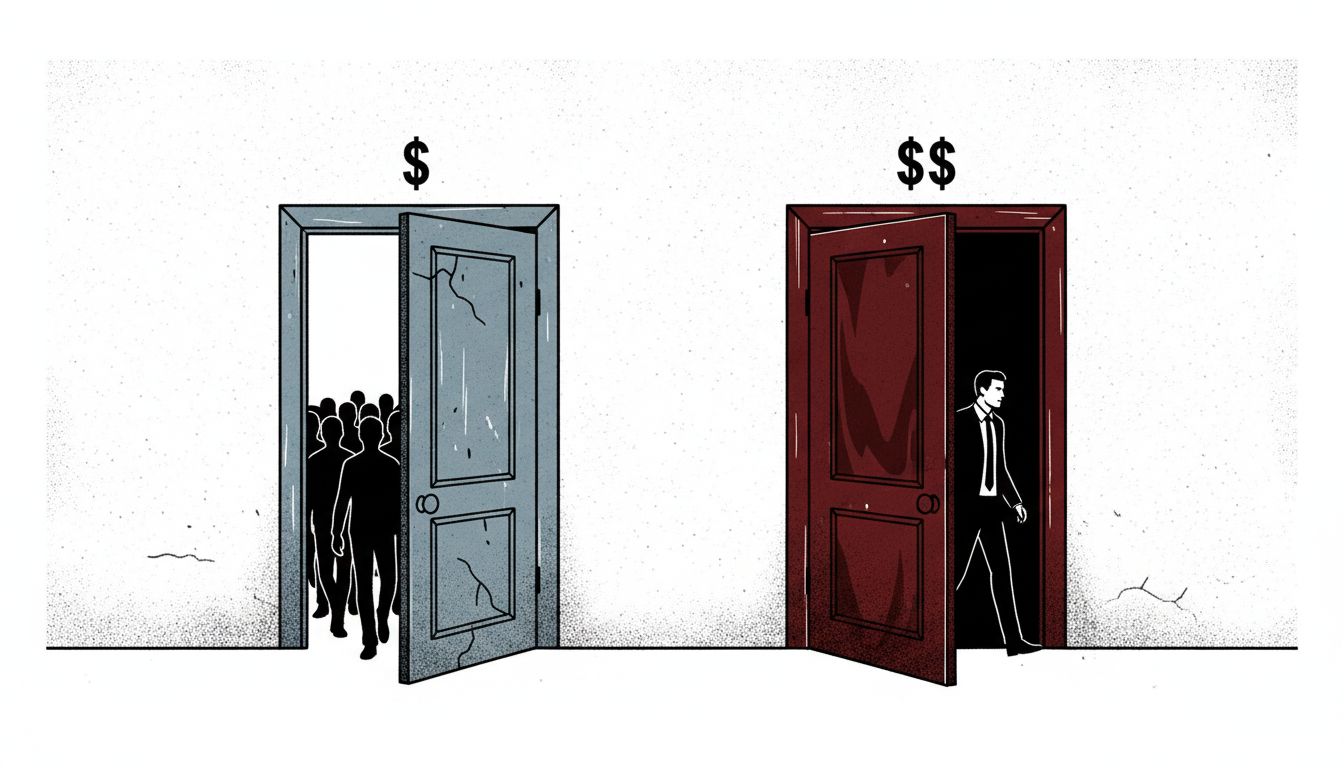

The Customers Who Kept You Alive Are Not the Ones Who Will Make You Big
A friend of mine ran a B2B analytics startup for four years before admitting to himself that he had been building the wrong product for two of them. Not wrong in the obvious sense. Revenue was growing. The team was shipping. Customers were paying and renewing. But when he tried to move upmarket, every enterprise conversation fell apart in the same place: the product assumed a level of manual configuration that his early customers had been happy to do themselves. They were analysts who liked tinkering. The enterprise buyers he was pitching were not.
He had optimized an entire product around the preferences of a customer segment that was never going to make him a hundred-million-dollar company.
This is not a rare story. It might be the most common non-obvious failure mode in startups that actually get traction. You survive the early months because early adopters find you. They tolerate your rough edges, configure around your limitations, and evangelize anyway. You learn everything from them. You build for them. And then, when it is time to grow, you discover that everything you built is upstream of a customer type that does not scale.
Why Early Adopters Are a Biased Sample
Early adopters are structurally different from mainstream buyers in ways that matter enormously for product decisions.
They have a higher pain tolerance. They found you when you were rough and chose to stay. That means they self-selected for patience with gaps in your product, which means the gaps never felt urgent enough to fix.
They have more technical sophistication, on average. Not always, but often. The person willing to adopt a product before it has a good onboarding flow, decent documentation, or an established reputation is usually someone who can figure things out. Build for that person long enough and you will produce a product that requires figuring out.
They have unusual urgency. They adopted early because the problem was acute enough to tolerate the friction. That means your product’s value proposition is validated against people who needed it badly. The mainstream market may need it less acutely, which means the same product may not convert.
None of this means early adopters are bad. They are the reason you have a company. But their preferences, workflows, and tolerance levels are a skewed signal, and if you treat that signal as representative, you will build yourself into a corner.
The Product Debt You Do Not See Accumulating
When you build features in response to early-customer requests, you are making bets about what future customers will also need. Sometimes those bets are right. Often they are not, and the problem is that wrong bets do not announce themselves.
This is a specific form of product debt that is harder to recognize than technical debt because it shows up as features rather than deficiencies. The product grows. The roadmap fills. Customers are happy. And the entire time, the product is quietly becoming something that a different, larger customer segment will find either over-complicated or mis-shaped for their needs.
Consider what happened with project management tools in the mid-2010s. Several startups built products that early adopters, mostly developers and technical product managers, loved. The workflows were powerful but assumed familiarity with concepts like sprints, story points, and dependency graphs. When those companies tried to move into broader organizational adoption, they ran into non-technical teams who found the interfaces alienating. The products were not bad. They were optimized for the wrong moment in their own growth.
The companies that solved this did not simply add a simpler mode. They rethought the entire information architecture for a user who had different mental models. That is expensive to do after the fact. It is much cheaper if you see it coming.
The Retention Trap
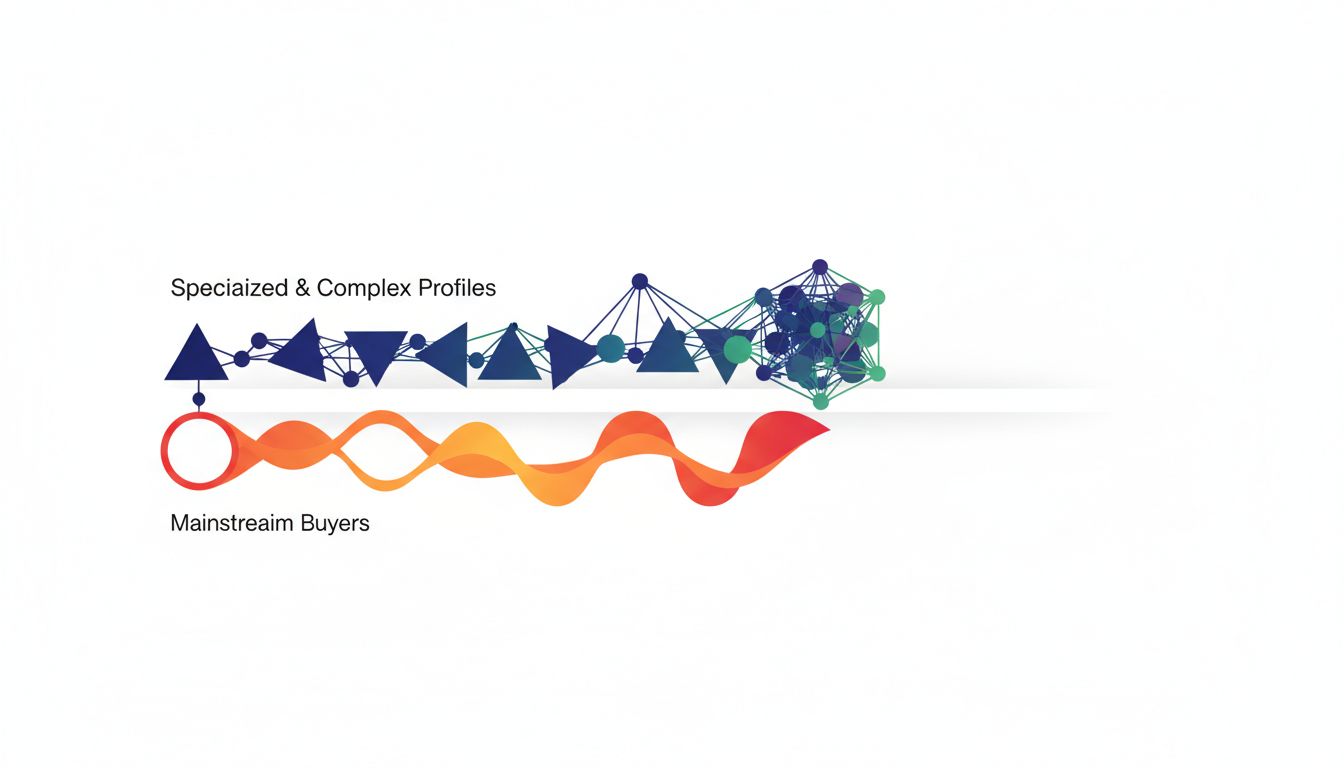
Here is the part that makes this problem particularly hard to escape: your early customers have good retention, and good retention feels like product-market fit.
If customers are staying and paying, the natural instinct is to keep serving them well. That is good instinct, up to a point. The trap is when serving your existing base well starts to conflict with building for the customers you need to acquire next. Early-customer requests that feel like reasonable incremental improvements can quietly be moving the product away from mainstream appeal.
Stripe spent years carefully managing the tension between what their developer-first early adopters wanted and what larger enterprise finance teams would need. The developer experience was the thing that made Stripe great, but pure developer tooling was not going to get them into large enterprise contracts. They had to build a second product surface, essentially, without breaking the first one. That is hard. It is much easier to see the fork coming before you have thousands of customers pulling one direction.
The companies that navigate this best do one thing consistently: they start talking to their target future customer before they need them. Not to sell to them yet, but to understand where the current product would land. What feels missing. What feels excessive. What the buying process looks like. You are not building for them immediately, but you are collecting the data that tells you when you are drifting.
What Customer Segmentation Actually Requires You to Do
Most founders understand conceptually that different customers have different needs. The part that is harder to internalize is that this requires you to explicitly decide which customer segment is your scaling segment and then hold that decision against the pressure of real revenue.
A paying early customer asking for a feature is not abstract. A future customer who might not like that feature is very abstract. The concrete beats the abstract every time, unless you have something that keeps the abstract real.
The practical version of this is maintaining what some teams call a scaling ICP (ideal customer profile) alongside your current-customer ICP, and running major product decisions against both. Not as a veto, but as a forcing function. When a request from an early customer conflicts with the scaling ICP, you should at least know that conflict is happening. Most teams make those tradeoffs unconsciously and invisibly, which means they cannot learn from the pattern.
This is related to a broader pricing and positioning problem. If you have priced your early product low to acquire customers, those customers have expectations about price that will not match your enterprise ambitions. Startups that charge more from day one are, in part, solving this problem by self-selecting for a customer who is closer to their scaling target.
How You Know You Are Stuck
There are specific signs that your early customers have constrained your scalability in ways you have not yet fully reckoned with.
Your sales cycle with new, larger prospects is longer than you expect and stalls in unusual places. Not at the demo stage, but after it, when they try to map the product to their actual workflows.
New customer onboarding requires significant manual support even though the product is mature. This usually means the product assumes context that only your most-engaged users have.
Your most loyal customers are also your most vocal critics of any simplification you attempt. They have built workflows on top of your complexity, and they will fight you when you try to clean it up. Their fight is rational from their perspective, but it is a sign that you built something optimized for their unusual sophistication.
Churn among new customers is higher than among customers who joined early. Not because your product has gotten worse, but because the gap between what new buyers expected and what they got is larger than the gap your early adopters experienced.
Any one of these in isolation is a normal startup problem. All of them together are a signal that you built a product that fits your first cohort very well and your target market somewhat poorly.
Getting Out Without Losing What You Have
The good news is that this is solvable. The bad news is that solving it requires honesty about timelines that founders usually resist.
You need to decide, explicitly, when you stop optimizing for your early customer segment and start optimizing for your scaling segment. This rarely happens cleanly, but having a deliberate plan beats drifting. For most B2B companies, this transition needs to start happening somewhere between customer fifty and customer two hundred, not after you have three hundred customers all shaped like your early adopters.
The decision has product implications (what to simplify, what to reframe, what to deprecate), sales implications (who to hire, what motion to run), and pricing implications. These need to move together. Companies that change their target segment but not their product end up with expensive salespeople failing to sell something that does not fit the buyer. Companies that rebuild the product for a new segment but do not change their sales motion never find the segment.
And keep your early customers. They are not problems to solve. They are your anchor, your reference point, and often your most enthusiastic word-of-mouth source. The goal is not to abandon them. The goal is to stop letting their preferences make all your decisions for you.
Your first hundred customers told you something was real. They do not get to tell you what it becomes.
What This Means
If your retention is good but your expansion is slow, check whether you have quietly built a product that fits an unusually tolerant customer segment. Talk to ten prospects who are closer to your scaling target and ask them to walk through the product honestly. If the friction points they describe are not on your roadmap, you have a prioritization problem that is going to get more expensive the longer you wait. Early customers save startups. They do not scale them. Those are different jobs, and the people who do them are rarely the same.