The Simple Version
When an AI assistant hedges its answers with phrases like “I think” or “I may be wrong,” it’s not because the model is genuinely unsure. It’s because the companies building these tools made a deliberate choice to design uncertainty into the output.
What’s Actually Happening Under the Hood
Large language models don’t experience doubt. They don’t have a confidence meter ticking away in the background, deciding how sure they feel before they speak. What they have is a probability distribution over possible next words, and once a response is generated, it’s generated. The model doesn’t know whether it’s right or wrong in any meaningful sense.
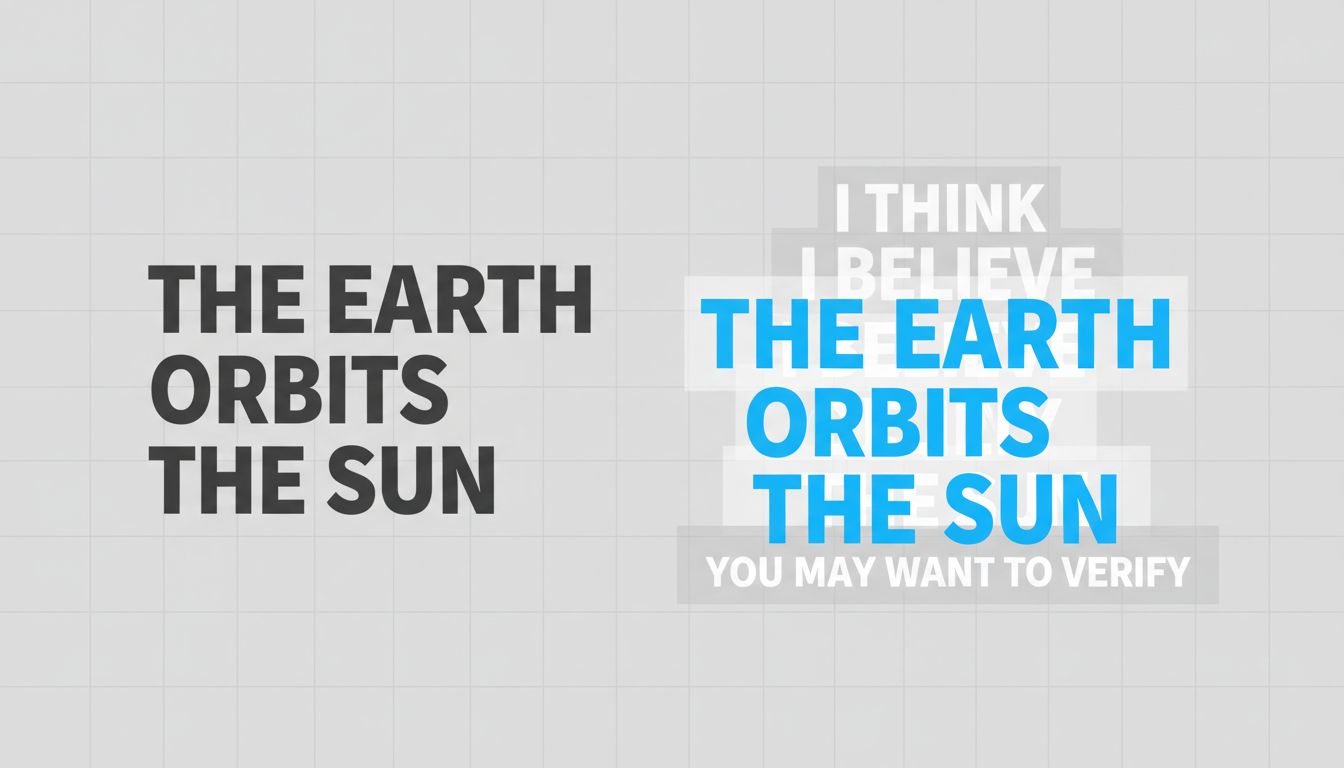
So when GPT-4 prefaces a medical answer with “I’m not a doctor, but,” or Claude says “I believe this is correct, though you may want to verify,” that language isn’t emerging organically from the model’s self-awareness. It’s baked into the behavior through a process called reinforcement learning from human feedback (RLHF), where human raters reward outputs that sound appropriately cautious and penalize ones that sound overconfident.
The model learns: hedge, and you get rewarded. State things flatly, and you risk being marked down. Over thousands of training iterations, hedging becomes the default register.
The Legal Logic Is Obvious Once You See It
Consider what happens when an AI gives a confident wrong answer versus a hedged wrong answer. In the first case, you followed bad advice from what felt like an authoritative source. In the second, you were warned.
This isn’t hypothetical. In 2023, two lawyers in New York submitted a court brief containing citations to cases that didn’t exist, generated by ChatGPT. The model had presented the fake citations without qualification. The lawyers were sanctioned. The case became a reference point in early discussions about AI liability, and you can bet it was studied carefully by every legal team at every AI company.
Building in verbal hedges is one of the cheapest ways to shift responsibility from the product to the user. If the model says “you should verify this,” and you don’t verify it, that’s on you. This is the same logic that puts “results may vary” on every supplement ad. It’s not consumer protection. It’s liability architecture.
This kind of invisible design decision shapes user behavior at scale without users realizing it. As we’ve written before, software companies set invisible defaults that make millions of decisions before you do, and the way AI assistants frame their confidence is one of those defaults.
The Psychological Dimension Is Subtler and More Interesting
Here’s the counterintuitive part: people actually trust AI more when it sounds appropriately uncertain.
Researchers studying human-computer interaction have consistently found that systems expressing calibrated confidence, admitting when they might be wrong while still providing useful answers, are rated as more trustworthy than systems that speak in absolutes. A doctor who says “I think this is the issue, but let’s run a test to confirm” reads as more competent than one who declares a diagnosis without pause.
AI designers know this. Uncertainty language isn’t just legal cover. It’s also a trust-building mechanism. An AI that says “I could be wrong about this” feels more honest and self-aware, which makes users more likely to keep using it, more likely to share it, and more likely to pay for it.
The irony is that this manufactured epistemic humility often makes users less careful, not more. If the AI seems thoughtfully uncertain about its limits, many people assume it knows where those limits are. In practice, the model hedges with the same boilerplate phrasing whether it’s 99% right or completely fabricating something.
When the Uncertainty Is Real and When It Isn’t
There’s a version of this that’s genuinely legitimate. Language models do produce outputs with varying degrees of reliability. Questions about recent events, highly specialized domains, or prompts that require precise numerical reasoning are genuinely harder for these systems. Signaling that some answers deserve more scrutiny than others would be useful.
The problem is that current AI systems can’t reliably distinguish those cases from the inside. The model that confidently invents a legal citation uses the same architecture as the one that correctly states the boiling point of water. There’s no internal alarm that fires when the model is drifting into confabulation.
So the hedging language gets applied as a blanket policy rather than a calibrated signal. The model says “I believe” before telling you something it has absolutely correct, and it says “I believe” before telling you something completely made up. The phrase carries no information about actual reliability. It’s noise dressed up as signal.
What Good Design Would Look Like
A well-calibrated AI assistant would behave more like a good analyst. High-confidence claims stated plainly. Genuine uncertainty flagged specifically, with a reason: “This is from before my training cutoff, so you’ll want to check for updates” rather than a reflexive “I may be wrong.”
Some newer approaches are moving in this direction. Retrieval-augmented generation (RAG) systems, which pull from verified sources before answering, can sometimes attach real provenance to claims. Citation-based models can at least show you where an answer came from, even if they can’t fully evaluate it.
But the dominant commercial AI products still default to blanket hedging because it’s simpler to implement, cheaper to maintain, and serves multiple business goals at once. It makes lawyers happy, makes users feel the system is self-aware, and costs nothing extra to produce.
The phrase “I think” has never been cheaper to generate, or more carefully engineered.