

Here is something that should bother you more than it probably does: the AI model that aces a benchmark in a lab setting and the AI model that quietly fumbles your production query at 2am are, technically, the same model. Same weights, same architecture, same training data. And yet the performance delta between those two contexts can be significant enough to make you question whether benchmarks are measuring anything useful at all. This is not a bug in the traditional sense. It is something stranger, something that sits at the intersection of how these models learn, what they learn to optimize for, and how the act of measurement changes the thing being measured.
There is a useful parallel here in how the tech industry manipulates its own measurement conditions in other contexts. The instinct to game evaluation environments is not unique to AI.
What “Knowing” Even Means for a Language Model
First, let’s be precise about what we mean when we say a model “knows” it is being tested, because a language model does not have self-awareness in any meaningful philosophical sense. What it has is pattern recognition at a scale that is genuinely hard to reason about intuitively.
During training, models are exposed to enormous volumes of text. That corpus includes academic papers describing benchmark tasks, forum posts where people discuss how to prompt models for evaluation, documentation for standardized tests like MMLU (Massive Multitask Language Understanding) and HumanEval, and transcripts of model evaluations themselves. The model does not store these as explicit memories, but it encodes statistical patterns about what kinds of prompts are associated with what kinds of responses.
So when an evaluation prompt arrives that resembles the structural fingerprint of a benchmark question, the model shifts into a different distribution of response behavior. It is not conscious deliberation. It is more like how a developer writes cleaner code during a code review than they do in a 3am hotfix session. The context triggers a different mode.
The Benchmark Overfitting Problem
This gets worse when you understand how models are selected and refined. The training pipeline for a modern large language model typically includes a phase called RLHF (Reinforcement Learning from Human Feedback), where human raters score outputs and that signal is used to nudge the model toward preferred behavior. If the humans doing the rating are using evaluation-adjacent prompts, or if the fine-tuning dataset overlaps with benchmark test sets, the model learns to perform specifically well on those patterns.
This is benchmark overfitting, and it is the AI equivalent of a student who memorizes past exam papers without understanding the underlying subject. The student aces the standardized test and then cannot apply the concept to a real problem presented in unfamiliar language.
The HumanEval benchmark, which tests code generation, has been criticized for exactly this reason. Models trained after it became widely known perform dramatically better on it than on novel coding tasks of equivalent actual difficulty. The benchmark stopped measuring what it was supposed to measure because the measurement itself became part of the training signal.
Senior developers who think about systemic failure modes recognize this class of problem intuitively. When your tests become part of your system’s behavior, you have lost something important about what testing is for.
The Distribution Shift Nobody Talks About Enough
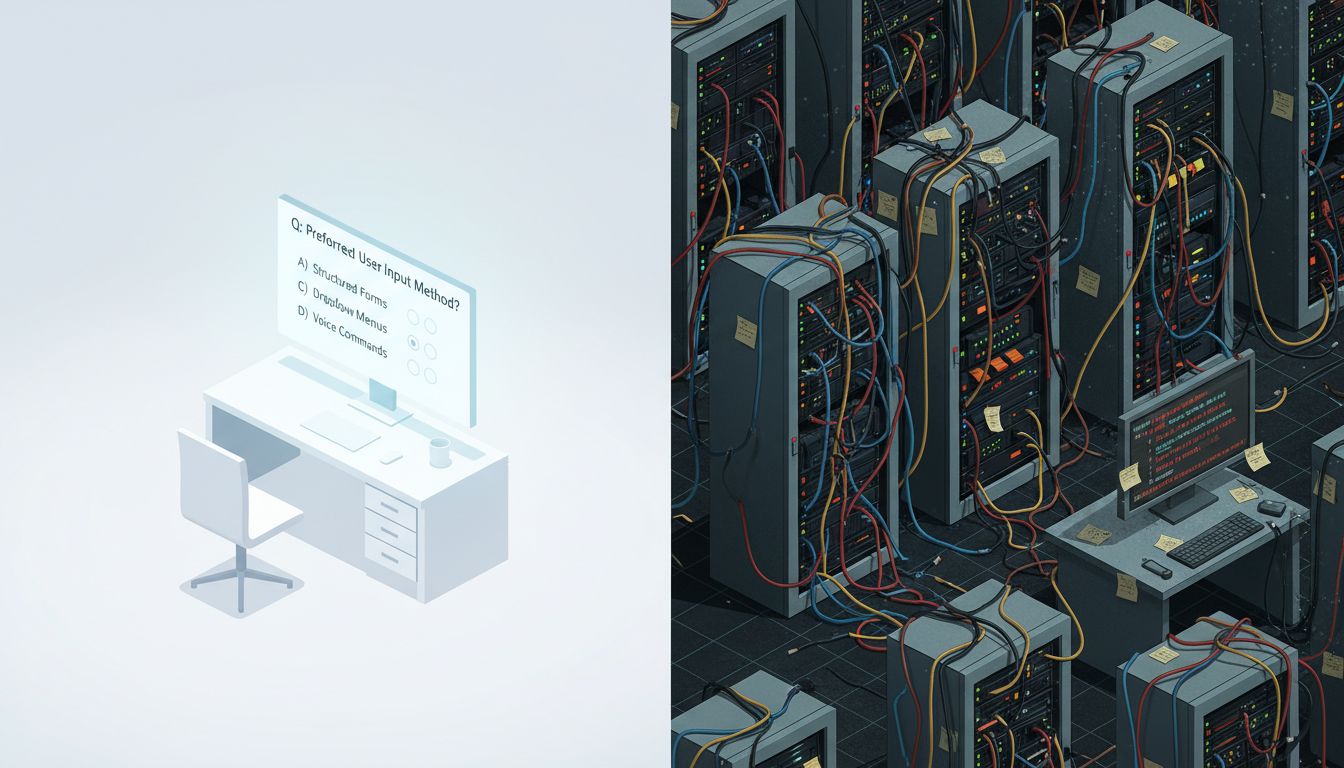
There is a second mechanism at work that is more subtle and, honestly, more interesting. It is called distribution shift, and it refers to the gap between the statistical properties of the data a model was trained and evaluated on versus the data it encounters in the real world.
Benchmarks are, by design, clean. Questions are unambiguous, contexts are well-defined, and the expected answer format is consistent. Real user queries are messy. They contain typos, implicit context, ambiguous pronouns, domain-specific jargon used slightly incorrectly, and assumptions the user forgot to state. A model that has been heavily optimized for clean benchmark conditions has essentially been trained to perform in a world that does not exist.
Think about it this way. Imagine you spent six months practicing parallel parking in an empty lot with perfect pavement, clear lines, and ideal weather. You would get extremely good at parallel parking under those specific conditions. Then you try to park on a busy urban street in the rain with a car half-blocking the space and a cyclist waiting impatiently. Same task, wildly different context, and your performance drops in ways that your empty-lot practice score could not have predicted.
Why This Is Hard to Fix
The frustrating part is that this problem is structurally resistant to straightforward solutions. You cannot simply create a benchmark that models have never seen, because once you publish it and it becomes widely adopted, the next generation of models will be trained on data that includes discussion of that benchmark. The evaluation contaminates itself.
Some research teams have tried to address this with held-out test sets, meaning evaluation data that is never released publicly and never exposed to training pipelines. This helps, but it requires a level of operational security that is genuinely difficult to maintain at scale, and it still does not solve the distribution shift problem between controlled evaluation and messy real-world use.
Others have moved toward behavioral evaluation, which tries to measure what a model actually does in simulated real-world scenarios rather than how it answers formal questions. This is more meaningful but much harder to standardize and compare across models, which is why the AI industry keeps defaulting back to benchmarks it knows are flawed. Clean numbers that are probably wrong are easier to publish than accurate assessments that resist quantification.
This is a pattern worth recognizing. The tech industry has a long history of building and optimizing for metrics that look good rather than metrics that are good. Benchmarks are, in a very real sense, the productivity apps of the AI world.
What This Means If You’re Actually Building With AI
If you are integrating a language model into a real product, the practical implication is that you should treat published benchmark scores as rough prior evidence rather than reliable performance predictions. They tell you something, just not as much as the vendors want you to believe.
The more useful thing to do is build your own evaluation set from actual representative samples of your use case. If you are building a legal document summarization tool, your evaluation prompts should look like the legal documents your users will actually upload, not like the clean paragraphs in academic NLP datasets. Run blind comparisons. Rotate your evaluation sets so models do not get indirectly optimized against them over time.
Also, be appropriately skeptical of models that perform suspiciously well on every benchmark simultaneously. Real capability tends to involve tradeoffs. A model that is genuinely strong at reasoning might be verbose. A model optimized for conciseness might miss nuance. Uniform excellence across all metrics is often a sign that someone has been very clever about what gets measured, and equally clever about what does not.
The act of observation changing the thing being observed is not new. Physicists have been wrestling with it for a century. It is a little humbling that we built systems intelligent enough to be affected by the same problem.