

Backward Compatibility Is Not a Feature. It Is a Fence.
Backward compatibility gets written about as though it is purely an engineering virtue, a sign of respect for users who built things on top of your platform. Sometimes it is. But it also functions as a competitive weapon, and the two uses are not always easy to tell apart from the outside.
Here is what the business logic actually looks like.
1. File Formats as Moats
Microsoft’s .doc and .xlsx formats were never designed to be open. For decades, the internal structure of a Word document was poorly documented, inconsistently implemented, and frequently updated in ways that only Microsoft’s own software could reliably handle. When competitors like WordPerfect or later LibreOffice tried to import .doc files, they got close but never quite right. Footnotes would shift. Tables would break. That wasn’t incompetence on the competitors’ part. It was the predictable result of trying to reverse-engineer a format the owner had no interest in helping you understand.
The promise to users was continuity: your files will always open. The side effect for the market was that switching to a competitor carried real risk of corrupting years of documents. That asymmetry compounds over time. A company with fifteen years of .xlsx spreadsheets is not evaluating Google Sheets on features alone. It is evaluating the cost of potential format loss, and that cost is hard to quantify and easy to overestimate, which is exactly how incumbents like it.
2. APIs That Lock Developers In Before Locking Competitors Out
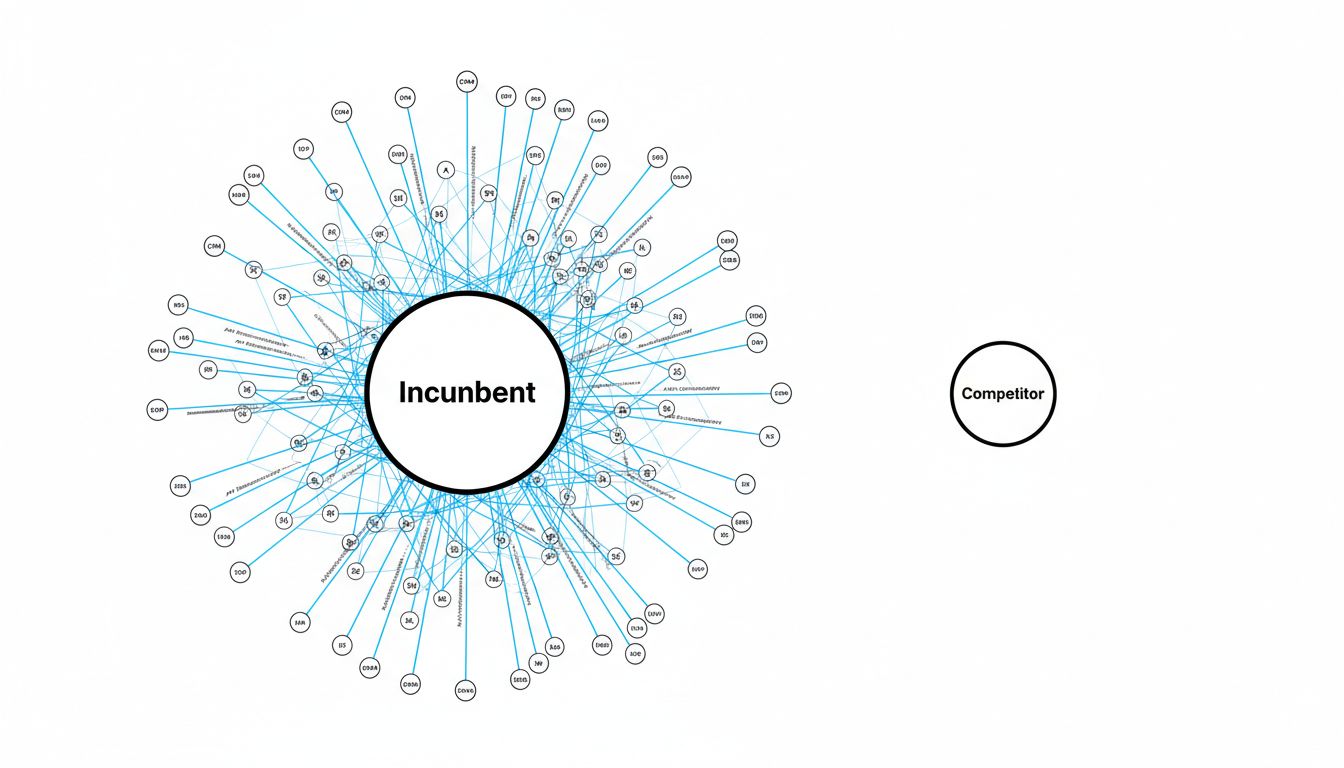
When a platform publishes a rich, stable API, developers build on it. That is the stated goal. What follows is a compounding dynamic that has nothing to do with altruism: the more third-party software depends on your API’s specific behavior, the more painful it becomes for anyone, developer or enterprise, to migrate to a competitor’s platform that does things even slightly differently.
Salesforce has maintained backward compatibility on its core APIs across major version changes for years, and that stability is part of why an entire ecosystem of system integrators, ISVs, and custom apps has been built on top of it. Switching from Salesforce is not primarily a software problem. It is an ecosystem problem. Every connected tool, every integration, every customization has to be rebuilt or replaced. Backward compatibility didn’t create that lock-in directly. It created the conditions under which developers felt safe enough to build the lock-in themselves.
3. Hardware Ecosystems Use the Same Logic
Apple’s transition from 32-bit to 64-bit apps on iOS is instructive. When Apple dropped 32-bit support in iOS 11, it rendered a large number of older apps non-functional overnight. Users who had paid for those apps lost them. The transition was framed as a technical necessity, and technically it was. But the competitive effect was to raise the floor on what it takes to maintain an app in the App Store, while simultaneously keeping users on iOS because their purchased app history couldn’t follow them to Android.
This is backward compatibility used in reverse: deliberately ending it to accelerate platform evolution, while the lock-in comes from the accumulated investment users have already made. The same logic applies to hardware peripherals. Printer manufacturers have historically maintained proprietary driver architectures not because open standards couldn’t work, but because open standards would make their printers interchangeable commodities. Backward compatibility with their own previous driver versions maintains the illusion of continuity while keeping third-party competition out.
4. Standards Bodies as Delay Mechanisms
When a dominant company participates in standards development, it can offer compatibility with the emerging standard as a feature while quietly shaping that standard to reflect its existing architecture. The result is a specification that competitors technically can implement, but that happens to align suspiciously well with how the incumbent already does things.
This played out visibly in the early browser wars, where Internet Explorer’s market dominance meant that web developers frequently coded for IE-specific behaviors rather than the W3C standard. Competitors had to support the standard and reverse-engineer IE’s quirks simultaneously. The “compatibility” being maintained was compatibility with IE’s bugs. More recently, Google has faced similar accusations around web standards, where proposals originating from Chrome’s team have been criticized for reflecting Chrome’s internal implementation details in ways that disadvantage other browser vendors.
5. Enterprise Software Uses Upgrade Cycles as Retention Contracts
Enterprise software vendors have long understood that backward compatibility pledges, packaged as long-term support commitments, function like informal retention contracts. SAP’s support lifecycle commitments, Oracle’s Java LTS releases, IBM’s mainframe software guarantees: these are sold as stability, and the stability is real. But the business effect is that enterprises plan their IT roadmaps around the vendor’s support calendar, not the other way around.
This is the mechanism described in older software ecosystems: once something critical depends on a given runtime or library version, changing it becomes a project rather than a task. Enterprise sales teams know this. Support contract renewals are easiest to close when the alternative is migrating off a platform that everything else in the organization has been built on top of. Backward compatibility created those dependencies. The support contract just harvests them.
6. The Competitor’s Dilemma: Match the Compatibility or Lose the Customer
The deepest strategic value of backward compatibility comes from the position it forces competitors into. If you build a new product that doesn’t import the incumbent’s file formats, migrate the incumbent’s API integrations, or replicate the incumbent’s keyboard shortcuts, you are asking customers to pay a switching cost up front to gain benefits they might see later. Most customers won’t.
So competitors either invest heavily in compatibility layers, which means spending engineering resources building someone else’s architecture into their product, or they give up on the enterprise market and aim at greenfield customers who have no legacy to protect. Neither option is great. The compatibility layer approach is expensive and positions you permanently as a derivative. The greenfield approach limits your total addressable market.
This is why so many enterprise software challengers end up targeting mid-market or startup segments rather than displacing incumbents directly. It is not always a strategic choice. Sometimes it is the only viable path given the compatibility walls already in place.
None of this means backward compatibility is bad. Customers benefit from it genuinely. The point is that the benefits to customers and the benefits to the incumbent are perfectly aligned, which is exactly what makes it such a durable competitive tool. When a strategy is good for your users and good for keeping competitors out, you don’t have to choose between being a good company and being a ruthless one. You just call it a feature.