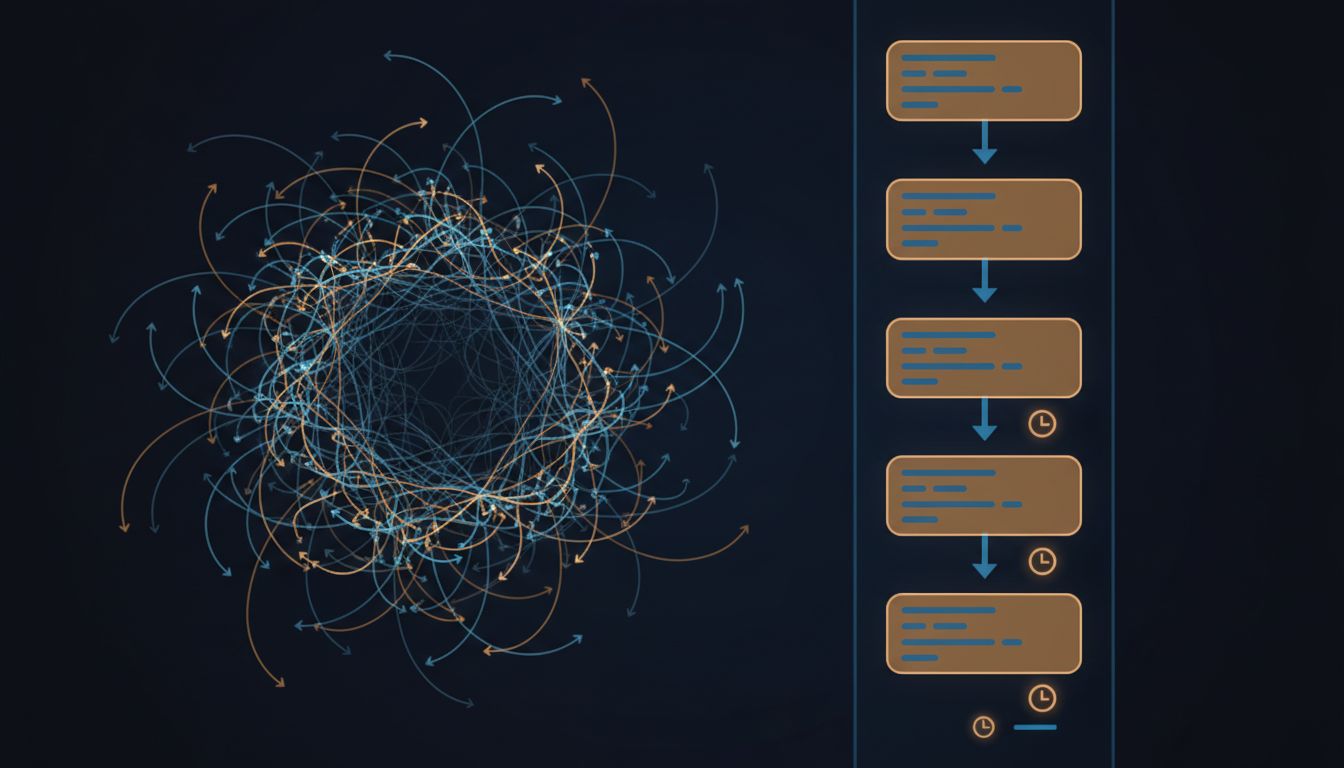

In 2020, Basecamp did something that made a lot of productivity-obsessed developers uncomfortable. They abolished the conventional meeting-heavy calendar culture inside their own company, went almost entirely asynchronous, and wrote about it publicly and in detail. Not as a productivity hack. As a philosophical position about how knowledge work actually happens.
The reaction from the broader tech industry was predictable: admiration, skepticism, and then a quiet return to booking thirty-minute syncs in Google Calendar. The experiment was observed, discussed, and ignored.
That response is exactly the problem this article is about.
The Setup
Basecamp is a useful case study precisely because they are not a scrappy startup figuring things out in real time. By the time they went deep on async work, they had been building software for nearly two decades, had written extensively about their process in books like Remote and It Doesn’t Have to Be Crazy at Work, and had a team that was already geographically distributed. They had thought harder about how work gets done than most companies ever will.
Their diagnosis was specific. The problem was not that people had too many calendar events. The problem was that calendar tools encode a particular theory of time, and that theory is wrong for most knowledge work.
Here is the theory, made explicit: time is a shared resource that can be allocated to tasks in blocks, and productivity is a function of how well those blocks are filled. Google Calendar, Outlook, Calendly, and every scheduling tool built in the last twenty years operates on this model. A slot is either free or busy. You fill free slots with obligations. The goal is to have the right things in the right slots.
This is a fine model for manufacturing. It is a reasonable model for customer support. For software development, writing, design, or any work that requires sustained concentration and non-linear thinking, it is actively harmful.
What Happened
Basecamp’s shift was not really about calendar features. They did not go looking for a better scheduling app. They concluded that the calendar itself, as an organizing metaphor for a workday, was the wrong abstraction. Their solution involved what they called “cycles” instead of sprints, long stretches of uninterrupted time called “cool-down” periods, and a heavy reliance on written communication that did not demand immediate response.
The technical analogy here is useful. A calendar app treats your attention like a CPU that can be scheduled using a simple round-robin algorithm: task A gets this time slice, task B gets the next one, and context switches between them are cheap. But human cognition does not work like a processor with uniform context-switch costs. For deep work, the context-switch penalty is enormous. Researchers studying interrupted work have found that it can take a significant amount of time to return to full concentration after an interruption, and the calendar culture that most companies operate in is essentially a system designed to maximize interruptions while pretending to minimize them.
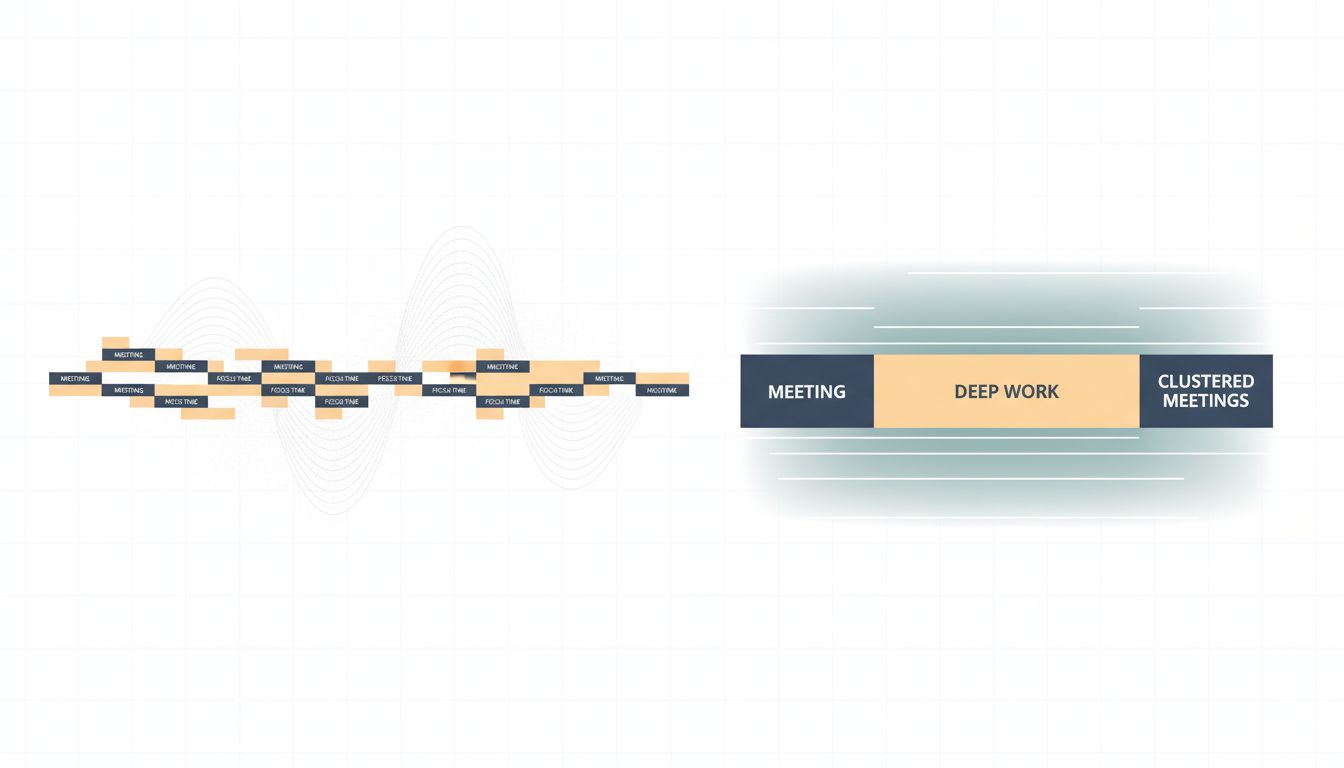
Basecamp’s own writing on this is precise about the failure mode. When your calendar is full of thirty-minute meetings, you do not have six hours of meeting time. You have six thirty-minute fragments of non-meeting time, each too small for concentrated work and each preceded by the mental overhead of switching into and out of meeting mode. The calendar is not showing you your availability. It is showing you the negative space left over after other people have claimed your attention.
The reason calendar apps never fix this is not that they lack features. Clockwise, Reclaim, and similar tools can now auto-schedule focus blocks, move meetings to cluster them together, and protect mornings or afternoons based on your preferences. These are genuine improvements at the scheduling layer. They are still operating on the wrong model.
Why It Matters
The Basecamp case is instructive because they had the organizational authority to change the underlying model, not just optimize the scheduling. Most individuals and most teams do not have that authority. You cannot unilaterally decide that meetings require async summaries and a 24-hour response window when your manager expects you in a Zoom room in fifteen minutes.
This is why the calendar app market is structurally incapable of solving the problem it sells itself as solving. The problem is not individual scheduling. It is a collective coordination protocol that most organizations have never explicitly designed. It grew up around email and then around calendar invites, and it gets inherited by each new employee as a set of unspoken norms. A better calendar app can help you personally navigate those norms more efficiently. It cannot change the norms.
The software industry’s response to this has been to add more features. AI scheduling assistants that negotiate meeting times. Integration with task managers so you can see your to-do list alongside your calendar. Focus mode indicators that show colleagues you are unavailable. Every one of these features assumes the calendar model is correct and attempts to optimize within it. Some of them help at the margins. None of them address the underlying mismatch.
What We Can Learn
The Basecamp experiment did not prove that calendars are useless. It demonstrated something more specific: the tools you use to organize time encode assumptions about how work gets done, and those assumptions are worth examining before you go shopping for better tools.
If your productivity problem is “I have too many meetings and cannot get real work done,” a new calendar app will not fix it. A faster car does not help when the roads are designed wrong. What you actually need is an explicit conversation with the people you work with about what coordination costs are acceptable, what response latency is tolerable, and which decisions genuinely require synchronous discussion versus which ones are being forced into meetings because that is the path of least resistance.
The teams that have actually solved this problem, and there are some, did it by treating their coordination protocol as a design problem with real constraints and real tradeoffs, not as a default to be managed with better software. They asked: what does this meeting accomplish that an async document cannot? They got specific answers and then built systems around those answers.
For most knowledge workers, the honest version of this is uncomfortable. The real reason your calendar does not solve your time management problem is that your time management problem is not really yours to solve alone. It is a shared system problem, and shared system problems require collective action, not better personal tooling. A calendar app is a local optimization on a globally misaligned system. That is a hard thing to accept when the app store has a four-star option available for $9.99 a month.
The Basecamp lesson is not “go async.” Not everyone can or should. The lesson is that the tool you choose carries a theory of work inside it, and before you adopt the tool, you should decide whether you believe the theory.