
Copy-paste is the closest thing computing has to a universal primitive. Developers use it to move code between files. Accountants use it to port numbers between spreadsheets. Writers use it to reorganize paragraphs. It is so fundamental that most people cannot imagine working without it, which makes it easy to forget that it was once a genuinely controversial idea, and that the objection nearly killed it.
My position is this: copy-paste was almost never invented not because the technology was hard, but because the people who controlled the technology thought it was beneath them. And that tells us something important about how computing institutions have historically evaluated ideas.
The Objection Was Not Technical
Larry Tesler developed the cut, copy, and paste model at Xerox PARC in the 1970s, working on the Gypsy word processor. The concept borrowed directly from physical editing: writers and editors literally cut strips of paper and pasted them together to reorganize text. Tesler’s insight was that this physical metaphor could map cleanly onto a digital workflow.
The objection from the computing establishment was not that it was technically infeasible. Computers in the mid-1970s were already capable of holding text in a buffer (a temporary storage area, essentially a short-term memory slot for data in transit) and pasting it elsewhere. The objection was softer and more damning: this was a feature for secretaries. Real users, meaning programmers and researchers, would use proper commands. They would invoke functions. They would not need a crutch.
This was not an isolated attitude. It was the dominant one. The assumption baked into early computing culture was that the right interface for a computer was a command line, that memorizing syntax was a skill worth having, and that any attempt to abstract over that syntax was an accommodation to the intellectually lazy.
The Metaphor Was the Insight
What Tesler understood, and what his critics missed, is that the clipboard metaphor was not a simplification. It was a correct model of what the user was actually trying to do.
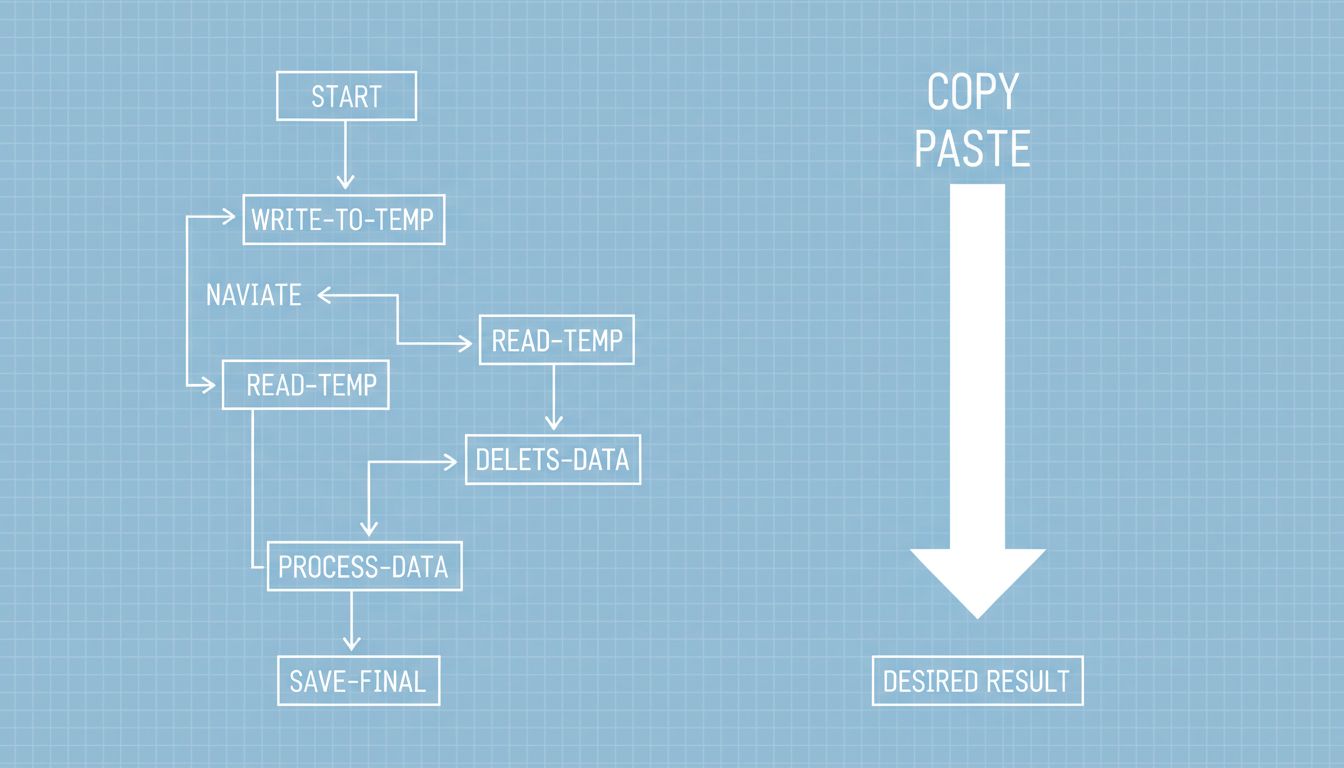
Consider what it means to “copy” something. In physical terms, you are duplicating a piece of information and holding it somewhere accessible while you navigate to a new location. The clipboard model encodes that intention directly. Compare that to the alternative: a command-line user in the same era might accomplish something similar by writing the file to a temporary location, navigating to the destination, reading from that location, and deleting the temp file. That sequence is not more powerful. It is just more opaque about what is actually happening.
Good abstractions do not hide complexity. They name the operation you actually intend. The clipboard abstraction named something real, which is why it transferred instantly to non-expert users and why it survived every subsequent paradigm shift in computing.
Institutional Gatekeeping Has Consistent Failure Modes
The near-death of copy-paste fits a pattern. Computing institutions have repeatedly evaluated ideas by asking the wrong question: not “does this solve a real problem” but “does this meet the complexity threshold that makes it worth our attention.”
This is not ancient history. The same logic shows up in how enterprise software gets designed, in how APIs get built (often with deliberate complexity that serves the vendor more than the user), and in how developer tools get evaluated. The implicit assumption is that friction is a feature, that difficulty signals power.
Tesler was so opposed to this idea that he spent the rest of his career fighting it. His personal website had one repeated phrase: “Don’t mode me in.” (A “mode” in interface design is a state where the same action produces different results, forcing users to track context. Tesler hated them with professional conviction.)
The Counterargument
The strongest version of the opposing view is that the computing establishment was not being elitist, it was being practical. Resources at Xerox PARC were finite. Decisions about where to invest engineering effort had to be made somehow. Prioritizing features for expert users was a reasonable heuristic given that expert users were the primary market.
This is fair as far as it goes. But it misidentifies the nature of the objection. Tesler’s colleagues were not saying “we can’t afford to build this.” They were saying the idea itself was beneath consideration, that its simplicity was evidence against it rather than for it. That is a different failure mode, and a more dangerous one. It is not resource allocation; it is a category error about what makes a feature valuable.
Simplicity that maps correctly onto user intent is one of the hardest things to build. Dismissing it as trivial mistakes the output for the work.
Why This Still Matters
Copy-paste is now so embedded in computing that it operates below the level of conscious thought. Ctrl+C and Ctrl+V are muscle memory for probably hundreds of millions of people. The idea that it nearly did not happen should be unsettling.
It is unsettling because the same institutional biases are still operating. The same instinct that dismissed copy-paste as a feature for secretaries now dismisses no-code tools as toys, criticizes high-level abstractions as hand-holding, and treats accessibility features as edge cases. The metric of “real” versus “casual” users has not gone away; it has just updated its vocabulary.
Tesler’s clipboard survived because Xerox had the organizational structure to let good ideas find patrons even when they lacked institutional enthusiasm, and because the idea was good enough to speak for itself once it existed. That is a fragile path for something so important. The question worth sitting with is how many equivalently useful ideas did not make it through because the gatekeeping held.