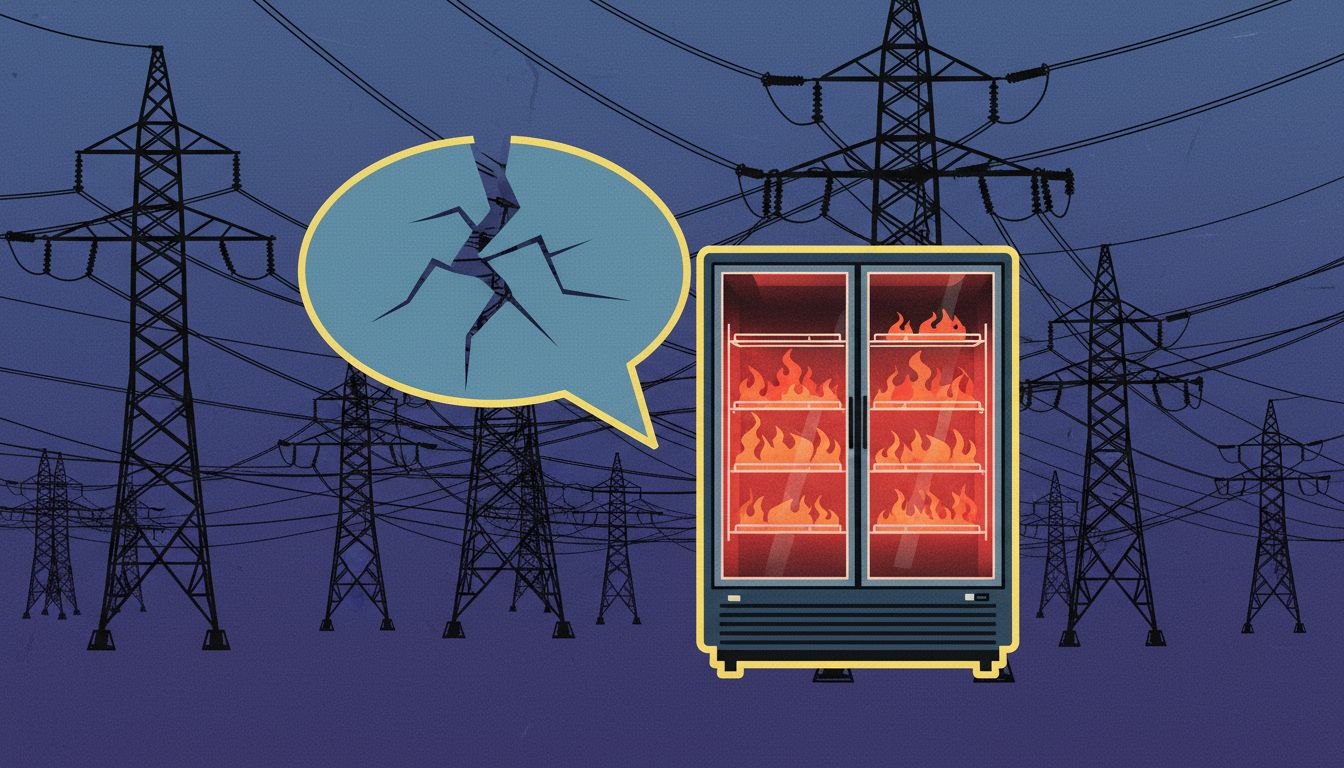
Today’s best read is a diplomatic simulation that collapsed over distrust, not climate science. The rest is more practical: cheaper logs, a wearable startup eyeing national health systems, and a headline about drones and datacenters.
1. Cloudflare Wants You to Stop Paying for Logs You Delete
Many teams pay to export, ingest and store log records they throw away the moment they arrive. Cloudflare’s new Logpush Transformers go after that waste. You write a SQL query, and Logpush filters, redacts and reshapes records before they leave for your SIEM or storage bucket. It is available on all plans, including Free.
The engineering choice is the interesting part. Cloudflare’s first prototype ran customer WebAssembly in Workers, then dropped it because a network call in the export path invites timeouts and retries. It now runs Apache DataFusion in-process, with Arrow batches crossing from Go to Rust. Its own benchmark, on a synthetic 5,000-row batch, came to roughly 1.6 million rows per second on a single goroutine.
The design also fails closed. If a transform breaks, Logpush retries and never sends the raw batch, which protects redaction rules. The catch is that a bad query stalls delivery, and jobs that fail long enough get disabled. My read is that downstream vendors who bill by volume have less reason to love this feature than customers do.
2. Ultrahuman’s Ring Is Becoming a Data Business With a Government Client
Ultrahuman has sold about 800,000 rings, yet CEO Mohit Kumar says the ring is just one way to acquire data. The company has signed a two-year memorandum of understanding with the Abu Dhabi Public Health Center to build and validate a biological-age model. It is meant to reach people across the UAE eventually, possibly through the government’s TAMM and Sahatna platforms. Kumar gave no rollout timeline.
The gap to watch is who the model has seen. Ultrahuman’s typical users are 25 to 43, and the model was built on its own users’ wearable signals plus blood markers for some. A national rollout means every age group. Kumar says the model won’t train on UAE data and Ultrahuman won’t see personally identifiable information. That makes the two-year validation the real test.
The UAE is a top-10 market, about 4% to 5% of revenue. Oura already has its own Abu Dhabi partnership, announced in May, so a government customer is a prize rivals are chasing too.
3. A Geoengineering War Game Ended With No Deal and No Listeners
In a London simulation of a UN committee on solar geoengineering, climate researcher Colleen Golja was the technical adviser. She says she was largely ignored. Her prepared emulator of regional weather effects went unused. Players mostly asked her leading questions that suited their side.
The game was built around mistrust. US and China players refused any deal that favored the other, and a fabricated intelligence scare set off finger-pointing. China wasn’t actually running experiments in the scenario, but everyone left believing it was. A fossil-fuel-backed NGO, which some players spotted and tolerated, offered Golja funding and then discredited her. No deal emerged. The organizers concluded that strategic competition drove the simulations, not climate concerns.
The caveat is real: games don’t predict, and many players lacked diplomatic experience. But the backdrop is real too. Stardust Solutions raised $60 million last year, and its CEO says policymakers are increasingly aware of the technology. The UK paper released last week backs research but rules out deployment.
4. Disrupt Opens Tomorrow, and the Pitch Is Mostly Proximity
TechCrunch Disrupt 2026 runs October 13 to 15 at Moscone West in San Francisco. TechCrunch’s own promotion claims 10,000-plus attendees, 300-plus exhibiting startups, 200-plus sessions and 20 Startup Battlefield finalists chasing $100,000.
This is a ticket-sale post, so treat the scale numbers as marketing. The offer is up to $100 off, 50% off a second pass, and a $75 Expo+ pass for people recently laid off. The product being sold is access to founders, investors and buyers in one place, helped by AI-powered matchmaking in the event app. Whether that beats a well-aimed cold email is the attendee’s math.
5. Drone Strikes Reportedly Hit Yandex Datacenters, Taking Cloud and Payments Offline
The Register’s headline says Ukrainian drone strikes on Yandex datacenters knocked its cloud and payments services offline. The supplied text is only a page of unrelated headlines, so there are no details on the damage, the duration or who confirmed what.
If the headline holds, it is a blunt reminder that datacenters are physical targets, and that payments and cloud can share a single point of failure. The questions that matter are how long the outage lasted and whether Yandex had any failover. Neither is answerable from what we have.