
Every product team celebrates the ship. There are blog posts, changelog entries, maybe a Slack emoji storm. Nobody celebrates the deletion. But the teams that actually build clean, fast, maintainable software have figured out something uncomfortable: removing a feature is a more demanding act than adding one. Here is why.
1. You Don’t Know Who Is Using It
When you build a feature, you control all the variables. When you try to remove one, you discover how little visibility you actually have into your own product. Usage metrics tell you frequency. They don’t tell you criticality. A feature touched by two percent of users might be the only reason your three largest enterprise accounts stay on the platform.
This is not hypothetical. Amazon famously discovered when auditing AWS services that internal teams had built quiet dependencies on APIs that were theoretically internal-only. The lesson generalizes: instrumentation tells you about quantity, not about what breaks if something disappears. Before you can delete anything, you need a level of user understanding that most teams haven’t invested in.
2. The Code Rarely Knows What It Belongs To
Features don’t live in tidy, labeled boxes. They are dispersed across shared utilities, database schemas, API contracts, and frontend components that serve ten other purposes simultaneously. When Twitter (now X) moved fast to strip out features after the 2022 acquisition, engineers found that removing certain components broke unrelated systems in ways nobody had anticipated, because the codebase had grown through accretion rather than design.
Compare that to building something new. You write the code, you connect it, you ship it. The blast radius of a mistake is bounded. Deletion, on the other hand, has unbounded blast radius. Every dependency you don’t find before you delete is a production incident waiting to happen. Deleting data is one of the hardest problems in software engineering, and deleting the code that produces data isn’t much easier.
3. Deprecation Is a Product Launch in Reverse
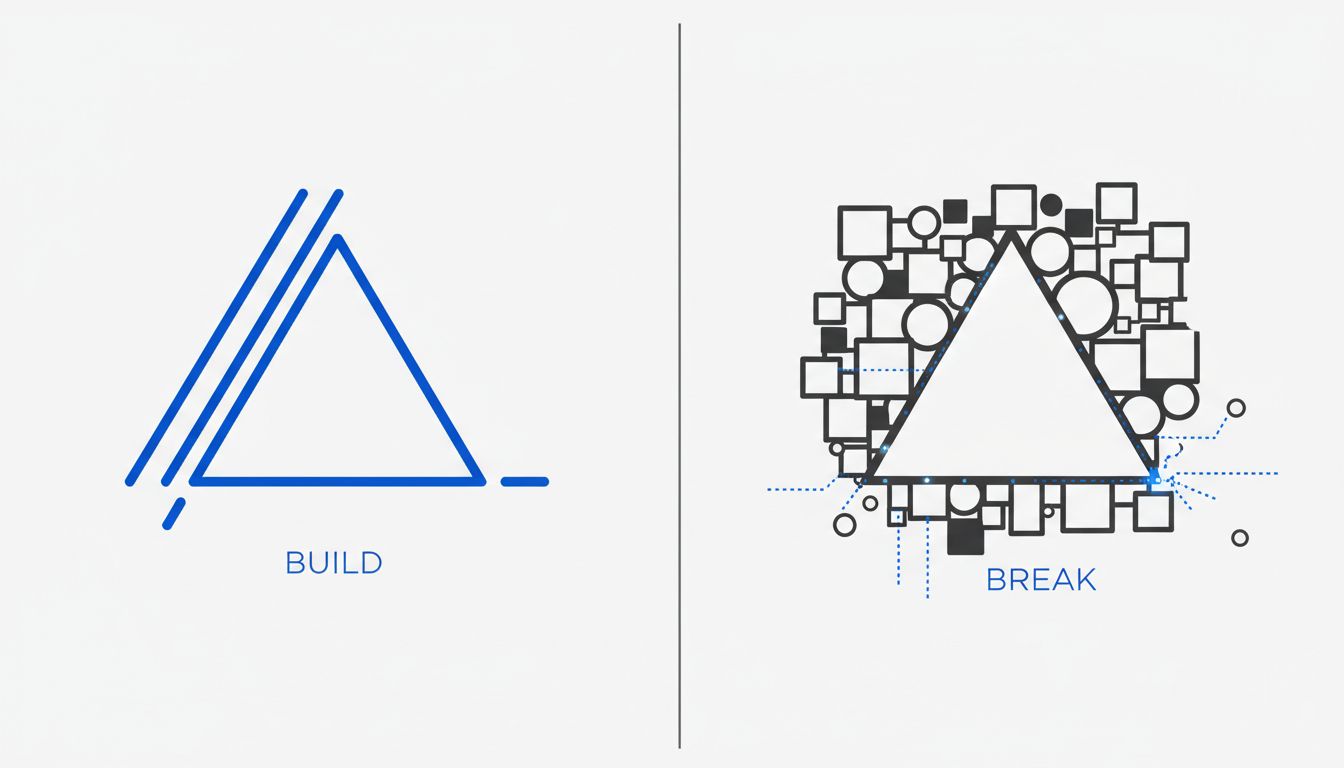
If you have external users or API consumers, deletion requires a deprecation process that demands nearly everything a launch does: communication, documentation, a migration path, a timeline, customer support capacity, and someone accountable for seeing it through. The difference is that a launch generates goodwill and deprecation generates complaints.
Google has deprecated hundreds of products and APIs over the years, and the pattern is consistent: even when a feature is genuinely underused, the announcement of its removal produces a vocal response disproportionate to actual usage. This is the endowment effect operating at scale. People overvalue things they already have relative to equivalent things they don’t. Your users didn’t ask for this feature, but they will fight to keep it.
4. Internal Politics Treats Addition as Progress and Subtraction as Loss
The organizational dynamics here deserve to be said plainly. Someone built that feature. It went on their performance review. A product manager championed it. A team lead approved the roadmap item. Removing it implicitly re-litigates all of those decisions, and the person who pushes for the removal becomes the one saying those decisions were wrong.
This is why product bloat is mostly a management problem masquerading as a technical one. Engineers frequently know which features should go. The incentive structures don’t reward acting on that knowledge. Adding features is legible as progress in a way that removing them isn’t, regardless of which one actually improves the product. Teams that want to build less, better, need explicit permission structures and leadership willing to treat removal as a success metric.
5. Testing Coverage Is Asymmetric
Most test suites are built to verify behavior, not absence. You have tests checking that a feature works correctly. You rarely have tests that would catch a case where a long-removed feature’s ghost is silently corrupting some downstream state. When you build something, your tests grow with it. When you delete something, the tests that validated it become dead code, but the subtle integration behaviors they never caught remain live.
This asymmetry bites hard in large codebases. The feature is gone. The migration script that ran once to transform old data formats left a column in the database. A new service, built by someone who joined after the deletion, reads that column and infers something incorrect about business logic. This class of bug is genuinely difficult to detect and it traces directly back to incomplete removal.
6. Users Build Workflows You Never Designed For
Features accrete meaning through use. What your team built as a lightweight tagging system becomes someone’s entire project management workflow. What you shipped as a quick export option becomes the input stage of an automated pipeline that runs every night. You cannot know this from inside the product, and users often don’t surface it until the deletion notice lands.
This is the deepest reason deletion is hard. Software, once released, is no longer entirely yours. It becomes part of the operating environment of the people using it, and those people have built things on top of your decisions. Respecting that, at a technical and human level, requires work that has nothing to do with writing code.
The practical takeaway is not that you should never delete features. The opposite is true: codebases that grow without subtraction become slower, harder to hire for, and more fragile over time. But deletion should be treated with the same seriousness as a major feature launch, not as a cleanup task assigned to an intern during a slow sprint. Build the deprecation plan before you write the deprecation notice. Instrument for criticality, not just frequency. Give the removal a project owner. And be honest with your team that the person who pushes to remove something is doing harder, more valuable work than the person who pushed to add it.