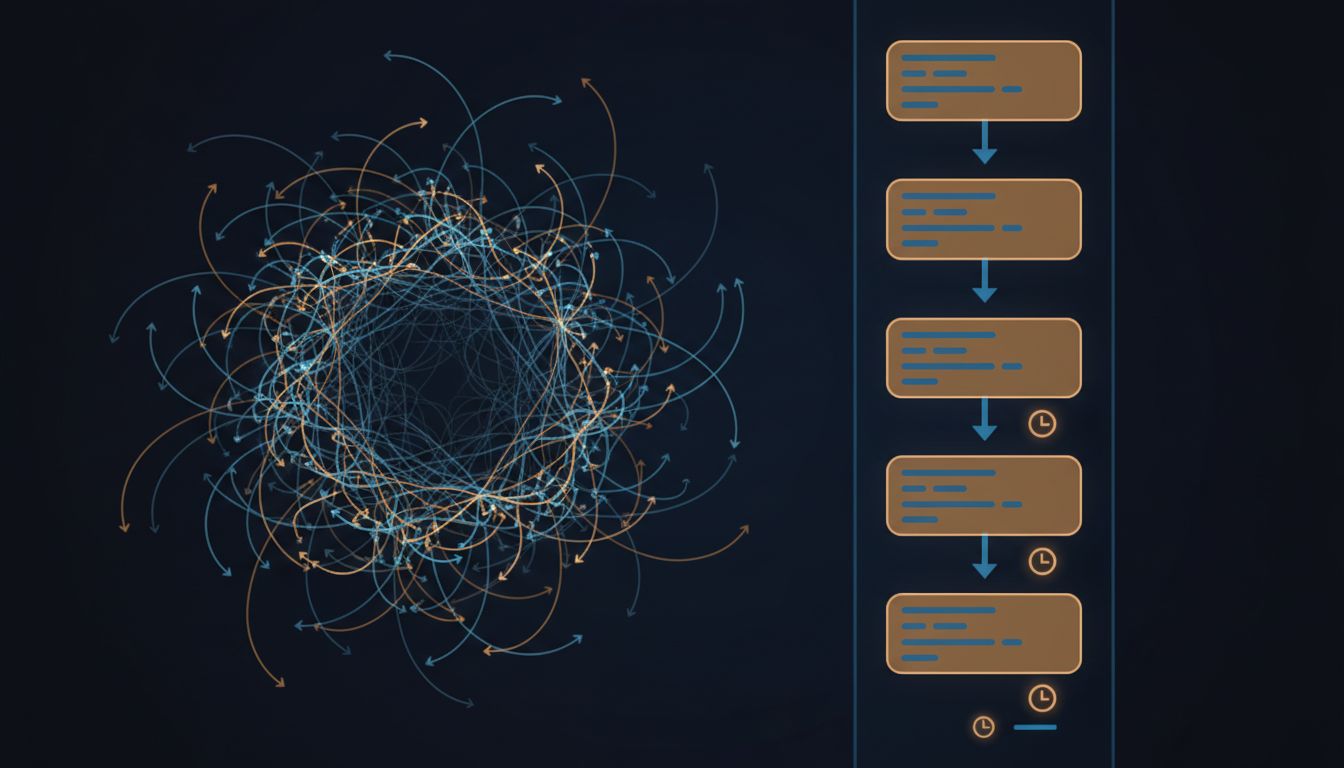
You open your calendar on Monday morning, see a neatly tiled grid of meetings and tasks, and feel organized. Then Friday arrives and you have no idea where the week went. Sound familiar? The problem isn’t your discipline or your priorities. The problem is that digital calendars were designed to schedule time, not to help you understand it. Those two things sound similar, but they produce completely different outcomes for your brain.
This isn’t a small UX quirk. It’s a fundamental mismatch between how calendar software works and how human cognition actually processes time. And once you see it, you can’t unsee it. If you’re curious about how multitasking apps were secretly designed to make you do one thing at a time, this problem will feel very familiar.
The Grid Illusion
Every major digital calendar, from Google Calendar to Outlook to Apple Calendar, displays time as a uniform grid. Each hour looks identical. Tuesday at 9am looks exactly like Tuesday at 3pm. A 30-minute meeting looks like a tidy rectangle, regardless of whether it requires two hours of mental preparation or leaves you emotionally drained for the rest of the afternoon.
This uniformity is visually clean. It’s also cognitively misleading.
Your brain does not experience time uniformly. A focused 90-minute deep work session costs you something very different than a 90-minute block of back-to-back status calls. Research on cognitive load consistently shows that mental effort depletes across a day in predictable waves, but your calendar has no way to represent that. It shows you what’s scheduled. It cannot show you what those scheduled things will cost.
The result is a planning illusion. You look at a day with three two-hour blocks and think, “That’s manageable.” But if those blocks each require high-stakes decision-making, you’ve just scheduled six hours of peak cognitive demand into a brain that realistically has two to four hours of it available.
Why Digital Calendars Train You to Think Reactively
Here’s a behavior pattern worth examining in yourself. When something needs to happen, where do you put it first? Most people open their calendar and look for an empty slot. That empty slot becomes the default answer to every planning question.
This seems logical. It’s actually backwards.
Scheduling should follow prioritization, not replace it. When you habitually scan for open time and fill it, you’re outsourcing your judgment about importance to the calendar’s visual whitespace. The calendar doesn’t know what matters most this week. It only knows what’s empty.
This is the reactive loop that digital calendars quietly encourage. You end up with a full calendar that’s optimized for availability rather than impact. Everything gets scheduled, which means nothing is truly prioritized. Most productive people run multiple calendars and have specific systems for keeping them from becoming a mess, and the reason that works is precisely because it forces intentional categorization rather than passive slot-filling.
The Notifications Trap
Digital calendars come with a default feature that paper calendars never had: reminders. A 10-minute warning before each event sounds helpful. In practice, it fragments your attention in a way that quietly destroys deep work.
Here’s what actually happens. You’re 40 minutes into a focused task. A notification appears for a meeting in 10 minutes. Your brain, which was building momentum, now has to hold two things: the work in front of you and the approaching context switch. The next 10 minutes are compromised. You’re not fully in the task anymore. You’re in a kind of cognitive waiting room.
Multiply that by five or six calendar reminders in a workday, and you’ve introduced a persistent low-grade distraction that interrupts flow states before they fully develop. The calendar was supposed to free your mind from remembering things. Instead, the notification system is actively pulling your attention away from the present moment, repeatedly, all day.
This connects to something broader about how tech products are designed. It’s worth reading about how tech companies deliberately design slow loading screens to understand how seemingly innocent UX decisions can have real psychological weight.
What to Do Instead: A Practical Framework
The goal here isn’t to abandon your digital calendar. It’s to use it with your eyes open and supplement it where it fails you.
Step 1: Prioritize before you schedule. Before opening your calendar each week, write down your top three outcomes for the week on paper or in a plain document. Only after you’ve named those outcomes should you open the calendar and build time around them. This sounds trivial. It fundamentally changes what ends up on your calendar.
Step 2: Add energy labels to your blocks. Most calendar apps let you color-code events or add short descriptions. Start using this to mark cognitive demand. A simple system works: high focus (deep work, complex writing, important decisions), medium focus (calls, collaborative work, planning), and low focus (admin, email, routine tasks). When you can see energy demand as well as time demand, you’ll start scheduling differently.
Step 3: Build in recovery buffers. After any high-focus block, schedule a 15-minute buffer. Not a meeting, not a task. A buffer. Calendar culture pressures you to see empty time as wasted time. It isn’t. It’s recovery time, and recovery time is what makes the next focused block actually productive.
Step 4: Batch your notifications. Turn off the default 10-minute reminders for everything. Instead, set a single daily alarm for the start of your workday that prompts you to review what’s ahead. One intentional look at the day beats six interruptions through it.
Step 5: Do a weekly calendar audit. Every Friday, spend five minutes looking at what actually happened versus what was planned. Not to judge yourself, but to notice patterns. Which blocks always run over? Which days consistently feel depleted by noon? This is the data that will make you a genuinely better time manager, and your calendar is the only tool that has it.
The Real Shift
The hidden problem with digital calendars isn’t that they’re poorly designed for what they do. It’s that people use them as if they’re productivity systems when they’re really just scheduling tools. Scheduling is one part of time management, and not the most important part.
The most important parts are knowing what matters, protecting the energy to do it, and recovering well enough to sustain it. Your calendar can support all of that, but only if you’re driving it consciously instead of letting it drive you.
Once you close the gap between what your calendar shows and what your day actually costs, you’ll find that managing time gets significantly less exhausting. Not because you did more, but because you finally stopped confusing a full calendar with a productive one.