Here is something that will sound wrong at first: the more features your calendar app has, the more likely you are to miss a deadline. Not because the app is buggy, not because your notifications are misconfigured, but because of something much more fundamental about how your brain processes information encoded in physical versus digital space. If you have ever stared at a missed deadline and thought, ‘But it was right there in my calendar,’ you already know this feeling. The explanation is hiding in cognitive science, and once you see it, you cannot unsee it.
This is not a productivity hot take. It is a systems problem, the kind developers actually enjoy digging into. And like most systems problems, the failure is not in the component you are looking at. It is in the interface between components. Digital minimalists consistently outperform power users for a reason rooted in how your brain allocates resources, and the calendar paradox is one of the cleanest examples of why.
The Cognitive Offloading Problem
In computer science, we talk about the difference between hot memory (things in active cache, fast to access) and cold storage (things on disk, slow to retrieve, easy to forget). Your brain works similarly. Working memory is small, roughly four chunks of information at a time according to cognitive psychologist Nelson Cowan’s research. Long-term memory is vast but requires encoding effort to write to reliably.
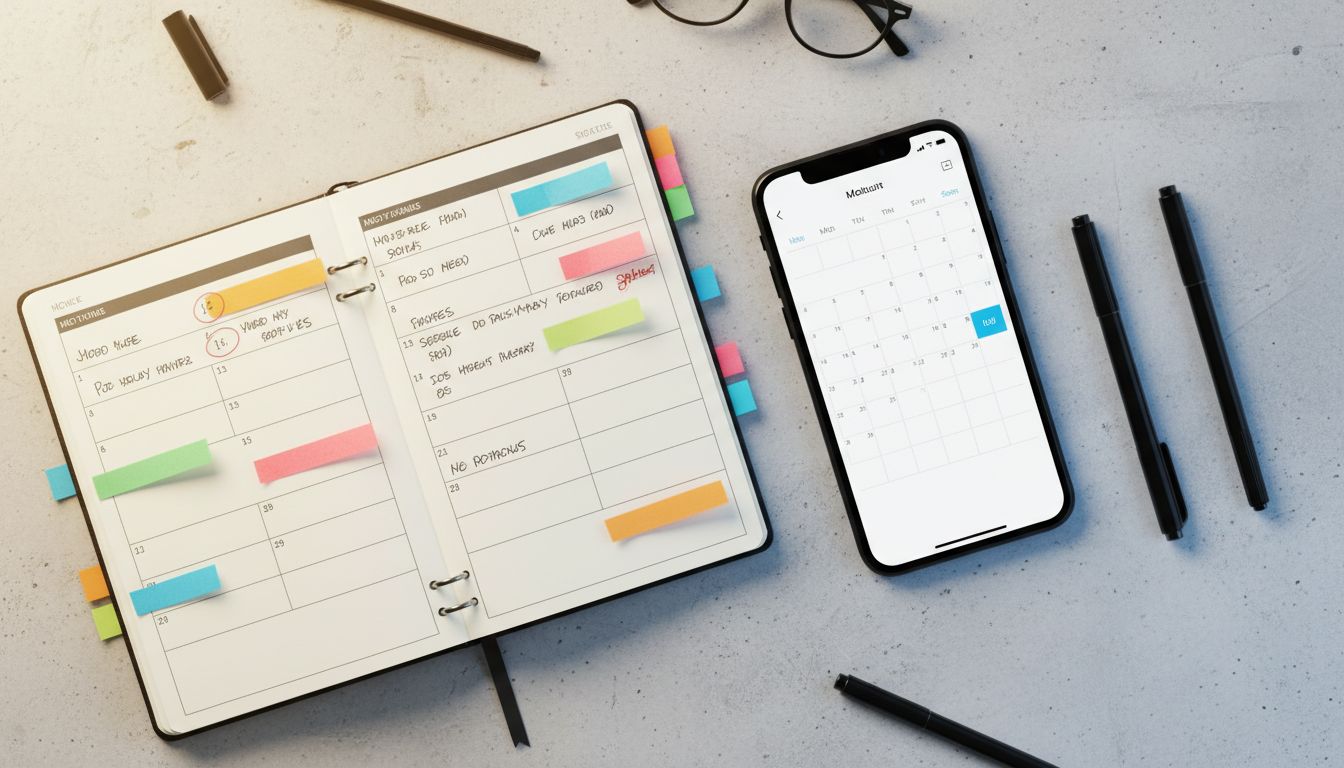
When you write something in a paper planner, your brain does real work. You physically form each letter, you spatially position the entry on the page, and you often decorate or annotate it. All of that friction is, counterintuitively, the point. That friction is encoding. The information is being written not just to paper but into your long-term memory as a parallel process.
When you tap ‘Add Event’ in Google Calendar, type a title, and hit save, almost none of that encoding happens. The cognitive load is so low that the event barely registers as a memory. You have successfully offloaded the information to an external system, which sounds efficient, but you have done it so completely that you no longer carry a meaningful internal representation of the commitment. The calendar becomes the single source of truth, and the single source of truth can fail.
The Notification Dependency Loop
Digital calendars compensate for shallow encoding by using notifications. This is a reasonable engineering solution to a real problem, but it creates a dependency loop that paper planners never require. When your memory of a deadline lives almost entirely in an external system, you become wholly dependent on that system’s alert mechanism to surface it at the right time.
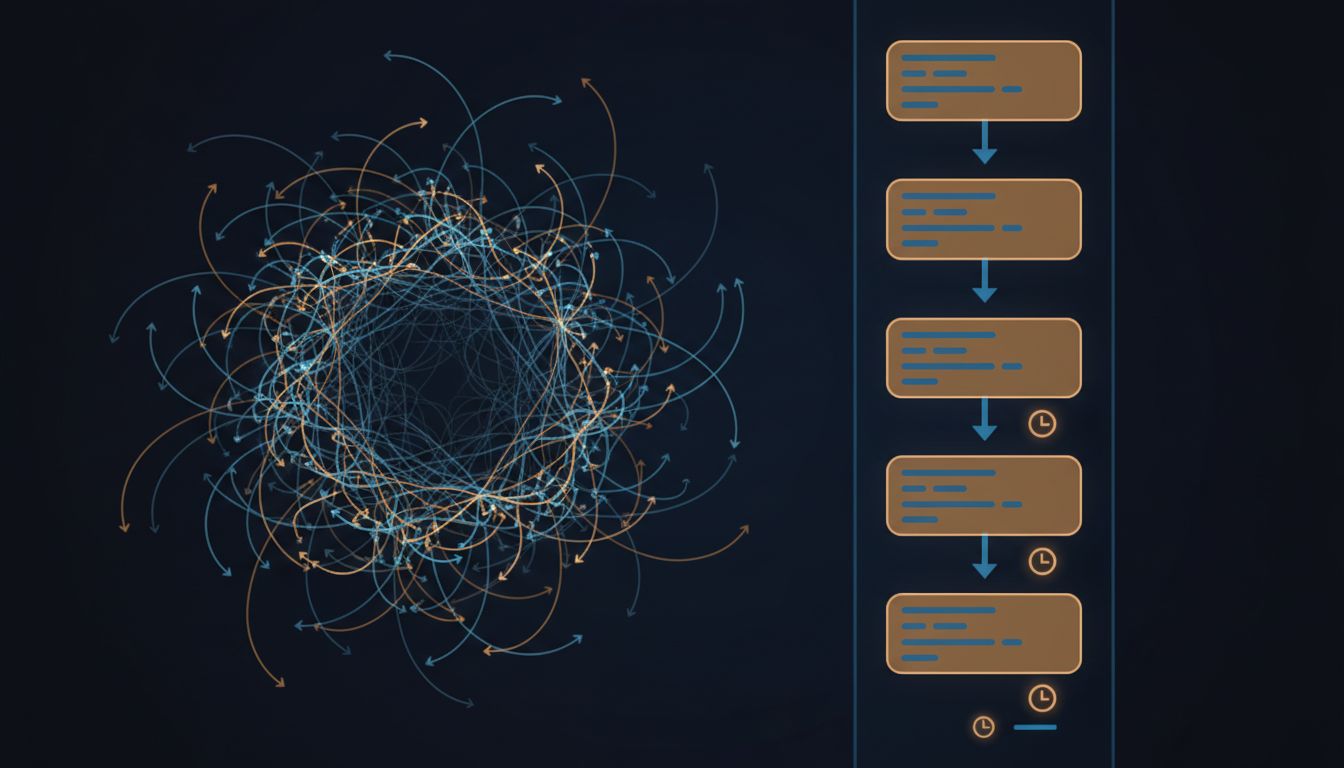
This is where things get interesting from a systems design perspective. Notification systems are lossy. Phone in do-not-disturb mode, notification buried under seventeen others, alert dismissed while half-awake, app permissions silently revoked after an OS update. Any one of these is a dropped packet in your reminder pipeline. And because your internal memory of the deadline is so weak (you offloaded it completely, remember), there is no fallback.
Paper planners have no notification system, which forces your brain to build one internally. You develop a habit of page-scanning, you remember approximately where on a Tuesday’s page you wrote something urgent, and you build a rough internal model of what the week holds. That internal model is distributed and redundant. It does not drop packets.
This connects to a broader pattern in how we design systems. We often mistake adding features for improving reliability, when sometimes the constraint is the reliability mechanism. The same logic applies when digital note-taking apps solve the wrong problem entirely, optimizing for storage and search while quietly eroding the encoding that made the original thought useful.
Spatial Memory and Why It Matters
Humans have extraordinarily powerful spatial memory. This is not a soft claim. It is the foundation of the ‘method of loci,’ a mnemonic technique documented by ancient Greek and Roman orators who memorized hours-long speeches by mentally walking through physical spaces. Neuroscientists call the underlying mechanism allocentric coding, the ability to remember where things are in space relative to other things.
A paper planner exploits this. You remember that the meeting you cannot miss is at the bottom right of the left-hand page of the third week of the month. You remember that you circled it and drew an arrow. That spatial and visual specificity is a form of retrieval cue, a pointer that your brain can follow later without any external prompt.
Digital calendars actively work against spatial memory. Every event looks identical. Every week view is the same white grid. Events are sortable, searchable, and color-coded, but they have no physical location in your memory. The interface is clean and uniform, which is great for usability and terrible for distinctiveness. Your brain cannot tell the important apart from the trivial because the system deliberately renders them in the same visual format.
Why Tech Companies Have Not Fixed This
This is the part that should make any developer a little uncomfortable. Calendar apps are not failing to solve this problem by accident. The cognitive encoding gap is well-understood in UX research circles. But the incentives do not point toward solving it.
Making an app feel effortless is a core design goal, not a side effect. Tech companies apply century-old psychology to make apps feel frictionless, and friction-reduction is practically a religion in product design. The problem is that the friction of writing something down is not a bug in the user experience. It is a feature of the cognitive process. Removing it feels like an improvement while creating a subtle and hard-to-attribute failure mode.
Engagement metrics also do not capture missed deadlines. If users open their calendar app frequently, set lots of events, and interact with notifications, the product looks healthy by every internal measure. The failure happens offline, in the real world, and never gets logged to any analytics dashboard.
What You Can Actually Do About This
The fix is not to throw your phone in a lake. It is to intentionally reintroduce encoding into your digital workflow. A few approaches that have solid cognitive science backing them up:
First, do a weekly paper review. Even if you live in Google Calendar, transcribe the upcoming week’s key deadlines into a small notebook by hand. You do not need to maintain the paper version after that. The act of writing is the encoding event.
Second, add friction to high-stakes events deliberately. Write a longer description for deadlines that really matter, add a location even if it is a Zoom link, set the color to something you do not use often. Distinctiveness is a retrieval cue. Make important things visually distinct from routine things.
Third, treat notifications as a backup system, not a primary one. If your only internal signal for a deadline is an alert you set six weeks ago, your memory architecture has a single point of failure. Build in a secondary review habit.
The irony here is that the most powerful productivity tool is also the most inconvenient one. But that inconvenience is doing real computational work, just inside your head instead of on a server somewhere. Understanding that distinction is the first step to designing a personal system that actually keeps its promises.