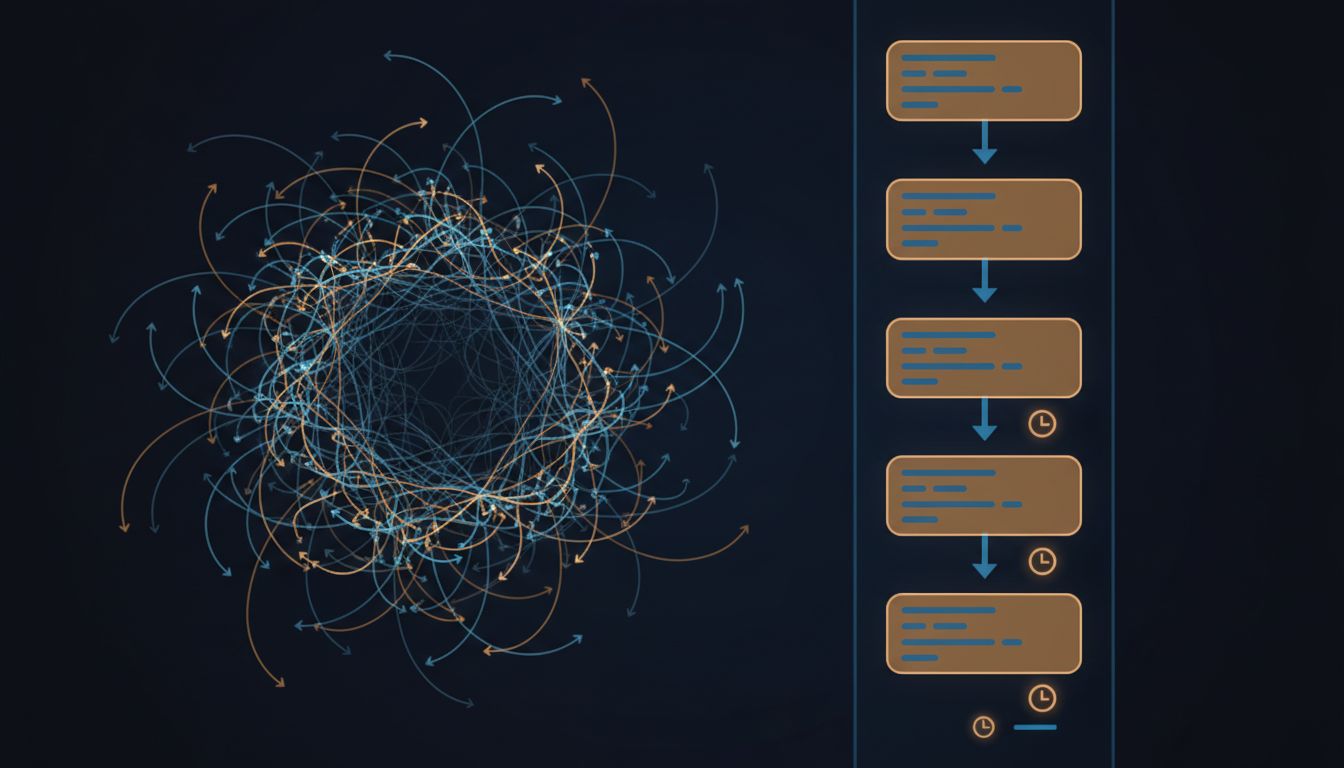

There is a certain kind of developer who hasn’t updated their terminal configuration in three years, still reaches for a plain text file when they need to think something through, and responds to every new productivity app launch with the same mild, slightly amused indifference. They are not behind. In most measurable ways, they are ahead. This is not an accident. Digital minimalism, applied deliberately and technically, functions less like a lifestyle choice and more like a performance optimization strategy, and the people doing it well have essentially reverse-engineered the attention economy to work in their favor.
This connects directly to something counterintuitive about how high-output work actually gets structured. Research into how senior executives configure their physical workspaces reveals a pattern worth paying attention to: the people with the most cognitive surface area to protect tend to use the fewest screens, the fewest tools, and the fewest inputs. The correlation isn’t coincidental.
The Cognitive Cost of “Keeping Up”
Every new tool you adopt carries what engineers would recognize as overhead, the background processing cost that runs even when you’re not actively using a system. In computing, this is called a daemon: a background process that consumes memory and CPU without being explicitly called. Your brain runs something functionally identical. Every tool you’ve added to your workflow but haven’t fully internalized is running as a cognitive daemon, consuming working memory, generating low-level anxiety about whether you’re using it correctly, and occasionally demanding attention at the worst possible moments.
Digital minimalists don’t avoid new technology because they’re incurious. They avoid it because they’ve done the cost-benefit analysis and found that most tools have a negative return on cognitive investment, at least for their specific context. They apply something like a dependency audit to their own workflows. In software development, dependency audits are regular reviews of every external library your codebase relies on. Each dependency is a liability: it can break, become unmaintained, or introduce security vulnerabilities. The same logic applies to productivity tools. Every app you depend on is a liability.
Deliberate Ignorance as a Filter, Not a Failure
The phrase “deliberate ignorance” sounds like an oxymoron, but it’s actually a well-defined strategy in information theory. When a system receives more input than it can usefully process, filtering becomes more valuable than receiving. The signal-to-noise ratio of the average technology news cycle is genuinely poor. Most framework announcements, tool releases, and productivity paradigm shifts will be irrelevant to your specific work context within 18 months. Digital minimalists treat trend-following the way good engineers treat premature optimization: as a tempting but ultimately wasteful use of limited resources.
This is also related to how your brain handles incomplete loops. Top performers exploit the fact that your brain never truly closes a task by deliberately limiting the number of open loops they carry. Every new tool you’re “evaluating” is an open loop. Every Slack integration you’ve enabled but haven’t configured properly is an open loop. Digital minimalists close loops aggressively by simply not opening most of them in the first place.
The practical implementation looks something like this. A developer practicing digital minimalism might apply a 90-day rule: if a tool or trend has not demonstrated clear, measurable value to their specific workflow within 90 days of widespread adoption in their community, they don’t adopt it. This isn’t stubbornness. It’s a heuristic that filters out the majority of tools that peak and fade, while still leaving a window for genuinely useful innovations to prove themselves.
The Compounding Returns of Tool Mastery
Here is where the math gets interesting. Productivity with any tool follows a learning curve that most people never finish climbing because they switch tools before reaching the inflection point. In calculus terms, they’re optimizing for the derivative (rate of improvement) rather than the integral (total accumulated value). Mastery compounds. A developer who has used the same editor for five years and knows every keyboard shortcut, every plugin interaction, every quirk of the configuration has a productivity floor that a developer constantly switching tools will never reach, regardless of how individually powerful each new tool might be.
This is the same logic behind why successful apps look simple because years of work were spent removing things. Simplicity isn’t the starting point. It’s the output of sustained, disciplined reduction. The developers who build those apps often work the same way: they have removed the extraneous from their workflows through the same iterative process they apply to their code.
The rubber duck debugging analogy is relevant here too. When you strip away all the ambient tooling and force yourself to articulate a problem clearly, you often solve it faster than colleagues with access to every possible resource. Constraint isn’t a handicap. It’s often the fastest path to clarity.
How to Actually Implement This Without Going Off the Grid
Digital minimalism in a professional tech context doesn’t mean using a flip phone and a legal pad (though some people do, and they’re annoyingly productive). It means applying engineering discipline to your tool selection.
Start with an audit. List every tool, app, notification source, and information feed you interact with in a given week. For each one, write a single sentence explaining the specific value it generates. If you can’t write that sentence in under 30 seconds, that’s a signal. Not a mandate to delete immediately, but a signal worth taking seriously.
Next, identify your core stack. In infrastructure terms, this is your critical path: the minimum set of tools required to ship work. Everything else is optional infrastructure. Treat optional infrastructure as optional. Enable it only when demand justifies the overhead.
Finally, build in a trend evaluation cadence rather than trying to ignore everything. Set aside a fixed, time-boxed period, maybe two hours every quarter, to review what’s new and interesting. Outside of that window, the answer to “have you tried this new tool” is a cheerful and confident “not yet.” This is the scheduled procrastination approach applied to technology adoption: top performers don’t fight the impulse to explore, they schedule it.
The developers who compound the most value over a career are rarely the ones who adopted everything first. They’re the ones who picked their tools carefully, learned them deeply, and spent the attention they saved on the actual work. That’s not a lifestyle. That’s an architecture decision.