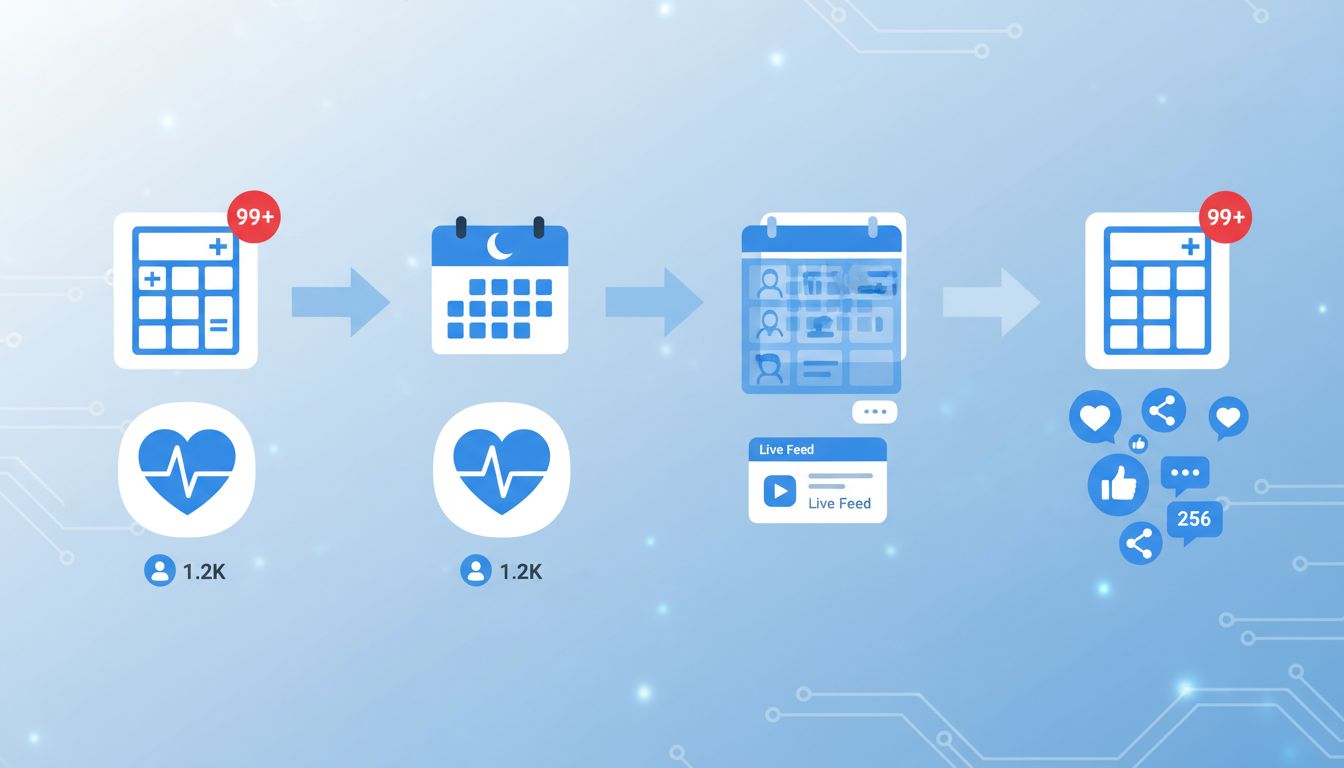
Look at your phone right now. Pick any app you installed for a purely practical reason, a workout tracker, a budgeting tool, a recipe organizer, maybe even a PDF reader. Chances are good it has a feed, a follow button, or a way to share your activity with strangers. You did not ask for that. Nobody did. And yet here we are, watching every piece of software slowly sprout a social layer like a vine taking over a wall.
This pattern is not accidental, and it is not driven by user demand. It is driven by a set of economic and product incentives that are almost impossible to resist once a company reaches a certain size. Understanding those incentives will help you make smarter decisions about the software you build, use, or invest in. The most successful apps got big by solving problems nobody was willing to admit they had, and the social pivot follows a similar logic: it solves a problem the company has, not the one you have.
The Retention Problem Nobody Talks About
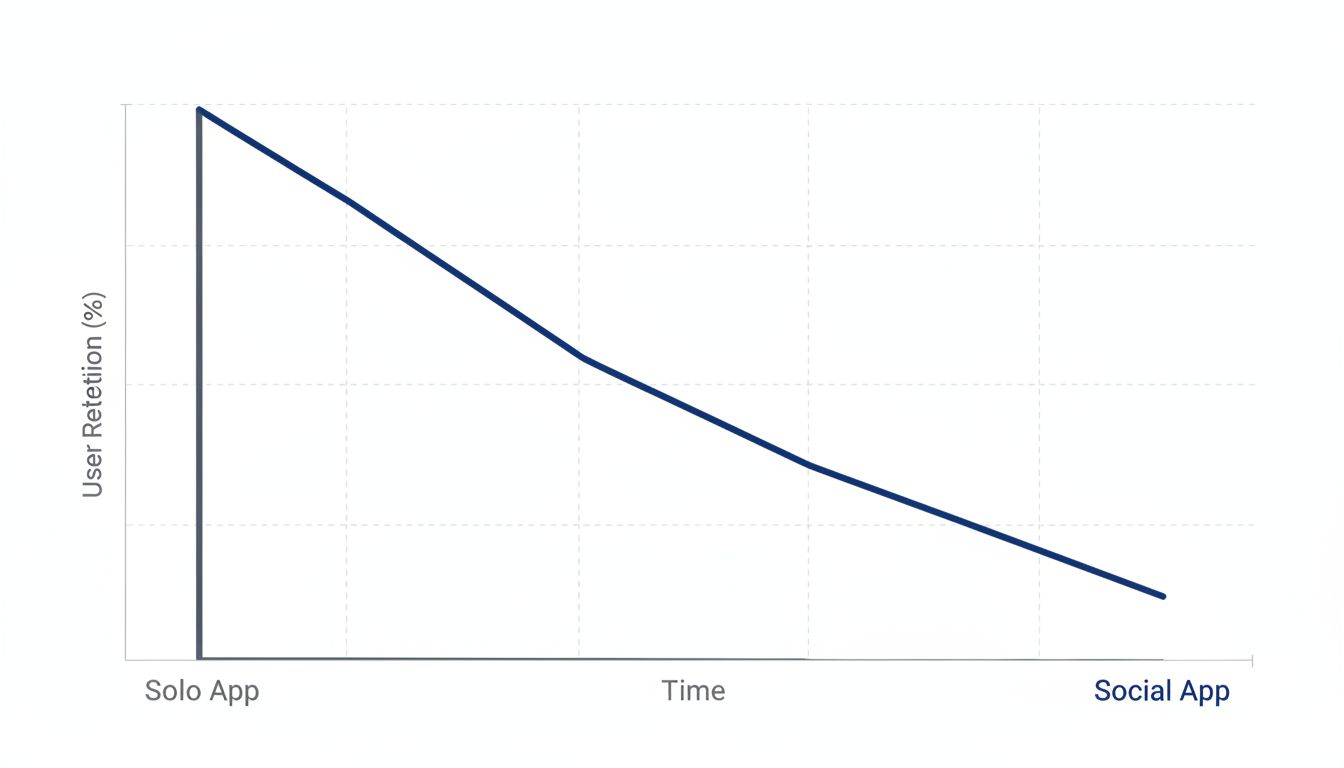
Every app, no matter how useful, faces the same cliff. You download it, use it intensely for a few weeks, and then your engagement drops. The product team calls this the “retention curve,” and watching it flatten is their version of a horror movie. Once you have learned the app’s value, you use it less, not more. A great budgeting tool, for example, becomes almost invisible once your finances are sorted. That is a success for you and a disaster for the company.
Social features solve this problem elegantly and ruthlessly. When your activity is tied to other people, your reasons to return multiply. You come back to see what they did. You come back because someone commented on your run. You come back because leaving now means disappearing from a community. The app has effectively outsourced its retention engine to your social anxiety, which is a far more reliable fuel than utility.
The Data Flywheel You Are Feeding
There is a second incentive, quieter but just as powerful. Social interactions generate a category of data that solo usage simply cannot: relational data. When you follow someone, compare your stats, or react to a friend’s achievement, you are teaching the app who you are in relation to other people. That data is extraordinarily valuable for building recommendation systems, improving ad targeting, and training the kind of behavioral models that keep you inside the product longer.
This connects directly to why tech companies deliberately hire their own users as employees. The people building these social layers are often the most engaged users of the product, and they intuitively understand which social hooks will land. They are not guessing. They are generalizing from their own behavior.
The result is a flywheel: more social data improves recommendations, better recommendations increase engagement, more engagement generates more social data. Once a company sees this loop working, adding social features to every corner of the product becomes almost compulsive.
Why “Nobody Asked for This” Is Irrelevant
Here is the part that surprises most people: the social pivot rarely starts with user requests. Product teams do not look at their support tickets and find thousands of messages saying “please let me follow my friends on this tax software.” The demand is manufactured, not discovered.
This is where winning startups treat customer complaints as a product roadmap breaks down as a framework, at least for this specific feature category. Social layers are not built to solve your problems. They are built to solve the company’s problems, specifically its need for engagement, data, and a defensible network effect that competitors cannot easily replicate.
Network effects are the real prize. Once enough of your friends are on a platform, switching costs become enormous. You are not just leaving an app, you are leaving a community. This is why companies absorb the short-term user irritation of a social redesign. The long-term lock-in is worth the complaints.

What This Means for Builders and Users
If you are building software, this pattern is worth thinking about carefully before you implement it. Social features are powerful, but they carry real costs.
First, they change your product’s identity. Users who came for utility often resent the pivot, and their frustration is legitimate. Second, moderation becomes your problem the moment users can interact. Third, and most importantly, social features signal to users that the app is optimizing for engagement rather than outcomes, which erodes trust in tools where trust is the core value proposition (think health apps, financial tools, productivity software).
If you are a user, knowing this pattern helps you make better choices. When an app you love adds a social layer you did not want, you now know why. You can decide whether the trade-off is worth it, or whether to look for a leaner alternative. Digital minimalists consistently outperform productivity app power users in part because they recognize when an app has stopped serving them and started serving itself.
The Escape Valve Most Companies Ignore
There is a version of the social pivot that actually serves users, but it requires discipline that most growth-focused teams cannot sustain. The key is making social features optional, low-friction to ignore, and genuinely tied to the app’s core purpose.
Strava does this reasonably well. Its social layer is built around the specific thing its users care about (athletic performance), not generic sharing. Duolingo’s leaderboards are annoying to many users, but they are at least thematically coherent. The apps that get this wrong are the ones bolting on feeds and profiles that have nothing to do with why you downloaded them in the first place.
The practical question you should ask about any app adding social features is this: does the social layer make the core product better, or does it just make the company stickier? Those are very different things, and the gap between them is where user trust goes to die.
The social creep will continue. The economics are too compelling and the network effects too attractive for most companies to resist. But now that you understand the machinery behind it, you are in a much better position, whether you are building the next app, funding it, or just deciding which ones deserve a place on your phone.