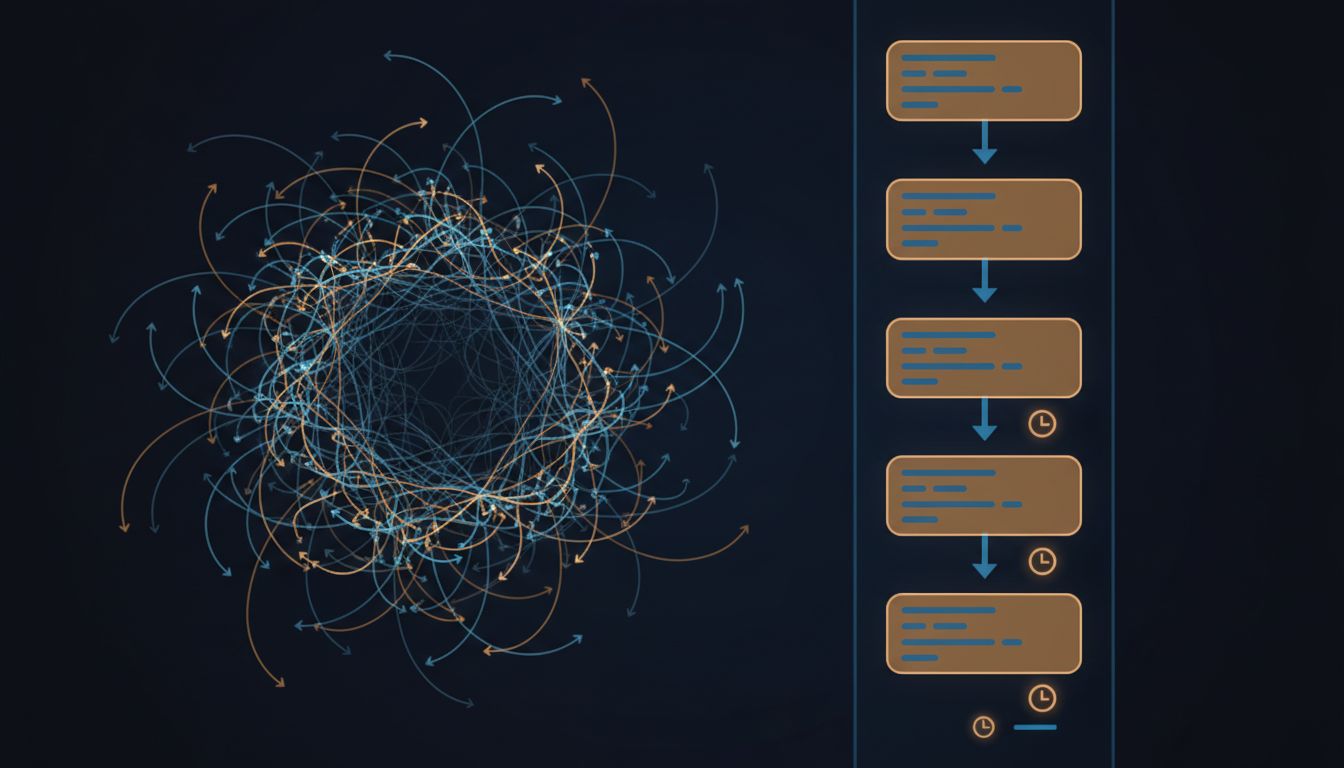

The most productive teams I have worked with share a habit that looks almost embarrassingly simple from the outside: they protect large, contiguous blocks of time from meetings. Not as a wellness initiative. Not because someone read a self-help book. They do it because they understand that interrupted work is qualitatively different from focused work, and that the difference compounds at the team level into something that looks like competitive advantage.
This is not a subtle point. But it is one that most engineering organizations, product teams, and technical leads consistently fail to act on, even when they intellectually agree with it.
The real cost is not the meeting, it is the crater it leaves
When a developer gets pulled into a 30-minute standup at 10 AM, the cost is not 30 minutes. Research by Gloria Mark at UC Irvine has found that after an interruption, it takes an average of over 20 minutes to fully return to a complex task. Stack two meetings with a 90-minute gap between them and you have not given someone a 90-minute work block. You have given them two fragmented sessions that may not be long enough to generate any meaningful output at all.
This is what makes meeting-free blocks structurally different from just “having fewer meetings.” The goal is not to reduce meeting count. It is to create time that is actually usable for the kind of work that requires sustained attention: designing systems, writing non-trivial code, working through a hard architectural tradeoff, or reviewing a complex pull request with enough context to say something useful.
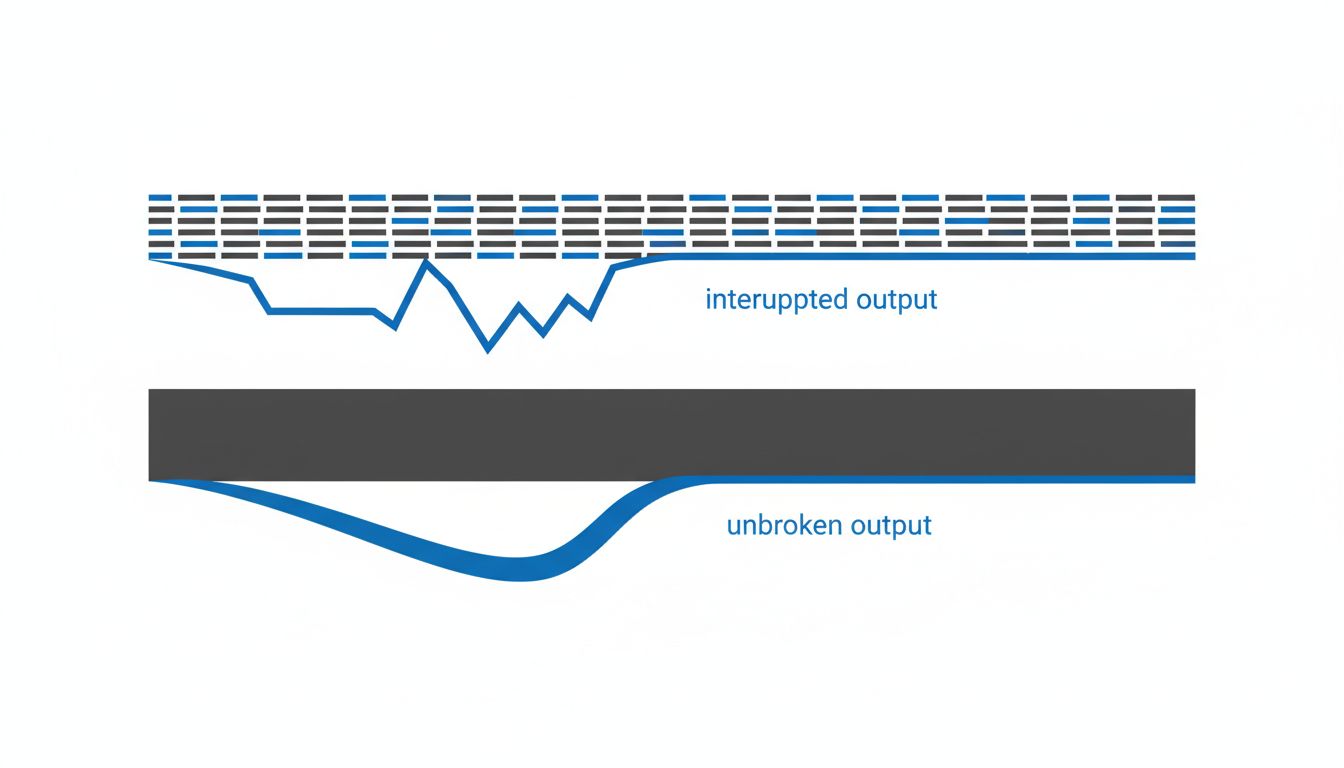
The teams that understand this do not schedule focus time around their meetings. They schedule meetings around their focus time. That inversion is the whole thing.
Focused time produces asymmetric output
Software development is not a linear process where more hours in equals proportionally more output out. A developer who gets four uninterrupted hours in the morning will typically produce work that is not just twice as good as what they would produce in eight fragmented hours. It is often categorically different: more coherent, less defensive, better anticipated for future requirements.
This is because complex problem-solving requires holding a large mental model in working memory simultaneously. You need to know the shape of the database schema, the constraints of the API contract, the edge cases in the business logic, and the implications for the deployment pipeline, all at once. Building that mental model takes time. Interruptions do not just pause it. They collapse it. Multitasking Does Not Make You Faster. Here Is What the Neuroscience Actually Says.
Teams that consistently produce high-quality work fast are usually teams where individuals can actually load this context and work with it for long enough to do something worthwhile.
Protecting focus time is a forcing function for better communication
Here is the objection I hear most often: “We need to stay aligned. If people disappear for three hours, things fall apart.”
This is usually a symptom of a communication problem that meetings are papering over rather than solving. When you force yourself to protect focus blocks, you also force yourself to answer the question of what actually needs synchronous discussion and what can be handled asynchronously. That question is uncomfortable because the honest answer, in most organizations, is that the majority of standing meetings exist to create the feeling of alignment rather than the substance of it.
Async-first teams have already worked this out. The discipline of protecting focus time creates pressure to write things down, to make decisions explicit in documentation rather than implicit in conversation, and to default to communication that does not require everyone to be available at the same moment. These habits make teams faster, not slower.
Competitors who ignore this pay the tax every day
If your team ships better work per person-hour because your engineers are not context-switching all day, that advantage accumulates. You refactor something properly instead of hacking around it under deadline pressure. Your code review comments are more substantive. Your architecture decisions have fewer regrets six months later.
Most competing organizations are running the same inherited calendar culture: standups, syncs, check-ins, all stacked through the morning. The engineers on those teams are not less capable. They are just operating in conditions that make careful thinking structurally difficult. Treating your calendar like source code means applying the same rigor to what you add and what you refuse to add.
The counterargument
The serious version of the pushback goes like this: some teams genuinely need high coordination bandwidth. Incident response, certain product discovery phases, onboarding, teams that are highly interdependent on blocked work. You cannot put your on-call engineer in a focus block and tell them to ignore the pager.
This is true. Meeting-free blocks are not a universal rule. They are a default that should be broken deliberately, with awareness of what the interruption actually costs. The problem is not that exceptions exist. The problem is that most teams treat every meeting as a potential exception and end up with no protected time at all.
The answer is not to eliminate the concept of focus time because it cannot be applied perfectly. The answer is to hold it as a default, protect it explicitly on the calendar, and be honest about which interruptions are actually worth the cost.
The position is simple
Meeting-free blocks are not a morale perk or a trend. They are a structural mechanism that allows skilled people to do the kind of work they were hired to do. Teams that implement them consistently will outproduce teams that do not, not because they work harder, but because they work in conditions that make serious thinking possible. The teams that have figured this out are not advertising it. They are just shipping.