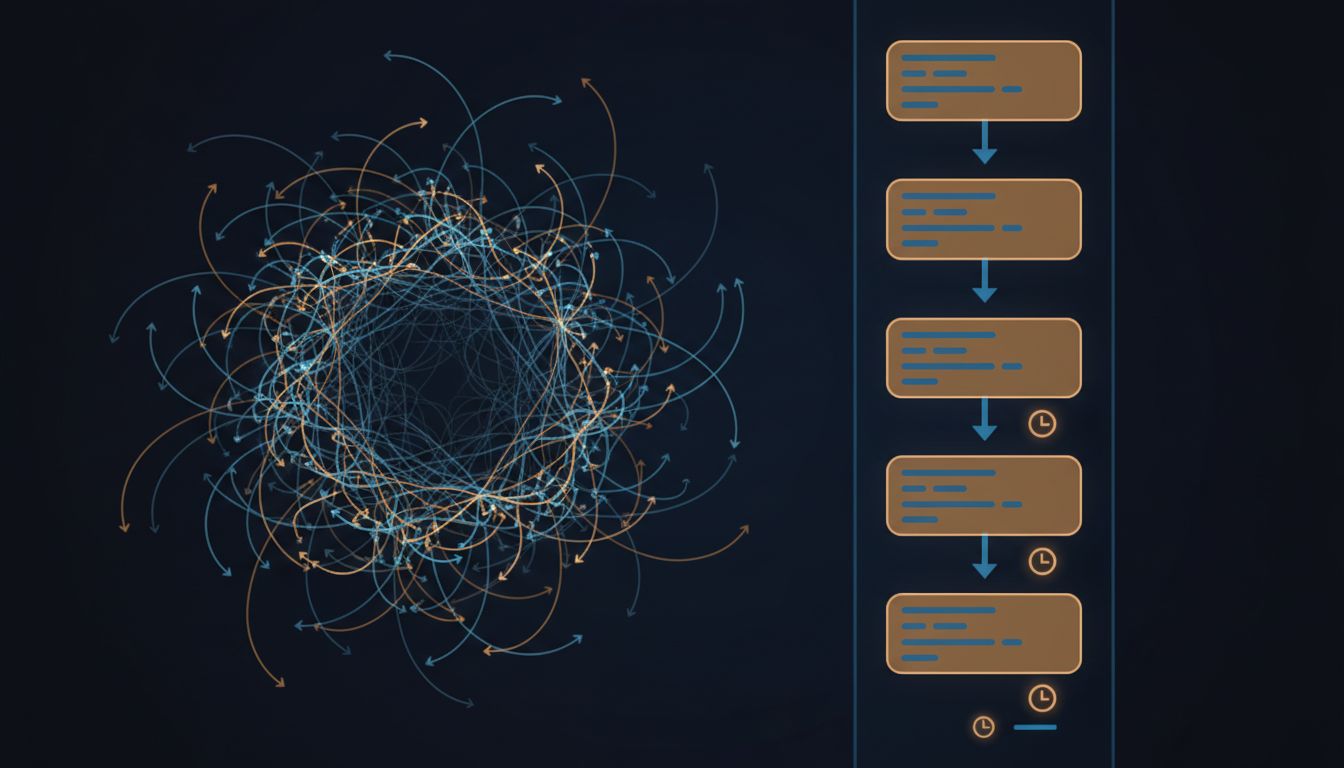

There is a pattern that shows up if you spend enough time talking to people who build productivity software, and it is uncomfortable once you notice it. The engineers at major calendar app companies, the consultants who write books about time-blocking, the UX researchers who spend their days optimizing notification flows, a surprising number of them manage their own time with a plain text file, a physical notebook, or a dead-simple system they built themselves in about forty minutes. They are not being ironic. They are solving a problem they understand better than anyone, and their solution is conspicuously not the product they helped ship.
This is not a coincidence, and it is not humility. It is an emergent behavior that tells you something important about the gap between what productivity tools are optimized for and what productive work actually requires. Top performers who understand this gap often find that the most effective move is not to find a better app, but to deliberately constrain their options.
The Incentive Mismatch Hidden in Plain Sight
Let’s think about this the way you would think about a codebase. Every software product has two sets of requirements: the stated requirements (what it’s supposed to do for the user) and the unstated requirements (what it needs to do to survive as a business). In well-aligned products, these overlap heavily. In productivity software, they frequently diverge.
A calendar app that perfectly solved your scheduling problem would need very little of your attention after the initial setup. You would open it, your week would be organized, and you would close it and go do the work. That is a terrible engagement metric. It produces low daily active users, low session duration, and weak retention signals. From a product analytics standpoint, a tool you barely need to touch looks identical to a tool you have abandoned.
So productivity apps are quietly optimized, not always maliciously, for engagement rather than for what engagement is supposed to produce. Features get added. Integrations multiply. The settings panel becomes a project in itself. Multitasking apps are engineered to pull you back into them more often than you need to be there, and the business logic behind that is worth billions.
The developer who built the recurring event sync logic understands this at a bone-deep level. She knows exactly which notification is there to help you and which one is there to help the retention dashboard. So she opts out.
The Cognitive Load Problem Is Structural, Not Accidental
Here is a concept worth understanding: cognitive load, in the psychology sense, refers to the total amount of mental effort being used in working memory at any given moment. It is a finite resource, and it gets depleted by decisions, interruptions, and context switches, not just by hard thinking.
Calendar apps, as a category, are extraordinarily expensive in cognitive load terms. Every time you open one, you are not just checking a time slot. You are processing color codes, evaluating whether your buffer blocks have been respected, noticing the meeting that got moved without anyone telling you, and wondering whether the third-party integration pulled in the right time zone. You have made a dozen micro-decisions before you have done a single unit of actual work.
A text file with six lines on it costs almost nothing. 9am: standup. 10am-12pm: deep work on auth refactor. 1pm: lunch. 2pm: 1:1 with manager. Rest of day: async. That is a complete picture of a workday that you can parse in under three seconds and never think about again until you need it.
Senior developers know this pattern well. The same instinct that leads an experienced engineer to reach for a simple, boring, well-understood solution rather than an impressive one is the instinct that leads them to manage their time with a tool that has almost no surface area. Senior developers write code for resilience and longevity, not for impressiveness, and the same principle applies to how they design their own workflows.
The Feature That Solves the Problem Is the One They Hide
Here is the interesting technical wrinkle. Most major calendar apps actually do have a stripped-down mode, a simpler view, a way to use them like the plain system the experts prefer. But these modes are consistently buried. The default experience is the complex one, and simplicity requires deliberate configuration by the user.
This is not an accident of design. Tech companies have a well-documented pattern of hiding their most effective features from new users because the simple version of the product is harder to justify in a feature comparison grid, harder to market against competitors, and harder to charge a premium for. Simplicity reads as “less” even when it performs better.
The expert who uses the product professionally knows where to find the simple mode, or they have built their own. The average user follows the onboarding flow, enables every suggested integration, and ends up with a system that requires ongoing maintenance just to stay functional.
What the Plain Text File Is Actually Doing
When a productivity expert uses a plain text file or a paper notebook, they are not being a Luddite. They are making a specific architectural decision about where to put their state.
In software terms, state is the information your system needs to hold in memory to function. Complex apps hold a lot of state: sync state, notification state, preference state, integration state. Every piece of state is a thing that can go wrong, a thing that requires reconciliation, a thing that costs attention. A plain text file has almost no state. It is a static artifact. It cannot notify you, conflict with itself, or require a refresh.
There is also something worth noting about how your brain handles tasks versus schedules. Your brain never actually finishes processing an incomplete task, which means a system that keeps surfacing unfinished items is not helping you close loops, it is just keeping them open longer. The simplest possible scheduling system surfaces only what is relevant right now and disappears otherwise.
The people who build calendar apps understand this. That is why they do not use them.
The Takeaway Is Not to Delete Your Calendar App
None of this means you should throw out your scheduling software. Shared calendars, meeting coordination across time zones, and recurring event management are genuinely hard problems that software solves well. The point is narrower than that.
The point is that the parts of your productivity system that are supposed to reduce friction are worth auditing for whether they are actually doing that. If you are spending twenty minutes a week managing your productivity system rather than using it, if the tool requires regular maintenance to stay useful, that is a sign the tool has become the work. The experts noticed this and adjusted. You can too.