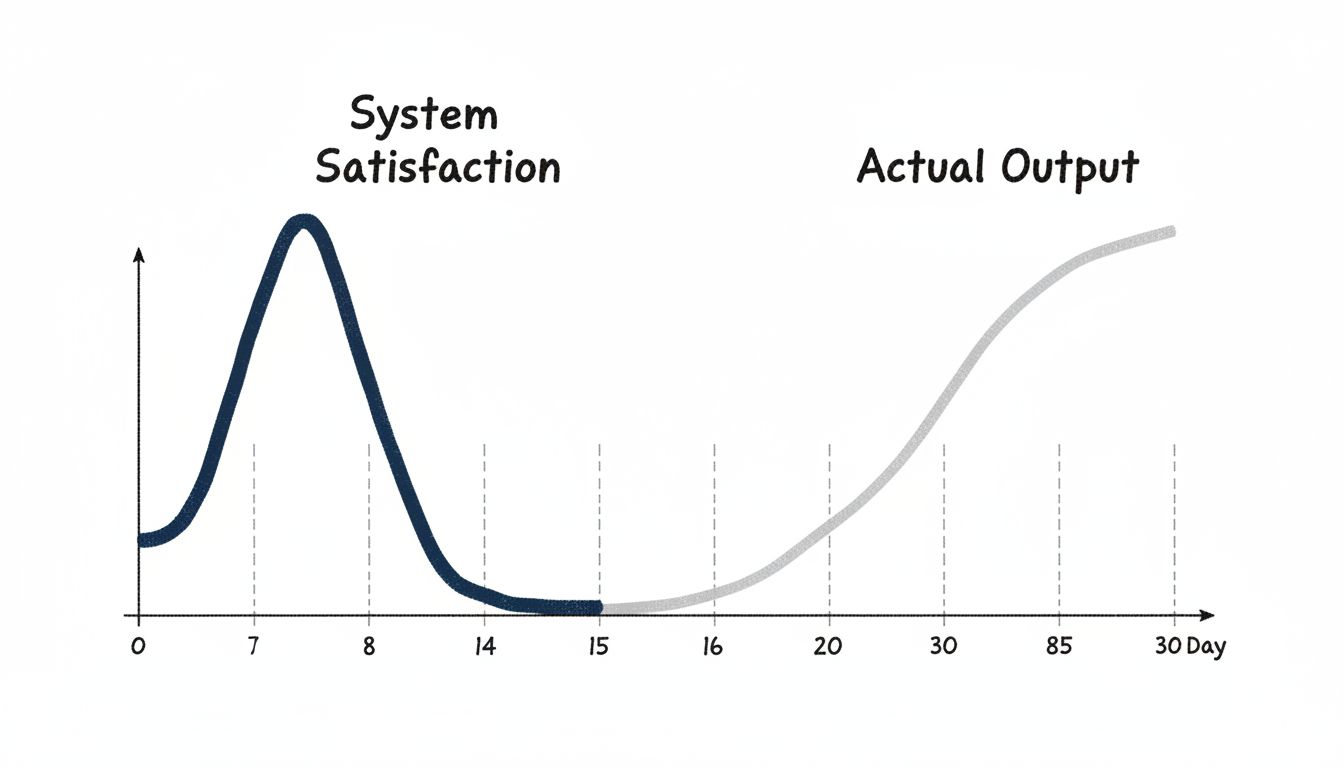
Every productivity system works at first. GTD, time-blocking, Pomodoro, Notion templates with seventeen linked databases. You adopt one, feel a surge of clarity, actually get things done for a few weeks, and then quietly stop using it. The system doesn’t fail loudly. It just gradually becomes another tab you don’t open.
Most people blame themselves. They call it a discipline problem or a motivation problem. It isn’t. The 30-day collapse is a design problem, and once you understand the mechanism, you’ll stop shopping for better productivity systems and start asking better questions.
The Setup Phase Feels Like Progress
When you adopt a new productivity system, the first thing you do is configure it. You create inbox categories, set up recurring reviews, build templates, import your task list. This activity is cognitively rewarding. You’re making decisions, creating structure, reducing ambient anxiety. Your brain interprets this as productive work.
But here’s the thing: you’re not actually doing your work. You’re doing meta-work, and meta-work carries a subtle trap. It borrows forward against future motivation. The clarity you feel during setup is real, but it’s a one-time dividend. Once the system is configured, you have to actually use it to accomplish tasks that have nothing to do with the satisfaction of building the system. That’s a fundamentally different experience, and for most people, it’s a worse one.
This is why the most enthusiastic productivity system adopters are often the least productive people in a building. They’re not lazy. They’re optimizing for the feeling of productivity rather than the output of it.
Your Life Changed, Your System Didn’t
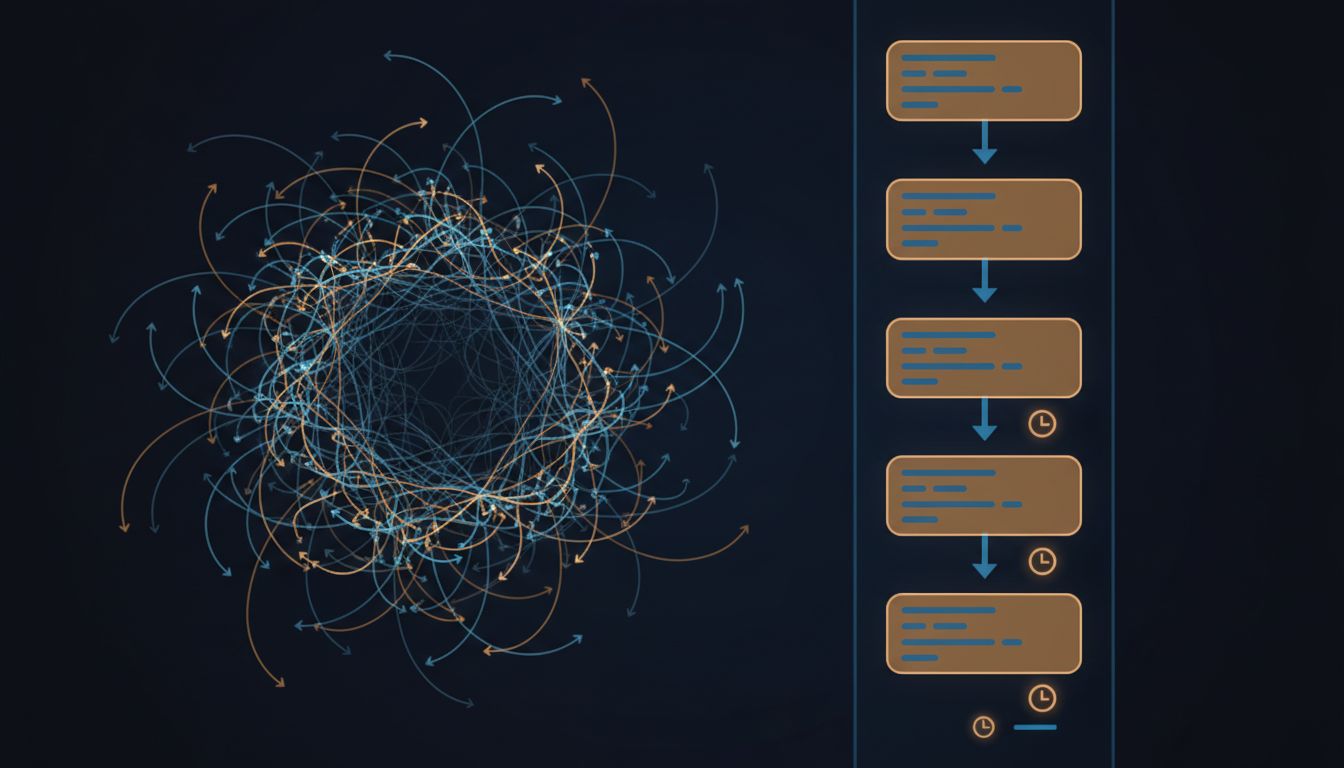
Software engineers talk about the difference between a system’s happy path (the flow it was designed for) and edge cases (everything else). Most productivity systems have a very narrow happy path. They assume your work is decomposable into discrete tasks, that your priorities are stable week to week, and that interruptions are exceptions rather than the norm.
None of those assumptions survive contact with actual work for very long. A project changes scope. A colleague leaves and you absorb their responsibilities. A client becomes a crisis. Your system, designed for last month’s job, now generates friction instead of reducing it. But because the system is supposed to help you, you assume the friction means you’re using it wrong, and you either try to force your work into the system’s model or you quietly abandon it.
A good system should degrade gracefully. Most don’t, because they were designed during a calm setup phase that doesn’t resemble the conditions under which you’ll actually use them.
Novelty Is Doing More Work Than You Think
There’s a straightforward psychological mechanism at work in the first 30 days. Novelty increases attention and engagement. A new system is interesting. You notice when you’re using it correctly. You feel the feedback loop.
After a month, the system is no longer new. Using it correctly generates no signal, only task completion, which is satisfying but quieter than the pleasure of using a novel tool. The system has become infrastructure, and infrastructure is invisible until it breaks.
This is the same dynamic that makes A/B tests on onboarding flows look spectacular in the short term and then wash out in six-month cohort analysis. The manipulation of initial engagement is not the same as durable behavior change. Productivity system designers know this, which is why many of them release new templates, new companion apps, and new editions that give existing users a reason to re-engage with setup. The novelty hit is the product.
The System Assumes You Know What Matters
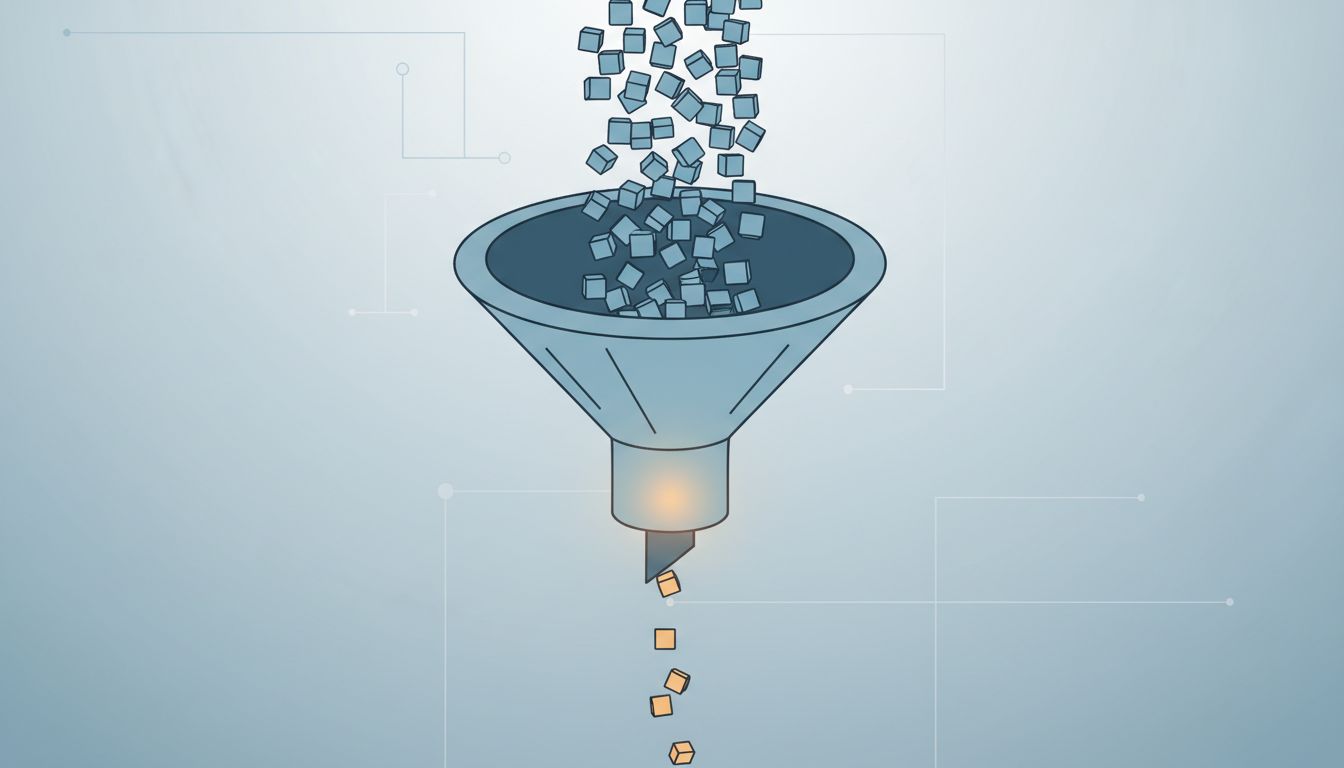
The deepest problem is that most productivity systems treat prioritization as an input rather than a problem to be solved. They give you frameworks for organizing and scheduling tasks, but they assume you already know which tasks are the right ones.
This assumption is almost always wrong. Most knowledge workers have a list of things they’re supposed to do, not a list of things that will actually matter six months from now. A system that helps you efficiently execute the wrong work faster is not a productivity tool. It’s a way to feel organized while making the wrong bets.
The people who seem immune to the 30-day collapse are rarely the ones who found a better system. They’re the ones who spent that energy clarifying what they’re actually trying to accomplish, so that any system, even a simple one, can serve them.
The Counterargument
The honest pushback here is that some people do maintain systems for years, and those people are genuinely more productive. GTD practitioners who stick with it past the initial phase report real, lasting benefits. Time-blocking is legitimately effective for researchers and developers who need to protect deep work.
This is true, and it matters. But notice what those successful long-term users have in common: they simplified their systems over time rather than elaborated them, they adapted the system to fit their actual work rather than adapting their work to fit the system, and they have unusual clarity about what their work actually is. The system didn’t create that clarity. The clarity made the system possible.
A hammer is useful if you’re building something. Owning a better hammer won’t tell you what to build.
Stop Optimizing the Container
The 30-day collapse isn’t a failure of willpower or a flaw in any particular system. It’s a predictable outcome of applying an organizational solution to a prioritization problem. You cannot organize your way to knowing what matters.
If you want a productivity system that actually lasts, build the smallest possible one that handles your actual recurring work, and spend the time you would have spent on elaborate setup figuring out whether you’re working on the right things. That second part is harder and less satisfying than building a Notion template. It’s also the only part that compounds.