
You probably typed a language name into a search bar today without thinking twice about it. Python. Ruby. Rust. Go. Swift. Kotlin. These names are so familiar that they stop registering as strange, but stop and think about them for a moment. Why would anyone name a programming language after a snake? Or a gemstone? Or a direction of movement? The answer involves psychology, community-building, and some surprisingly strategic thinking about how tools get adopted.
This is more connected to how software succeeds or fails than it might appear at first. As most revolutionary software features were discovered by accident, so too were many of the naming conventions that now feel deliberate and inevitable. The patterns are hiding in plain sight once you know where to look.
The Four Naming Strategies (and What They Signal)
If you survey the landscape of programming languages, you start to notice four distinct naming camps, each with its own logic.
The Acronym School. PHP stands for “PHP: Hypertext Preprocessor” (a recursive acronym, which is a programmer joke in itself). LISP comes from “LISt Processing.” COBOL is “Common Business-Oriented Language.” These names were built for institutional credibility. When you are trying to sell a language to a corporation or a government body in the 1960s or 1970s, sounding technical and purposeful matters. The name is a features list compressed into a word.
The Mythology and Culture School. Python was named after Monty Python, not the snake. Guido van Rossum wanted something short, unique, and slightly irreverent. Ruby’s creator, Yukihiro Matsumoto, chose the name as a nod to Perl (another gemstone metaphor), but also because he liked how it sounded. Erlang references Agner Krarup Erlang, a Danish mathematician, but also sounds vaguely mythological. These names signal that the language has a personality. They invite you into a culture rather than just a toolset.
The Concept School. Go, Rust, Swift, and Kotlin all name an idea or quality rather than a metaphor. Go implies speed and simplicity. Rust implies durability and systems-level strength. Swift speaks for itself. These names function almost like brand promises. You are told what the language is trying to be before you write a single line.
The Accidental and Inherited School. C got its name because it followed B, which followed BCPL. Java was originally called Oak, then Green, and landed on Java (after the coffee) almost by default. This category tends to include languages that were internal tools nobody meant to release publicly, where naming was an afterthought until it suddenly was not.
Why the Name Affects Whether People Actually Use the Language
This is where it gets practically useful for you if you are ever building a tool, a framework, or a product in the developer space.
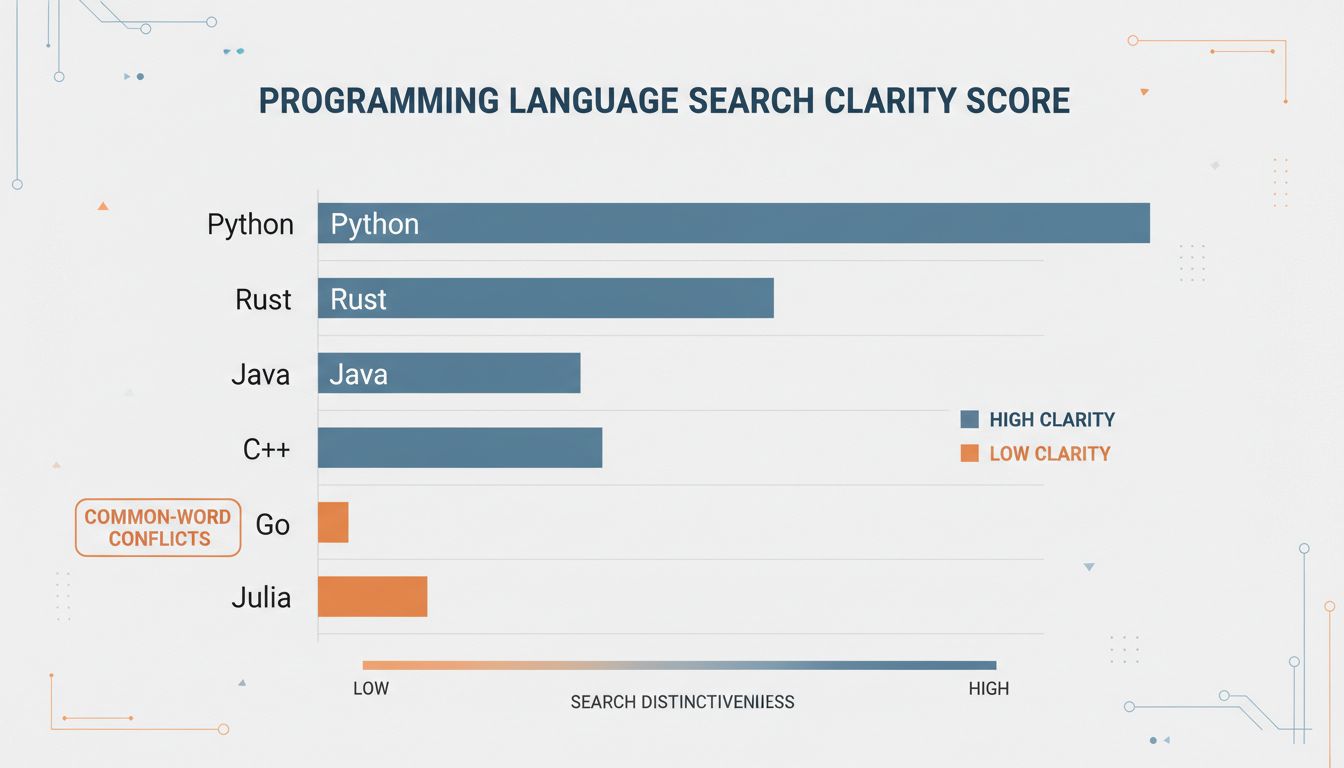
Research on open-source project adoption consistently finds that discoverability and memorability are underrated factors. A name that is easy to search for, easy to say out loud, and easy to remember in a conversation compounds over time. Python’s name has an unusual advantage here: it is distinctive enough that searching for it (plus a relevant term) almost always surfaces the language rather than the reptile. Ruby has the same property. Go, by contrast, has a notorious searchability problem. “How to do X in Go” returns muddier results than “How to do X in Python” because “go” is a common English verb.
Matsumoto has said that he wanted Ruby to feel “joyful,” and the name carries that forward. When a language name feels playful or warm, it subtly lowers the psychological barrier to trying it. This is not a small thing. Language adoption is largely a social and emotional process before it is a technical one.
What the Name Tells You About the Community
Here is a framework you can use immediately. When you encounter a new language or tool, look at the name and ask three questions.
First: Is this name functional or expressive? Functional names (PHP, COBOL, SQL) tend to attract communities that value precision and professional credibility. Expressive names (Ruby, Elixir, Crystal) tend to attract communities that value craft and personality. Neither is better, but knowing this helps you predict who you will be working alongside.
Second: Is this name self-explanatory or does it require context? Swift tells you what it does. Haskell (named after logician Haskell Curry) tells you nothing unless you know the history. Languages that require context to name tend to have steeper, more insular community entry points.
Third: Does this name have room to grow? A name like Rust implies robustness and systems-level work. It would feel strange as the go-to language for building a whimsical game. Python, being slightly absurdist, has no such constraint. It scales emotionally from scientific computing to web development to beginner education. The name does not box the community in.
This third question matters most if you are building something yourself, because programming languages don’t die from competition, they die from abandonment by the people who built them. A name that grows with a community’s ambition keeps those builders emotionally invested.
The Lesson for Anyone Building Developer Tools
If you are working on a framework, a library, an API, or anything developers will type repeatedly, the naming logic above applies directly to you.
Avoid purely descriptive names. “PythonWebFramework” tells you everything and invites no attachment. Django sounds like something you would want to be good at. Flask sounds light and approachable. The feeling the name creates is doing real work.
Test searchability before you commit. Type your name into a search engine with common adjacent terms and see what you get back. A name collision with a popular consumer product or a common English verb is a quiet tax on every developer who ever tries to find your documentation.
And do not underestimate the cultural signal. The name of your tool tells people what kind of community they are joining before they have written a line of code. That signal shapes who shows up, what norms develop, and whether the community eventually sustains the tool or lets it drift.
The names that stuck, from Python to Rust to the recursive absurdity of GNU (GNU’s Not Unix), were not accidents. They were the first piece of communication a language ever made with the world. In most cases, the creator got lucky. In a few, they were genuinely strategic. Either way, you can learn from both.