
Everyone agrees that most meetings should be documents. Then everyone schedules another meeting. This is not a mystery if you look at what meetings actually do for the people scheduling them.
1. Writing Forces You to Have a Position
A meeting lets you explore ideas out loud without committing to any of them. You can say “I’m wondering if we should…” and let the room respond and adjust. A document requires you to write something down, which means you have to actually think it through first. The act of writing is where vague intuitions meet the hard question: do I actually believe this?
This is why the people who resist writing things down are often the people whose thinking would fall apart under scrutiny. Not because they’re dishonest, but because they haven’t done the work yet. The meeting is the procrastination.
2. Meetings Create Accountability That Disappears Afterward
There is a social pressure in a live room that documents don’t replicate. People feel obligated to respond, to participate, to not visibly disengage. This feels productive. The trap is that this pressure evaporates the moment the call ends. Nobody follows up on the thing three people said they’d look into. The action items in the notes rot.
A document with a clear ask and a named owner doesn’t let people off the hook the same way. The written request sits there. The silence is visible. Many teams find that switching to written proposals actually surfaces who is consistently unresponsive, which is information a meeting successfully hid.
3. You’re Solving an Anxiety Problem, Not an Information Problem
A lot of meetings exist because someone, usually the organizer, is anxious about a situation and wants to feel like they’re doing something about it. Scheduling a meeting feels like taking action. Sending a Slack message or writing a doc feels like waiting.
This is a psychological pattern, not a communication strategy. The meeting soothes the anxiety while frequently doing nothing to address the underlying situation. If your instinct is to “get everyone in a room” when something goes wrong, ask yourself whether you actually need input from those people or whether you need to feel less alone with the problem.
4. Synchronous Communication Hides Poor Preparation
In a meeting, a half-formed idea can survive on charm, momentum, and the fact that nobody has time to push back carefully. In a document, the same idea sits there and people can read it twice, think about it overnight, and come back with a considered objection. Documents are adversarial to bad ideas in a way that meetings are not.
This is actually a feature, not a problem. If your proposal can’t survive being written down and read carefully, it shouldn’t survive. The meeting format is not doing you any favors by letting weak reasoning slide through on the strength of your confidence in the room.
5. Most Meetings Optimize for the Fastest Responder, Not the Best Thinker
Live discussions reward people who think quickly and speak confidently. This selects for a particular kind of intelligence that correlates poorly with being right. The person who needs twenty minutes of quiet to formulate a nuanced view loses to the person who has a snappy take ready immediately.
Amazon’s famous practice of starting executive meetings with silent reading of a written memo before any discussion is a direct response to this problem. You don’t have to adopt their exact ritual, but the underlying logic is sound: give people time to actually think before you ask them to respond. An async document does this by default. A live meeting almost never does. This connects to a broader problem about why your most important work keeps getting scheduled last, where reactive tasks (meetings) crowd out the deeper thinking that actually moves things forward.
6. The “Alignment” Meeting Usually Signals a Broken Trust Model
Many recurring meetings exist to create the feeling that everyone is on the same page. This is sometimes legitimate and often a symptom of something worse: a team that doesn’t trust written communication to carry nuance, or a manager who doesn’t trust their reports to make decisions without supervision.
If you’re holding a weekly alignment meeting because people go off in the wrong direction without it, the problem is not a lack of meetings. The problem is unclear ownership, ambiguous goals, or a culture where written decisions aren’t treated as real decisions. The meeting is a workaround for an organizational dysfunction, and running it weekly ensures the dysfunction never has to get fixed.
7. Writing Scales. Meetings Don’t.
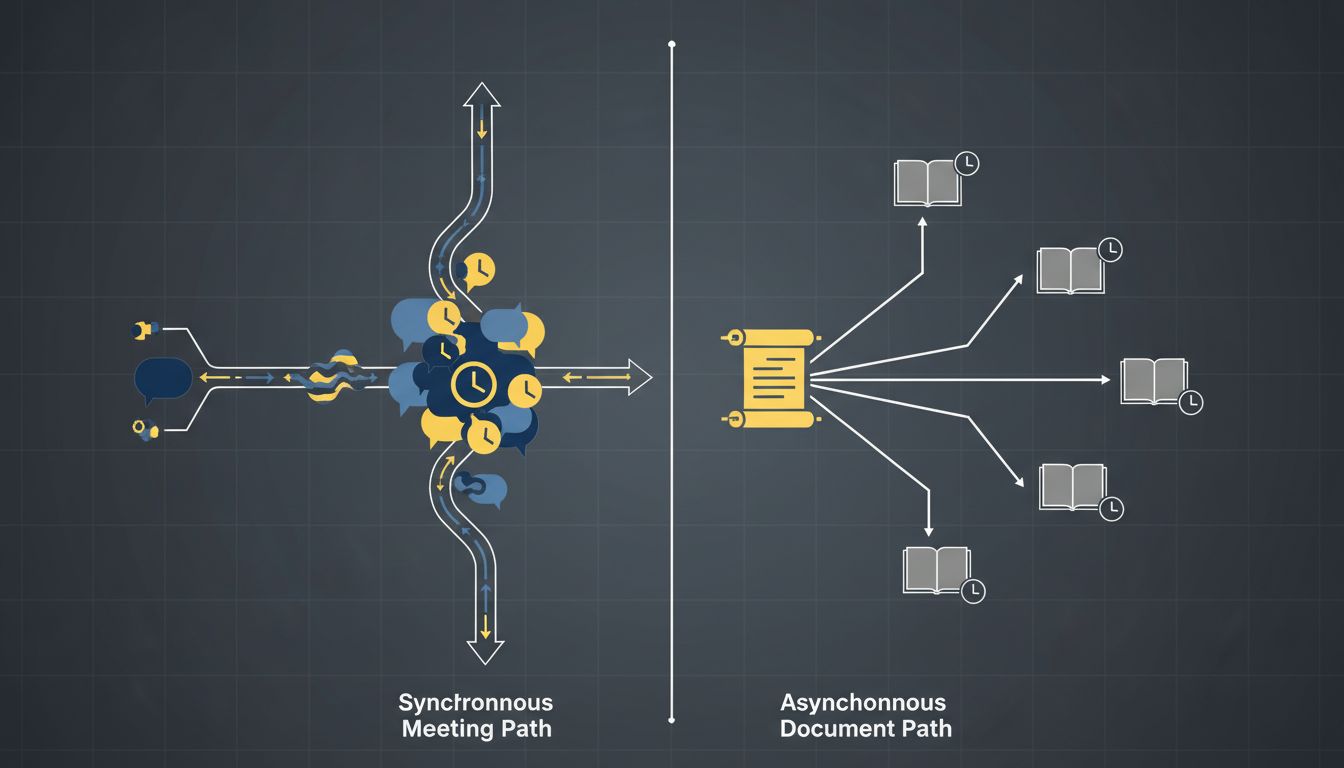
Every person who needs to be informed about something requires either their own meeting slot or a document they can read. The document takes the same amount of effort to write whether one person or fifty people read it. The meeting cost scales linearly with every attendee you add, and then multiplies again with every scheduling conflict that delays it.
This is especially sharp when information needs to cross time zones. A written document reaches your Singapore office immediately and at their convenience. A meeting requires someone to join at 10pm or wait until Monday. If you work with a distributed team and you’re still defaulting to meetings for things that could be written down, you’re not just wasting time, you’re systematically disadvantaging the people who aren’t in your timezone. Good async communication works when you treat it like a protocol, not a preference, meaning you have to actually design for it.
None of this means meetings are always wrong. Real-time conversation is genuinely valuable for conflict resolution, brainstorming with high uncertainty, and relationship-building that written text doesn’t replicate well. But those use cases cover maybe a third of what actually ends up on most people’s calendars. The rest is anxiety management, unclear ownership, and the comfortable feeling of having done something without having to write down what you actually think.