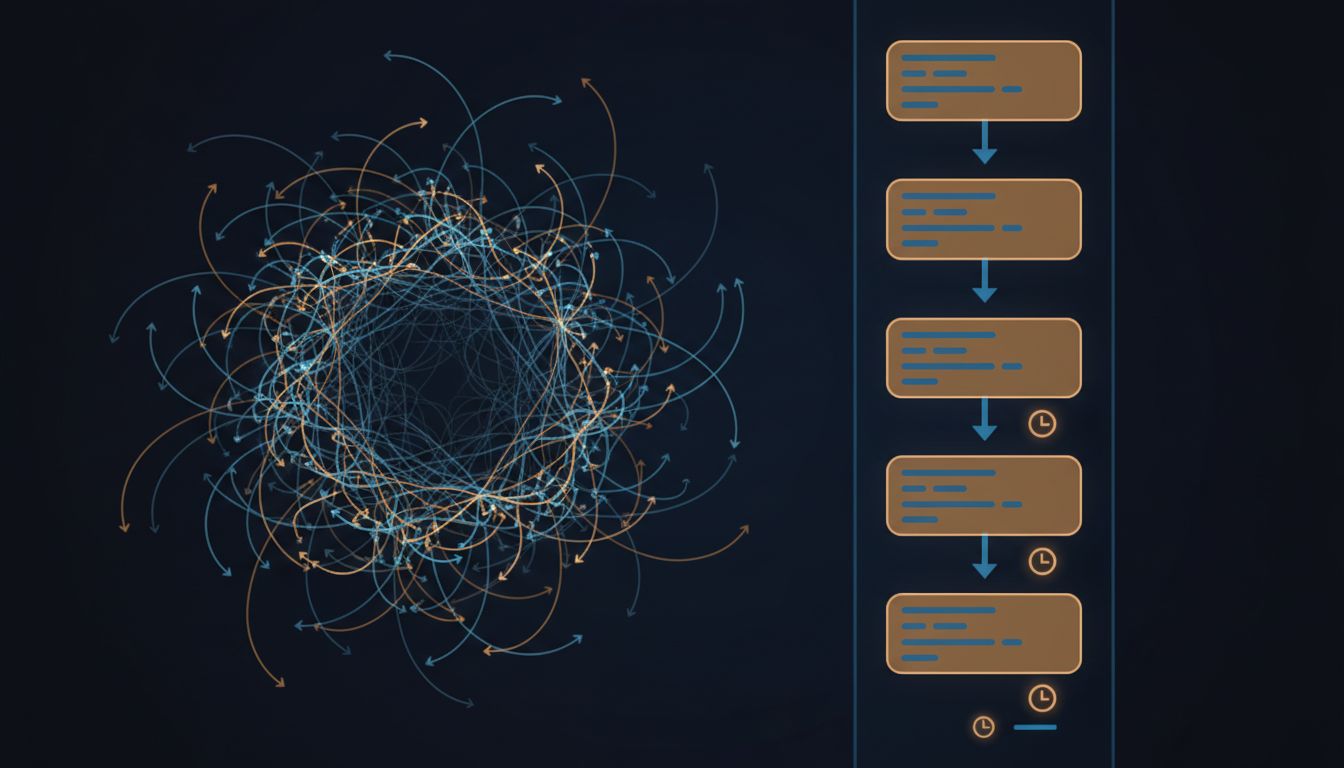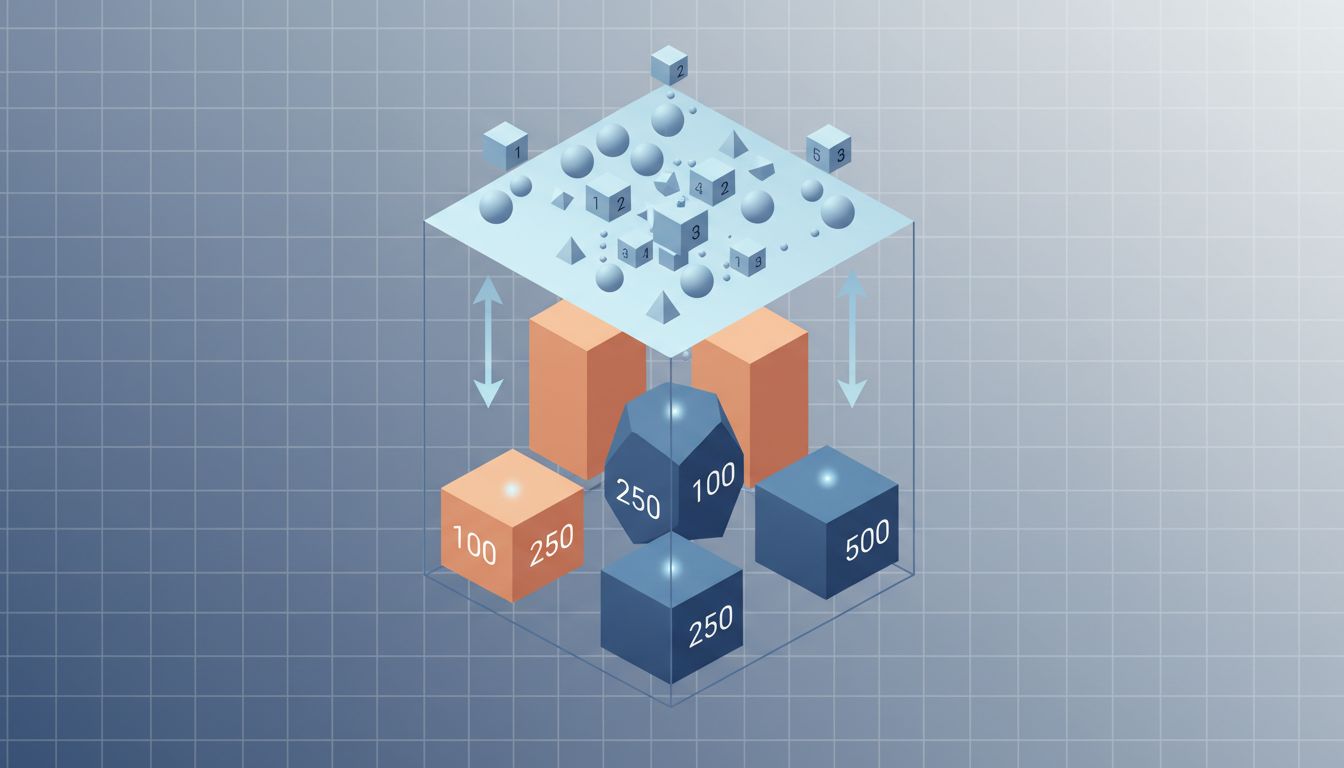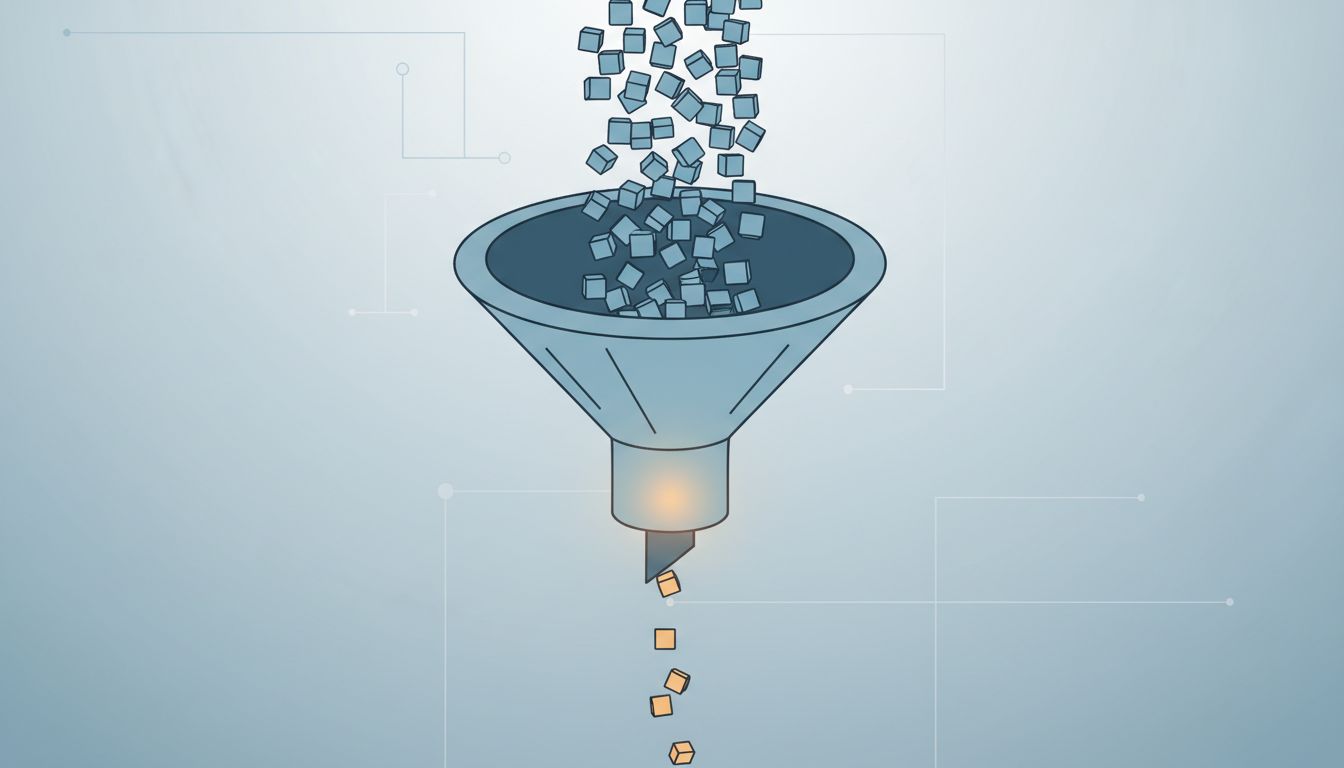

The productivity industry wants you to believe that the person who works longest wins. Eight hours of deep focus, inbox zero, no breaks until the work is done. This framing is wrong, and following it is quietly making skilled people worse at their jobs.
The most productive engineers, writers, and researchers I’ve observed don’t grind through eight-hour focus blocks. They work in sharp, bounded intervals, step away deliberately, and return to problems with renewed processing capacity. This isn’t discipline theater. It reflects something real about how human cognition handles complex problems.
Your Brain Is Not a CPU That Scales With Clock Speed
There’s a tempting mental model where more focused time equals more output, the way adding CPU cycles speeds up computation. Brains don’t work this way. Sustained attention on a single problem doesn’t compound linearly. It degrades.
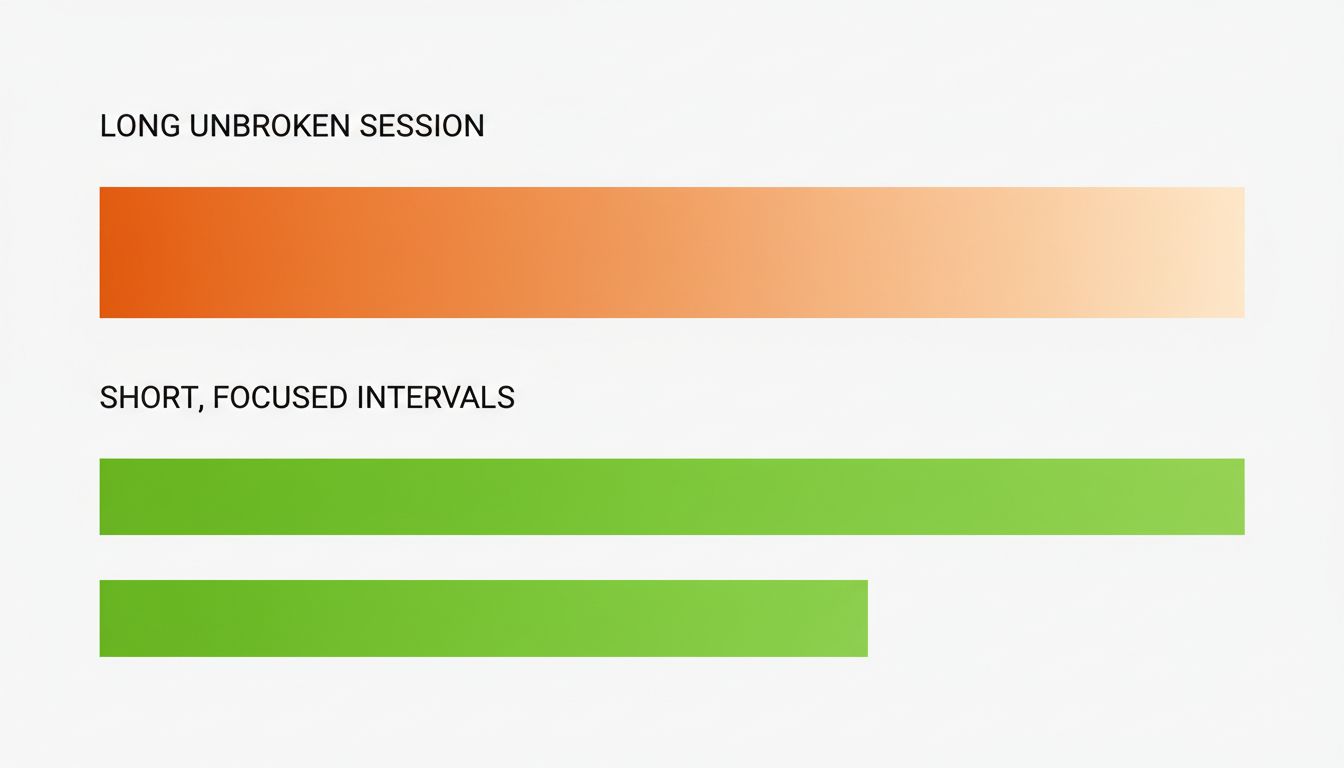
Researchers studying vigilance tasks (tasks requiring sustained focused attention) have documented consistent performance drops after roughly 20-30 minutes without any mental shift. The mechanism isn’t laziness. It’s adaptation. The brain treats a constant stimulus as background noise and begins allocating attention elsewhere. Your focus doesn’t hold steady for three hours and then crash. It starts eroding much earlier, quietly, while you still feel like you’re working.
The practical consequence: the code you’re reviewing in hour three of an unbroken session is getting less cognitive effort than the code you reviewed in hour one, even though your subjective sense of effort might feel the same or higher.
Breaks Are Not Interruptions to Productive Work. They Are Part of It.
One of the more counterintuitive findings in cognitive science is that the brain continues processing problems during apparent rest. The default mode network (the set of brain regions that activates when you stop focusing on a specific task) is associated with consolidation, insight, and connecting disparate ideas. It’s not idle. It’s doing a different kind of work.
This is why solutions to hard problems arrive in the shower, on a walk, or in the first few minutes after waking. You stepped away from deliberate focus and the background process finished running. Programmers know this experience intimately. You stare at a bug for two hours, take a break, come back, and see the problem in thirty seconds. The break wasn’t wasted time. It was processing time running on a different substrate.
Forcing yourself to stay at the desk during this phase doesn’t accelerate the insight. It delays it by keeping the foreground process spinning on the same failed approaches.
The Structure of Short Bursts Forces Better Problem Decomposition
There’s a second-order benefit that gets less attention: working in deliberate time-bounded intervals forces you to break problems into units small enough to make progress on in a single session. This constraint is generative.
A developer who sits down for an eight-hour block often starts with a vaguely defined task and spends hours in a diffuse, unfocused state. A developer who has committed to a 45-minute focused sprint has to answer a more precise question first: what specifically am I trying to accomplish in this window? That forcing function produces better task decomposition, which is one of the core skills separating good engineers from great ones.
This connects to something The Power User Is Losing to Someone With Half the Tools gets at: constraints clarify. People with unlimited time and resources often diffuse their effort across too many things. Artificial scarcity (of time, in this case) focuses execution.
Attention Residue Compounds Across Long Sessions
When you switch tasks, even briefly, a portion of your cognitive resources stays allocated to the previous task. Researcher Sophie Leroy at the University of Washington documented this effect and called it attention residue. The longer and more interrupted your sessions become, the more residue accumulates.
Here’s the practical implication: a long, fragmented eight-hour session with email checks, Slack notifications, and context switches may produce worse outcomes than three clean 90-minute bursts with genuine disengagement between them. The total hours are similar. The cognitive quality of the work is not.
This is part of what Attention Residue Is Real and Tech Companies Are Quietly Building Their Workflows Around It covers in more depth. The tools you use are often actively working against clean session boundaries.
The Counterargument
The strongest objection to this position is that some problems require extended immersion. Writing a complex architecture document, debugging a subtle concurrency issue, or doing serious mathematical work may need more than 45 minutes to even load the relevant context into working memory. This is true. Context-loading overhead is real, and some tasks punish frequent context switching.
But this objection proves a narrower point than it’s usually taken to prove. It argues for sessions long enough to get past context loading, not for the elimination of deliberate breaks. A 90-minute focused burst followed by a 20-minute real disengagement isn’t the same as a 90-minute burst followed by checking Twitter. The disengagement has to be genuine. And the architecture that benefits from extended immersion still benefits from the consolidation that happens when you step away.
The mistake is conflating session length with session quality. More time in the chair is not more time thinking. It’s often more time pretending to think while your actual cognitive capacity sits depleted.
The Underlying Claim
The most productive knowledge workers are not the ones with the most hours logged. They’re the ones who’ve built workflows that match how human attention and cognition actually function, rather than how we wish they functioned.
Shorter, bounded work bursts work because they respect the biological constraints of sustained attention, they leverage background processing during genuine rest, they force cleaner problem decomposition, and they reduce the compounding damage of attention residue. None of this requires special tools or expensive systems. It requires being honest about what a brain can actually do in a given stretch of time, and designing your work around that reality instead of a flattering fiction.
The eight-hour grind isn’t a sign of dedication. It’s often a sign that someone hasn’t examined their assumptions about how cognitive work gets done.