
You open a weather app. You see a temperature, a little sun icon, and maybe a five-day forecast. Three buttons at the bottom. It feels like something a clever college student could knock out over a weekend. So why does the team behind it employ 40 engineers, a handful of product managers, two data scientists, and a dedicated security specialist? The answer reveals something important about how software actually works, and understanding it will change how you think about every digital product you use.
This gap between perceived simplicity and actual complexity is one of the most persistent misunderstandings in tech. And it matters, because if you’re building something, managing a team, or just trying to evaluate whether a product is worth its price tag, you need to see past the surface. The hidden reason enterprise software looks so terrible is often rooted in this same problem: the visible layer is just the tip of the iceberg.
The Iceberg Nobody Talks About
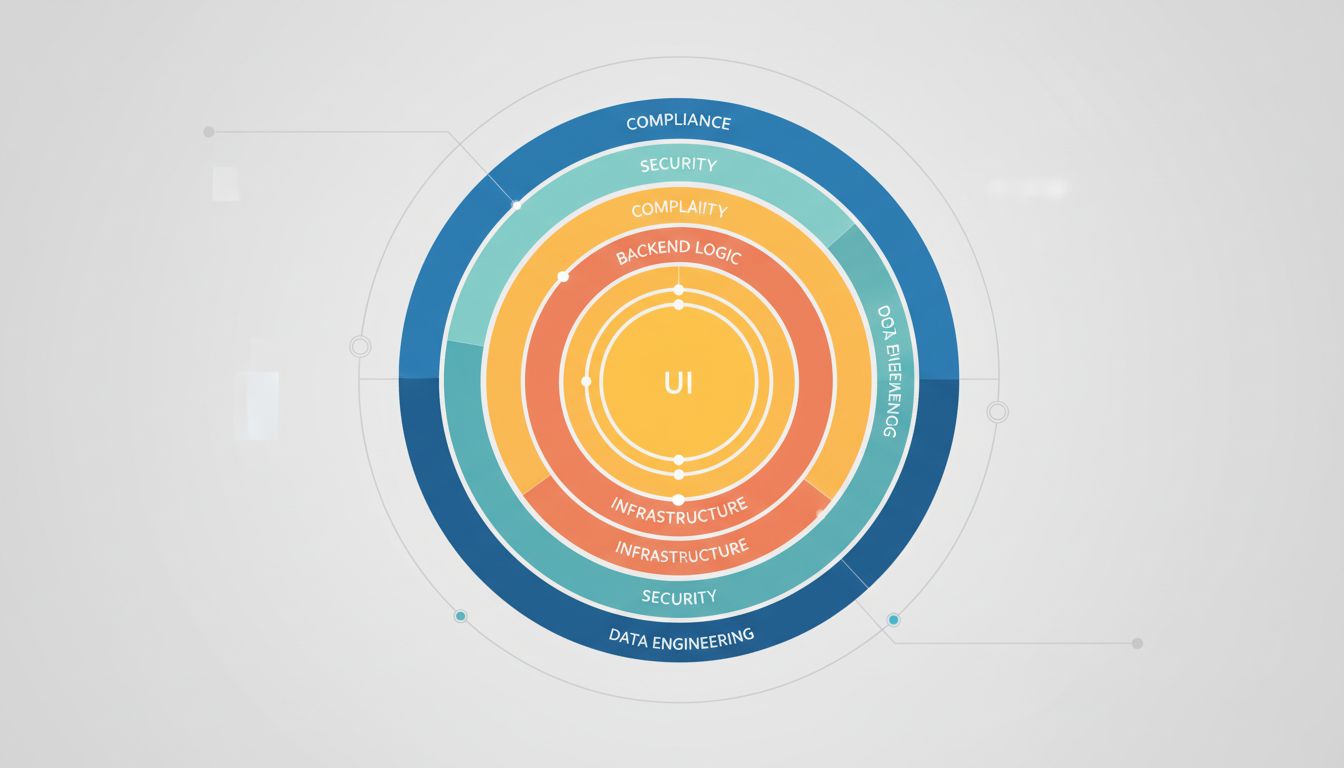
Here is a useful mental model. Think of any app as an iceberg. What you see, the buttons, the screens, the animations, represents roughly 10 to 20 percent of the actual work. The rest sits underwater, invisible to you but absolutely critical.
Take that weather app. On the surface, it pulls a temperature from somewhere and displays it. Underneath, it is handling real-time data feeds from multiple meteorological sources, normalizing data across different formats, managing API rate limits, caching results intelligently so the app stays fast without hammering servers, and failing gracefully when any one of those sources goes down. That last part alone, building systems that degrade elegantly instead of crashing completely, can occupy an engineer for weeks.
Now add location services. The app needs to know where you are, which means integrating with device GPS, handling the case where you deny location permissions, letting you search manually, and storing your frequent locations without feeling creepy about it. Each of those branches is a separate engineering problem.
Then multiply all of this across iOS, Android, and often a web version. Each platform has its own quirks, update cycles, and breaking changes. Engineers who focus exclusively on software rewrites will tell you that keeping three platform versions in sync is sometimes harder than building the product from scratch.
The Hidden Roles You Never See
Beyond the obvious engineers, simple apps accumulate specialist roles that outsiders rarely anticipate.
Security engineers are often the most invisible and the most essential. Every app that handles user accounts, location data, or payment information is a target. A small team skipping this role is not saving money, they are deferring a very large and public disaster. As remote work revealed old security problems rather than creating new ones, so too does growth reveal the security shortcuts taken during early development.
Data engineers manage the pipeline of information flowing in and out of your app. When your weather app learns your preferences over time, someone had to build the system that collects, stores, and retrieves that data without violating privacy regulations in multiple countries simultaneously.
Reliability engineers spend their entire careers making sure the app stays up. Not building new features. Not fixing bugs. Just keeping existing functionality running at scale. When your app has 10 users, reliability is easy. At 10 million users, it is a full-time specialty.
Compliance and legal specialists are often embedded directly in product teams at larger companies. A weather app operating in Europe has to comply with GDPR. One handling payments needs PCI compliance. Adding a social feature triggers an entirely different regulatory checklist.
Why Simplicity Itself Is Expensive
Here is the part that surprises most people. Making something feel simple is genuinely one of the hardest things you can do in software. Complexity is the natural resting state of any system that has to do real work. Simplicity is something you have to actively fight for, and that fight costs money and time.
Every feature you do not see in a simple app represents a decision someone had to make, argue for, and defend against organizational pressure to add more. Product managers spend significant energy saying no. Designers run study after study to figure out which three things users actually need versus the twenty things stakeholders want to include. Engineers prototype and discard implementations that would have worked but created technical debt downstream.
Free apps cost more to build than paid ones for a similar reason: the monetization layer, the analytics infrastructure, the engagement optimization systems, all of that runs parallel to the actual product. Simple-feeling apps that are also free are often the most expensive products in the industry to build and maintain.
What This Means If You Are Building Something
If you are planning a product or evaluating a team’s size, here is a practical framework you can use right now.
First, list every user-facing feature, even the tiny ones. Then for each feature, ask three questions: What data does this require and where does it come from? What happens when it fails? Who is responsible when it breaks in production?
You will quickly discover that a feature list with 10 items generates an engineering workload that is closer to 50 items once infrastructure, failure handling, and maintenance are included.
Second, do not underestimate cross-cutting concerns. Security, accessibility, performance, and analytics are not features. They are layers that affect every single feature. Teams that staff for features but not for layers end up rebuilding everything later, usually under pressure and at great expense.
Third, recognize that team size often reflects surface area, not inefficiency. When a startup with a two-screen app has 15 engineers, your first instinct might be that the team is bloated. But if those two screens handle payments, user authentication, real-time syncing, and regulatory compliance in six jurisdictions, 15 engineers might actually be lean. Tech companies hiring overqualified engineers on purpose is a related strategy rooted in the same logic: the visible work is never the whole work.
The Takeaway You Can Use Today
Next time you use a product and think, “this is so simple, how hard could it be to build?” do this one thing. Spend two minutes listing every way it could fail. What happens if the internet drops? What if you are in a country with different laws? What if a million people open it at exactly the same moment?
That list is your iceberg. The team size makes a lot more sense once you can see the whole thing.