
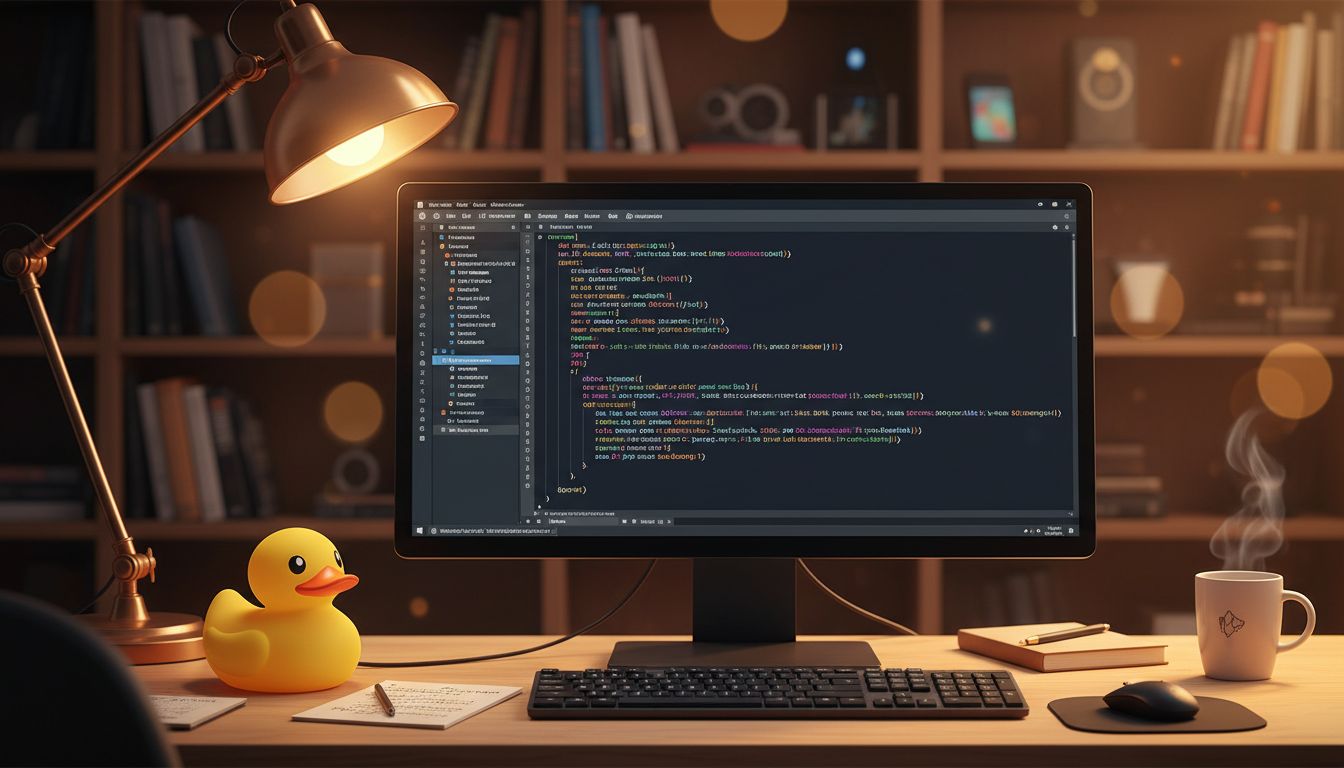
There is a debugging technique so effective that professional software engineers at Google, NASA, and startups alike swear by it, and it requires nothing more than a cheap plastic toy. You place a rubber duck on your desk. You explain your code to it, line by line, out loud, as if the duck might actually understand. And somewhere in that explanation, you find the bug. It sounds ridiculous. The cognitive science behind why it works is anything but.
This is rubber duck debugging, and it sits at the intersection of how human brains encode knowledge, how language forces precision, and why the act of teaching something is often the fastest path to understanding it yourself. Software engineers deliberately write code that other humans can’t read, and the same mental shortcuts that make code cryptic to colleagues also make it invisible to its own author. The duck breaks that spell.
The Problem With Expert Blindness
When you write code for several hours, your brain builds a detailed internal model of what the code is supposed to do. The problem is that this mental model starts substituting for what the code actually does. You read a flawed function and your brain autocorrects it in real time, filling gaps and smoothing contradictions because it already knows the intended logic. This is called the “curse of knowledge,” and it is brutal for debugging.
The moment you try to explain the code to someone else, that autocorrection mechanism gets interrupted. Language is sequential and explicit. You cannot simultaneously hold a fuzzy mental shortcut and translate it into a coherent spoken sentence. The act of narrating forces you to confront each step individually, and that is precisely where hidden assumptions surface.
A developer at a mid-sized fintech company once described spending three days on a production bug involving a race condition in a payment processing queue. Every tool, every log, every colleague review had missed it. Within four minutes of explaining the queue logic to a rubber duck, she caught it herself. The bug had been in her mental model, not just in the code.
Why the Duck Works Better Than a Colleague (Sometimes)
Asking a colleague for help is genuinely useful, but it introduces social friction. You edit your explanation before you give it. You skip the parts that feel obvious. You respond to their facial expressions and adjust your story accordingly. The explanation becomes a negotiation rather than a complete account.
The duck has no face. It cannot look confused or impatient. It cannot ask a shortcut question that lets you skip the embarrassing detail you glossed over. The duck demands a complete, sequential, unedited account because it offers nothing in return. That completeness is the entire mechanism.
This connects to something broader about how top performers structure their cognitive work. The context switching that happens during a colleague conversation, the social processing, the status awareness, all of it consumes working memory. Top performers use what’s called the context switch tax to structure their entire workday, and rubber duck debugging is essentially a way to eliminate that tax from the debugging process entirely.
The Protégé Effect and What It Tells Us About Learning
Psychologists have a name for the broader phenomenon underpinning rubber duck debugging. The “protégé effect” describes how people learn material more deeply when they expect to teach it than when they expect to simply use it. Studies from educational psychology consistently show that students who teach content to others (or even to fictional others) retain it better and identify errors in their own understanding more reliably.
A 2018 study at Washington University in St. Louis found that participants who explained a concept aloud to a novice audience detected logical inconsistencies in that concept at nearly twice the rate of participants who reviewed the same concept silently. The mechanism was not smarter people talking out loud. It was that articulation forced sequential, explicit processing of each claim.
Software debugging is exactly this problem. The developer is the expert with flawed knowledge. The duck is the patient novice. The explanation is the test.
How Rubber Duck Debugging Scales Into Modern Teams
The technique has evolved beyond a single duck on a single desk. Many engineering teams now build formalized rubber duck practices into their workflows. Some use written rubber duck debugging, where developers are required to write a complete problem description before opening a ticket or pinging a colleague. The act of writing the description resolves the problem often enough that ticket volume drops measurably.
Others use asynchronous voice memos, recording a narrated walkthrough of the problem before any synchronous communication happens. This practice fits naturally into distributed teams where real-time interruption is expensive. The most productive teams stopped using real-time collaboration tools for exactly this reason: the overhead of synchronous communication regularly exceeds its benefit when the problem can be solved by structuring individual thought more carefully first.
There is also a growing category of AI-powered rubber duck tools, chatbots designed specifically to ask clarifying questions without offering answers, simulating the listener who knows just enough to keep you talking. The interesting wrinkle is that an AI assistant that is too helpful actually degrades the rubber duck effect, because a genuinely useful response short-circuits the self-explanation process before it finishes. The value is in the explanation, not the answer.
The Deeper Lesson About How Debugging Actually Works
Rubber duck debugging reveals something uncomfortable about software development culture: a significant percentage of bugs are not errors in technical knowledge. They are errors in attention and assumption. They are places where the developer stopped thinking explicitly and started coasting on intuition. No linter catches those. No code review reliably surfaces them. Only the act of full, explicit, sequential narration does.
This is why the technique scales across experience levels. Junior developers use it to catch syntax errors and logic inversions. Senior developers use it to find architectural assumptions that have quietly stopped being true. The mechanism is identical because the underlying problem is identical: expertise creates blind spots, and language dissolves them.
The next time you are forty minutes into a bug you cannot find, before you open a ticket, before you ping a colleague, before you start a new Stack Overflow search, try finding the cheapest, most patient debugging partner available. Explain the whole thing out loud, from the beginning, to something that cannot possibly help you. Odds are, it will.